
Understanding Flood Insurance Payment Options
Are flood insurance premiums quoted annual or monthly? The answer depends on your insurance provider and policy type. Here’s what you need to know:
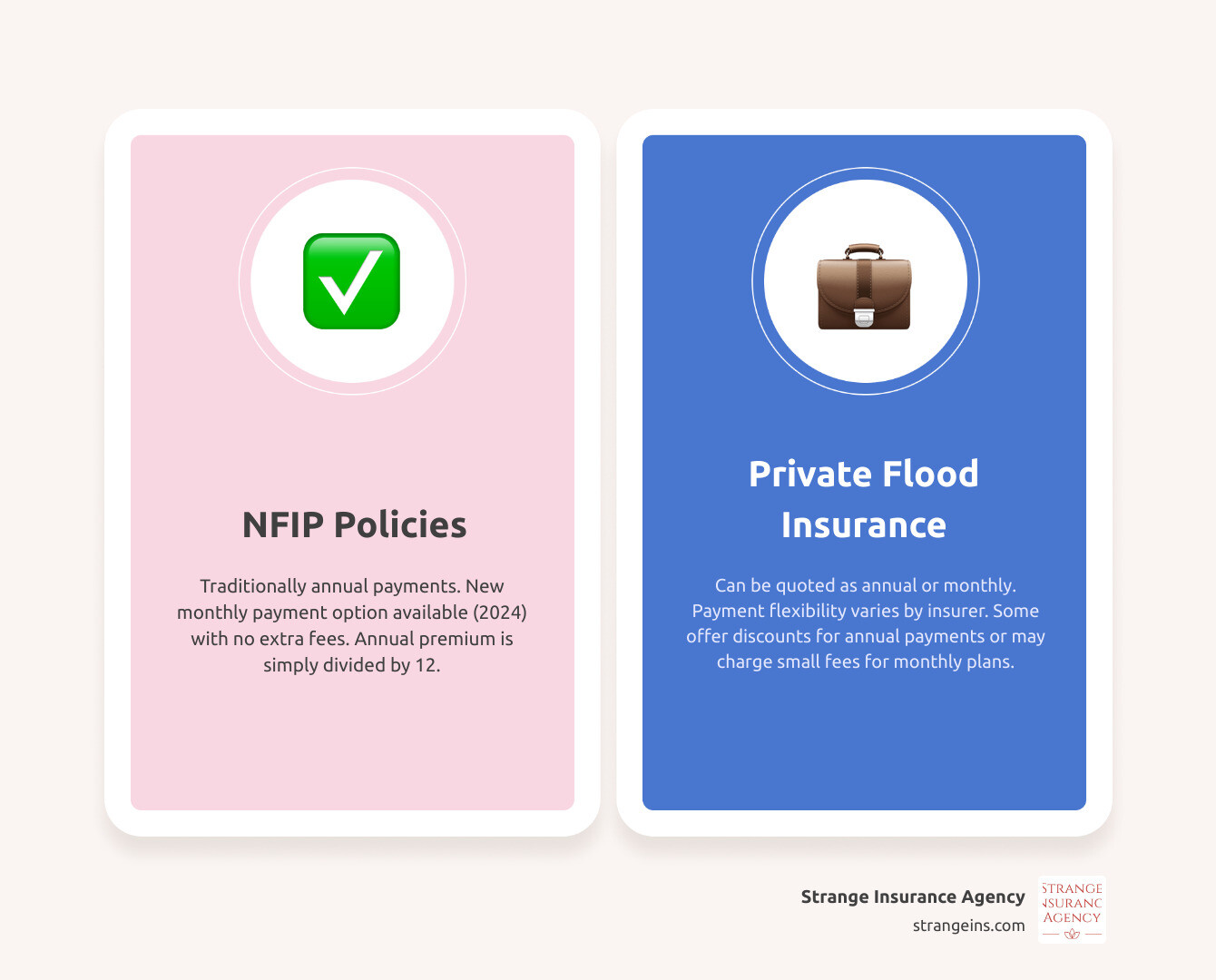
Government Program Policies (NFIP):
- Traditionally quoted as annual premiums
- New monthly payment option available (2024)
- No extra fees for monthly payments
- Annual premium divided by 12
Private Flood Insurance:
- Can be quoted both annually or monthly
- Payment flexibility varies by insurer
- Some offer discounts for annual payments
- Monthly options may include small fees
For decades, flood insurance operated on an annual payment system. The National Flood Insurance Program required policyholders to pay their entire premium upfront each year, creating budget challenges for many homeowners. However, recent changes have transformed this landscape, offering more flexible payment options to make flood protection more accessible.
The average annual cost of flood insurance has risen to $892 as of February 2024, up from $689 in December 2022. With premiums increasing under FEMA’s Risk Rating 2.0 system, understanding your payment options becomes even more crucial for budget planning.
Whether you’re paying through your mortgage escrow account or directly to your insurer, the way flood insurance premiums are structured affects your monthly budget and overall financial planning. Private insurers have begun offering more competitive alternatives, while FEMA has finally introduced monthly payment flexibility for direct-billed NFIP policies.
I’m Christian Strange, and with over 15 years of experience in insurance and treasury management, I’ve helped countless clients steer the complexities of flood insurance payments, including understanding are flood insurance premiums quoted annual or monthly and choosing the best payment structure for their financial situation. My expertise in cash flow optimization and risk mitigation has shown me how the right payment plan can make flood protection both affordable and manageable for busy professionals and families.
Are flood insurance premiums quoted annual or monthly vocab explained:
How Flood Insurance Premiums Are Traditionally Quoted
For a very long time, if you were looking for flood insurance, especially through the National Flood Insurance Program (NFIP) run by the Federal Emergency Management Agency (FEMA), there was one main way to pay: a big, single payment once a year. This meant when you got a quote for flood insurance, it was always for the annual lump sum. Imagine getting a bill for an entire year’s worth of coverage all at once – for many homeowners, this could feel like a pretty big financial hurdle!
This traditional approach was built into the NFIP’s history and its federal structure. It was simpler for them to manage millions of policies this way. So, every year, when it was time to renew your policy, you’d get a notice asking for that full annual payment again. It was just how things were done, reflecting a long-standing policy renewal process.
Now, many folks found a way to soften this blow a bit: through their mortgage escrow account. If your flood insurance was set up this way (often a mortgage requirement in flood zones), you’d pay a little extra with your monthly mortgage payment. Your lender would collect these smaller amounts, and then, when the annual premium was due, they’d pay the full sum on your behalf. This helped spread out the cost for you, even though the insurance policy itself still required that payment in full each year. But for anyone paying directly, it meant having to set aside a significant chunk of cash all at once. You can dive deeper into the history and workings of The National Flood Insurance Program.
The Standard: Annual Premium Quotes
So, if you called an insurance agent and asked, “are flood insurance premiums quoted annual or monthly?” back then, the answer would have been a clear “annual!” Every single flood insurance quote you received, whether it was for an NFIP policy (even if sold by a private company through their Write-Your-Own program) or a private market flood insurance policy, was presented as an annual cost. This was the universal standard.
This annual figure represented the total premium calculation for a full year of flood protection. Your insurance agent would hand you policy documents clearly showing this annual cost, often broken down by what it covered – like your home’s structure or your personal belongings.
Why was annual the norm? A big part of it came down to the federal program structure of the NFIP. Since NFIP rates were set at a federal level, they were the same no matter which of the many insurance companies or independent agents you went to. This meant while you could certainly shop around for the best customer service or a great agent, the actual annual premium for the exact same NFIP policy wouldn’t change. This standardization was why annual was the norm, emphasizing simplicity in billing and collection for a massive nationwide program, even if it meant a big payment for policyholders.
Are Flood Insurance Premiums Quoted Annual or Monthly? A Breakdown by Policy Type

The answer to whether are flood insurance premiums quoted annual or monthly has become more nuanced in recent years, particularly with significant changes to the NFIP and the growing private flood insurance market. Let’s break it down by policy type.
The National Program’s Shift: From Annual-Only to Monthly Payments
This is big news for homeowners! Historically, the NFIP was strictly an annual payment program. However, in a significant policy change, FEMA officially “green-lit monthly payments for NFIP policies” in January 2024. This change became effective in 2024, allowing homeowners to make monthly flood insurance payments without any extra fees. It’s a game-changer for budgeting.
The motivation behind this shift is clear: FEMA aims to increase policy participation and retention, reversing a decline in enrollment that has seen NFIP policies drop from a high of 5.7 million in 2009 to 4.7 million recently. By making premiums more manageable on a monthly basis, FEMA hopes to make flood insurance more accessible and affordable for a wider range of homeowners.
For those who choose this new option, the annual policy cost is simply divided by 12 to determine the monthly payment. This means you’re paying the exact same total amount over the year, just in smaller, more frequent installments. This monthly payment option is primarily available for direct-billed policies – meaning, if you pay your flood insurance bill directly, not through a mortgage escrow account. If your mortgage lender handles your flood insurance payments via escrow, they will continue to pay the annual premium on your behalf.
This is a huge step towards making flood insurance less of a financial burden and more of an easily integrated part of your monthly budget. You can find more details about FEMA’s new monthly payment option. To explore your options and get a quote, you can always learn how to get a flood insurance quote from us.
Private Flood Insurance: Are Premiums Quoted Annual or Monthly?
The private flood insurance market operates with more flexibility compared to the NFIP. Because private insurers use their own proprietary risk models, advanced technology (like AI, machine learning, and LiDAR), and have greater underwriting flexibility, their quoting practices can vary.
When seeking a private flood insurance quote, you’ll often find that insurers can provide estimates as either an annual cost or a monthly cost. This flexibility allows them to cater to different customer preferences and budgeting styles. For example, some private insurers might even offer modest discounts for paying your entire premium annually rather than in monthly installments. Conversely, some may apply a small administrative or installment fee if you opt for monthly payments.
The average costs for private flood insurance can vary significantly. Research shows average costs ranging from $38 to $206 per month, depending on factors like your property’s risk, coverage limits, and the specific insurer’s pricing model. This range highlights the importance of comparing options. Our role as a concierge insurance agency means we can help you compare flood insurance quotes from multiple carriers to find the best fit for your needs and budget, considering both annual and monthly payment structures.
Choosing Your Payment Plan: Pros and Cons

Now that you know are flood insurance premiums quoted annual or monthly varies by provider, let’s talk about which payment option makes the most sense for your situation. It’s not just about convenience – your choice can impact your wallet and peace of mind.
The decision really comes down to your cash flow, budgeting style, and personal preferences. Some folks love getting their insurance “done and dusted” with one annual payment, while others prefer the gentle monthly approach that doesn’t hit their checking account like a financial sledgehammer.
The Case for Annual Payments
There’s something satisfying about paying your flood insurance once and forgetting about it for an entire year. If you have the cash flow to handle a larger upfront payment, annual payments offer some compelling advantages.
Pay-in-full discounts are one of the sweetest perks of going annual, especially with private insurers. While NFIP policies don’t offer discounts (the rate is the rate), many private companies will knock a modest amount off your premium if you pay everything upfront. It’s like getting a small reward for being financially organized.
The “set-it-and-forget-it” approach appeals to busy professionals who prefer fewer bills cluttering their monthly routine. Once you’ve paid, that’s one less thing on your mental to-do list for the next 12 months. You also completely avoid the risk of late fees that could sneak up on you with monthly payments.
If your flood insurance is handled through your mortgage escrow account, annual payments work seamlessly. Your lender takes care of the big annual payment while you contribute smaller amounts to escrow each month. It’s the best of both worlds – you get monthly budgeting without the hassle of managing the payments yourself.
Simpler bookkeeping is another bonus. One payment, one receipt, one line item in your annual budget. If you’re someone who tracks expenses yearly rather than monthly, this approach keeps things clean and straightforward.
The Case for Monthly Payments
The game-changer here is accessibility. Monthly payments have opened flood insurance doors for homeowners who previously found the annual lump sum too daunting. It’s made protection possible for people who need it most.
Easier budgeting is the biggest win. Instead of scrambling to find $800-$1,200 once a year, you’re looking at $65-$100 per month. That’s much easier to work into your regular monthly expenses alongside your cell phone bill and grocery budget.
The lower upfront cost removes a major barrier. You don’t need to save up a large chunk of money or raid your emergency fund just to keep your flood protection active. This is especially helpful for first-time homeowners or those rebuilding their finances.
Increased affordability means the difference between having flood insurance and going without. For many families, the choice isn’t between annual and monthly payments – it’s between monthly payments and no coverage at all.
Automatic payments make monthly plans nearly foolproof. Set it up once through your bank account or debit card, and you’re covered. Just a word of caution from financial experts: avoid putting automatic insurance payments on a credit card unless you’re absolutely certain you can pay the full balance each month. High interest rates can quickly turn your budget-friendly monthly payments into an expensive mistake.
| Payment Type | Best For | Main Benefit | Watch Out For |
|---|---|---|---|
| Annual | Strong cash flow, prefer simplicity | Potential discounts, one-and-done convenience | Large upfront cost, requires financial planning |
| Monthly | Tight budgets, prefer steady payments | Easier budgeting, lower barrier to entry | Risk of missed payments, potential small fees with some private insurers |
The bottom line? There’s no universally “right” choice. Your decision should align with your financial situation and how you prefer to manage your money. The important thing is that you have flood protection in place, regardless of how you choose to pay for it.
How Risk Rating 2.0 Affects Your Premium Calculation
When people ask are flood insurance premiums quoted annual or monthly, they’re often surprised to learn that the underlying calculation method has completely transformed in recent years. FEMA’s Risk Rating 2.0, launched in October 2021, represents the biggest shake-up to flood insurance pricing in decades.
Gone are the days when your flood insurance cost was determined primarily by looking at broad flood zone maps. Now, Risk Rating 2.0 calculates your premium based on your individual property’s unique characteristics – think of it as a personalized risk assessment rather than a one-size-fits-all approach.
This sophisticated system examines multiple factors to determine your property’s specific flood risk. Flood frequency plays a major role – how often is your property likely to see water? The system also considers multiple flood types, recognizing that flooding can come from river overflow, storm surge, coastal erosion, or heavy rainfall. Your distance to water sources matters too, whether that’s rivers, lakes, or coastal areas.
Your home’s current elevation and building characteristics are crucial pieces of the puzzle. The system looks at your foundation type, first-floor elevation, and building materials. It also factors in the cost to rebuild your home – that’s your replacement cost value. If you’ve made flood adaptation improvements like installing flood vents or elevating machinery, those efforts can help reduce your premium.
Here’s the important part: while Risk Rating 2.0 has completely revolutionized how your total annual premium is calculated, it doesn’t change your payment options. Whether you choose the new monthly payment plan or stick with annual payments, you’re paying the same total amount. The system calculates that comprehensive annual figure first, then simply divides by 12 if you opt for monthly payments.
You can dive deeper into how premiums are calculated under the NFIP pricing approach to understand all the technical details.
Don’t worry about sudden premium shock, though. NFIP premiums are capped at an 18% increase per year for most renewing policyholders. Many people are on what FEMA calls a “glide path” – meaning their current premiums are actually lower than their full risk-based rate, and they’ll gradually reach that true cost over several years.
The numbers tell an interesting story. As of August 2023, FEMA data shows that 37% of single-family NFIP policies cost less than $1,000 per year, while 32% fall between $1,000 and $2,000 annually. This wide range reflects how personalized the pricing has become based on individual property risk.
Want to understand one piece of your flood risk puzzle? You can check your flood zone to see where your property stands on FEMA’s flood maps, though remember that Risk Rating 2.0 considers many factors beyond just your flood zone designation.
Frequently Asked Questions about Flood Insurance Payments
Navigating flood insurance payments can sometimes feel a bit like untangling a garden hose – a few twists and turns, but ultimately, it’s about getting the flow right! We often hear common questions about how premiums are paid, especially with the recent changes. Let’s clear up some of those frequently asked questions for you.
Does choosing monthly payments for a federally-backed policy cost more?
Here’s some really good news: If you’re considering the new monthly payment option for your National Flood Insurance Program (NFIP) policy, the answer is a resounding no, it does not cost more! FEMA has introduced this option to make flood insurance more accessible, not more expensive.
This means your total annual premium is simply divided by 12. So, you’ll pay the exact same amount over the year, just in smaller, much more budget-friendly chunks each month. There are no extra fees, no interest charges, and no hidden costs for choosing this payment frequency with the NFIP. It’s all about making your flood protection fit more easily into your monthly budget.
Do private flood insurance companies charge extra for monthly payments?
When it comes to private flood insurance companies, the answer to this question is a bit more varied – it depends on the specific insurer. Some private carriers might add a small administrative or installment fee if you choose to pay monthly. These fees are usually just to cover the extra processing involved with more frequent payments.
On the flip side, some private insurers actually offer a small discount if you pay your entire annual premium upfront. This is their way of encouraging a lump sum payment. So, whether you’re asking are flood insurance premiums quoted annual or monthly with a private company, it’s always a great idea to ask about any potential fees for monthly payments or discounts for annual payments. This way, you can pick the payment plan that truly works best for your wallet.
If my flood insurance is in escrow, can I switch to monthly payments?
This is a common question, and it’s an important one! If your flood insurance premium is currently handled through your mortgage escrow account, then the new NFIP monthly payment option is generally not available to you.
Here’s why: When your flood insurance is in escrow, your mortgage lender collects a portion of your annual premium with your monthly mortgage payments. Then, when the flood insurance bill is due, your lender pays the full annual premium on your behalf directly to the insurer from that escrow account. The new monthly payment option from FEMA is designed for policyholders who pay their flood insurance bill directly to the insurer. So, if your lender is managing your flood insurance payments via escrow, they will continue to pay that annual sum for you.
Get the Right Flood Protection for Your Budget
Understanding whether are flood insurance premiums quoted annual or monthly is a really important step in managing your household budget and getting the vital protection you need. While the NFIP has made big strides by finally offering monthly payment options, the private flood insurance market still gives you a wide range of choices, including different ways to get quotes and pay.
At Strange Insurance, we truly specialize in helping homeowners like you steer flood insurance. We know that every home and every budget is unique. Whether you’re in Virginia or North Carolina, facing specific Virginia flood risk or North Carolina flood risk, or living anywhere else across the U.S., we’re here to help. We can show you all your policy options, comparing both NFIP policies and private market solutions. Our goal is to make sure you get comprehensive coverage that fits your specific needs, often with competitive pricing, thanks to our access to quotes from over 30 companies.
With flooding becoming more frequent and severe, getting proactive protection is more important than ever before. Did you know that almost half of all flood damage happens outside the high-risk flood zones? As Donald Hornstein of the University of North Carolina at Chapel Hill wisely pointed out, “nearly half of all flood damage occurs outside designated flood zones, where homeowners often don’t think to buy insurance.” And the financial hit can be huge: just one inch of floodwater in your home can cause as much as $25,000 in damage.
Please don’t wait until it’s too late. We’re here to make securing flood insurance simple and straightforward. We’ll help you understand exactly what coverage you need and find a payment plan that works perfectly for your budget. Let us help you protect your most valuable asset. Find more about your Flood Insurance options with us today.