
Why Business Flood Insurance Quotes Are More Critical Than Ever
A business flood insurance quote is your first line of defense against the devastating financial impact of flooding—and with over 40% of small businesses never reopening after a major flood, getting the right coverage has never been more urgent.
Quick Answer for Business Flood Insurance Quotes:
- Where to get quotes: NFIP Direct tool, private carriers, or licensed agents
- Information needed: Business address, building details, contents value, desired coverage limits
- Timeline: 10 minutes for online quotes, 30-day waiting period before coverage starts
- Cost factors: Flood zone, building elevation, construction type, coverage amount
- Coverage limits: Up to $500,000 each for building and contents (NFIP), higher limits available through private carriers
The statistics paint a sobering picture. Just one inch of water can cause $25,000 in damage to your business. Even more concerning—over 20% of flood claims come from properties outside high-risk flood zones, meaning businesses everywhere face potential exposure.
Standard commercial property insurance won’t cover flood damage. You need separate flood insurance, and with extreme weather events becoming more frequent, waiting until storm season isn’t an option.
As Christian Strange, I’ve spent over 15 years helping businesses steer complex insurance needs, and I’ve seen how the right business flood insurance quote can mean the difference between recovery and permanent closure. My experience in treasury management and risk mitigation has taught me that proactive protection always beats reactive damage control.

Know your business flood insurance quote terms:
- Flood insurance for business owners
- Private flood insurance companies
- How to get a flood insurance quote
Why Every Business Needs Separate Flood Coverage
Here’s what keeps us up at night: businesses across Virginia and North Carolina are operating under a dangerous assumption that their commercial property insurance covers flooding. It doesn’t. Not even close.
The reality is stark. Between 2015 and 2019, more than 40% of claims filed with the National Flood Insurance Program came from policyholders outside high-risk flood zones. That means businesses in moderate- and low-risk areas are getting hit just as hard as those in designated flood plains.
Consider this: 90% of small businesses fail within two years following a major flooding event. At least 25% of businesses that close after destructive floods never reopen their doors. These aren’t just statistics—they’re real businesses with real employees and real families depending on them.
The Eastern United States now experiences up to 70% more heavy downpours each year than in previous decades. Climate change isn’t a future threat—it’s reshaping flood risk today. What used to be a “100-year flood” is now happening every few years in some areas.
We’ve seen it in our Virginia and North Carolina markets. Businesses that thought they were safe because they weren’t near rivers or coastlines have been devastated by flash floods from overwhelmed storm drains, rapid snowmelt, and even construction runoff.
For more comprehensive protection, consider our Commercial Property Insurance options alongside flood coverage.
Key Differences From Standard Commercial Property Policies
Let’s clear up the confusion once and for all. Your standard commercial property policy excludes flood damage—period. The National Flood Insurance Program defines a flood as “a general and temporary condition where two or more acres of normally dry land or two or more properties are inundated by water or mudflow.”
This means surface water from storms, overflowing rivers, storm surge, and even clogged drains that cause water to back up onto your property aren’t covered by your regular business insurance. Neither is sewer backup unless you’ve specifically added that endorsement.
The exclusions are comprehensive and intentional. Insurance companies learned long ago that flood losses are too catastrophic and correlated to include in standard policies. When floods hit, they affect entire communities simultaneously, creating claims volumes that would bankrupt traditional insurers.
What Flood Insurance Actually Covers
Flood insurance protects the physical structure of your building and its contents. For buildings, this includes the foundation, walls, floors, HVAC systems, electrical wiring, plumbing, and permanently installed fixtures like built-in bookcases or cabinets.
Contents coverage protects your furniture, equipment, inventory, supplies, and even important documents. If you rent your space, contents coverage is especially critical since the building owner’s policy won’t cover your business property.
The coverage extends to cleanup costs and debris removal—expenses that can quickly mount into tens of thousands of dollars. We’ve seen businesses face $50,000+ in cleanup costs alone after just a few inches of water.
What Flood Insurance Will Not Cover
Understanding what’s excluded is just as important as knowing what’s covered. Flood insurance won’t pay for mold damage that could have been prevented with proper maintenance and timely cleanup. It won’t cover exterior landscaping, fences, or vehicles.
Most importantly for business owners, standard NFIP policies don’t cover loss of business income during the rebuilding process. This is where private flood insurance often provides superior coverage options.
The policy also won’t cover temporary housing or additional living expenses if your business operates from your home. These exclusions underscore why many businesses need both NFIP coverage and private market improvements.
How to Get a Business Flood Insurance Quote
Getting a business flood insurance quote is easier than most business owners think, but timing is everything. 30-day waiting period—you can’t wait until storm clouds are gathering.
You have three main paths to securing quotes: the NFIP Direct tool, private market carriers, and licensed agents who can shop both markets. Each has advantages depending on your situation and timeline.
The NFIP Direct tool is free and available 24/7. Most quotes are ready in 10 minutes or less, but you’ll need to complete the process in one session. It’s perfect for straightforward properties with standard risk profiles.
Private market quotes often require more detailed information but can provide higher coverage limits and additional features like business interruption coverage. These quotes typically take 24-48 hours but offer more customization options.
For complex properties or businesses with unique exposures, working with a licensed agent who understands both NFIP and private market options is invaluable. We can steer the nuances and ensure you’re getting the best coverage for your specific situation.
Visit the National Flood Insurance Program for official information, or get started with our Commercial Flood Insurance Quote service.
Business Flood Insurance Quote Checklist
Before requesting your business flood insurance quote, gather these essential details:
Property Information:
- Complete business address
- Building construction details (frame, masonry, steel)
- Year built and any major renovations
- Square footage and number of stories
- Basement or crawl space details
FEMA Flood Map Details:
- Flood zone designation
- Base flood elevation (if available)
- Community participation status in NFIP
Coverage Needs:
- Building replacement cost estimate
- Contents/inventory value
- Desired deductible amount
- Any special equipment or high-value items
Risk Factors:
- Previous flood claims or damage
- Proximity to water bodies
- Recent construction or development nearby
- Existing flood mitigation measures
Having this information ready will ensure accurate quotes and prevent delays in the application process.
Top Platforms for Instant Quotes
The NFIP Quoting Tool remains the gold standard for federal flood insurance quotes. It’s free, fast, and provides standardized pricing based on your property’s flood risk. The tool assesses your property against FEMA’s flood maps and applies current rating factors.
Private market platforms have revolutionized the quote process. Advanced mapping technology can often eliminate the need for costly elevation certificates, and some platforms provide instant quotes from multiple carriers simultaneously.
Agent marketplaces offer the best of both worlds—professional guidance combined with access to multiple markets. We can quickly compare NFIP and private options, explaining the trade-offs and helping you make an informed decision.
For comprehensive comparison shopping, check out our Commercial Flood Insurance Quotes service.

Cost Drivers & Ways to Save on Premiums
Understanding what drives flood insurance costs helps you make smarter coverage decisions. FEMA’s Risk Rating 2.0 system now considers individual property characteristics rather than just broad flood zones, making pricing more precise but sometimes more expensive.
Your flood zone remains the primary factor, but now elevation, distance from water sources, and local drainage patterns all influence your premium. A building just a few feet higher or a block further from a creek can see significantly different rates.
Building construction matters enormously. Masonry and steel construction typically costs less to insure than wood frame buildings. Properties with basements or crawl spaces face higher premiums due to increased flood damage potential.
Coverage limits directly impact premiums. The maximum NFIP coverage is $500,000 each for building and contents, but private markets can provide coverage up to $5 million or more. Higher limits cost more, but the per-dollar cost often decreases as coverage amounts increase.
Your deductible choice significantly affects premiums. Increasing your deductible from $1,000 to $5,000 can reduce premiums by 10-20%, but make sure you have the cash flow to handle the higher out-of-pocket expense.
Practical Mitigation Steps That Lower Rates
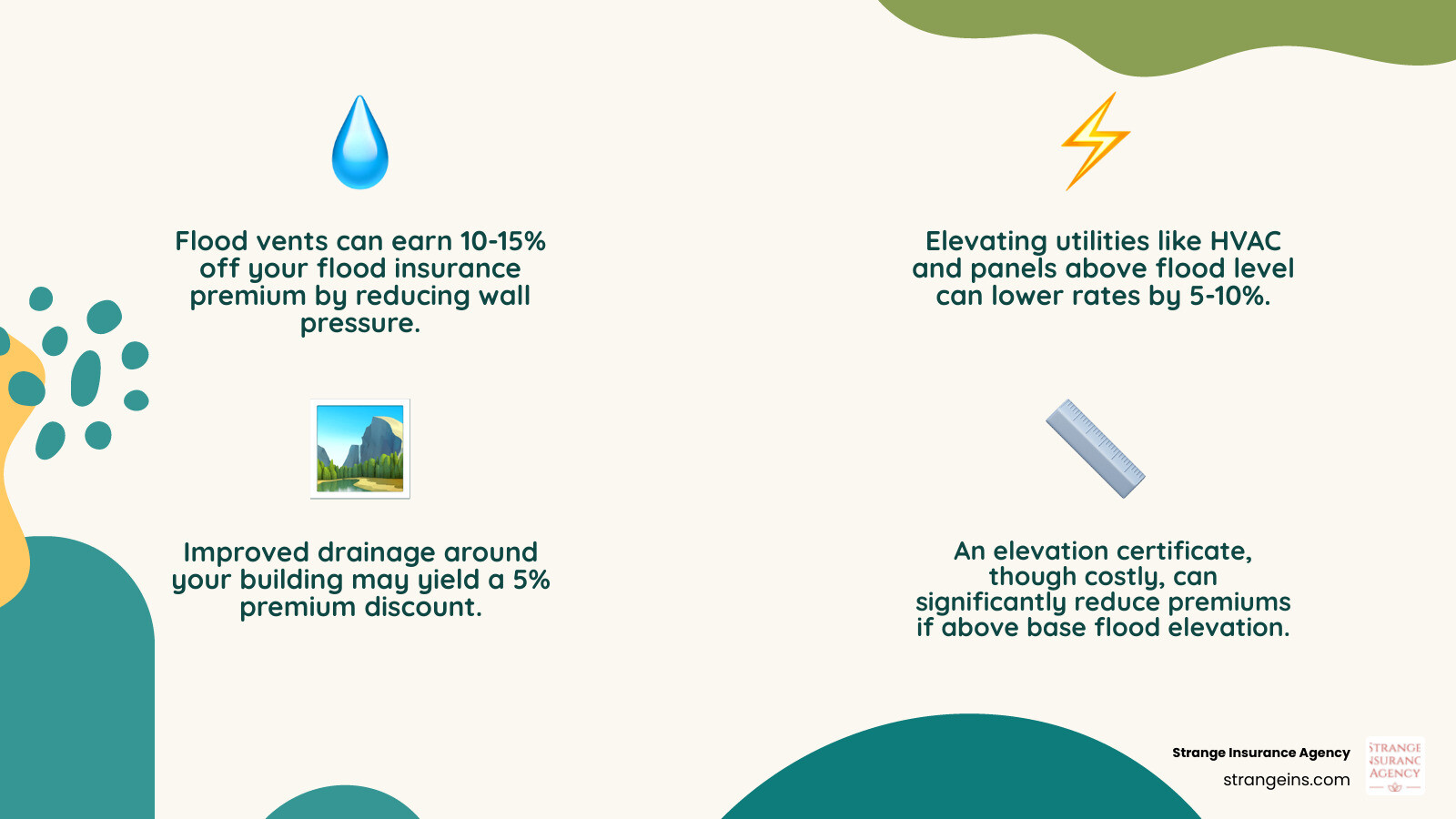
Smart flood mitigation can reduce your premiums while protecting your business. Installing flood vents in foundation walls can qualify for significant discounts by allowing water to flow through rather than building up pressure against walls.
Elevating utilities like HVAC systems, electrical panels, and water heaters above potential flood levels can reduce damage and qualify for premium reductions. Even raising equipment just a few feet can make a substantial difference.
Sump pumps with battery backup systems help manage water intrusion and demonstrate proactive risk management to insurers. Combined with proper drainage around your building, these measures can meaningfully reduce premiums.
Obtaining an elevation certificate, while expensive upfront ($600-$2,000), can result in lower premiums if your building is higher than FEMA’s base flood elevation estimates. The certificate provides precise elevation data that often results in more favorable rating.
Product Roundup: Best Options for Fast Business Flood Quotes
The flood insurance market has evolved dramatically, offering business owners more options than ever for quick, comprehensive quotes. Here’s our roundup of the best platforms and approaches for securing business flood insurance quotes.
NFIP Direct Tools remain the fastest option for standard coverage. The federal quoting tool provides instant rate calculations based on your property’s flood risk profile. It’s free, available 24/7, and typically generates quotes in under 10 minutes.
Multi-Carrier Agent Platforms offer the advantage of shopping multiple markets simultaneously. We can compare NFIP rates with private carrier options, often finding better coverage or lower premiums through private markets.
Instant Bind Applications have revolutionized the private flood market. Some carriers now offer immediate coverage binding for qualifying properties, eliminating the traditional waiting period for urgent situations.
Bundled Package Options combine flood insurance with other commercial coverages, often providing discounts and simplified administration. These packages work particularly well for businesses with multiple insurance needs.
Excess Flood Options provide coverage above NFIP limits without requiring you to abandon federal coverage entirely. This approach offers the best of both worlds—affordable base coverage through NFIP plus higher limits through private markets.
For comprehensive comparison shopping, explore our Compare Flood Insurance Quotes service.
NFIP vs Private Market—Which Quote Fits Your Needs?
The choice between NFIP and private flood insurance depends on your specific coverage needs and risk profile. NFIP provides standardized coverage with predictable terms and universal lender acceptance, making it the safe choice for most businesses.
NFIP coverage maxes out at $500,000 each for building and contents, with actual cash value settlement that accounts for depreciation. There’s no business interruption coverage, and the claims process follows federal guidelines that can be slow but thorough.
Private market options offer higher coverage limits—up to $5 million or more for building coverage and $500,000+ for contents. Many private policies provide replacement cost coverage without depreciation deductions, and some include business interruption protection.
Private policies often have shorter waiting periods (15 days vs. 30 days) and may offer more flexible terms. However, they can be more expensive and may not be available in all areas or for all property types.
The sweet spot for many businesses is a combination approach: NFIP coverage for the base layer plus private excess coverage for higher limits and improved features.
Beyond Basic Limits: Excess & Business Interruption Add-Ons
Standard flood coverage only addresses property damage, but the real financial impact often comes from business interruption. When flood damage forces you to close temporarily, you’re still paying rent, utilities, and employee salaries while losing revenue.
Business interruption coverage pays for lost income and extra expenses during the restoration period. This can include costs for temporary locations, expedited repairs, and overtime labor to get back in business quickly.
Replacement cost coverage eliminates depreciation deductions, paying the full cost to repair or replace damaged property with new materials. This can mean the difference between a full recovery and a significant out-of-pocket expense.
Extra expense coverage goes beyond basic business interruption, covering additional costs to minimize the interruption period. This might include rush delivery charges for replacement equipment or premium costs for temporary facilities.
These improved coverages typically require private market policies, but the additional premium is often minimal compared to the potential financial exposure.
Frequently Asked Questions About Business Flood Insurance Quotes
How long before my new flood policy becomes active?
Standard flood insurance policies have a 30-day waiting period before coverage takes effect. This waiting period prevents people from purchasing coverage only when storms are approaching. However, there are exceptions:
- Policies required by lenders for new mortgages take effect immediately
- Some private carriers offer 15-day waiting periods
- Policies purchased due to flood map changes may have reduced waiting periods
The key is planning ahead. Don’t wait until hurricane season or when heavy rains are forecasted to secure your business flood insurance quote.
Is flood insurance mandatory for my SBA or FHA-backed loan?
If your business is located in a Special Flood Hazard Area (high-risk flood zone) and you have a loan from a federally regulated or insured lender, flood insurance is mandatory. This includes:
- SBA loans for businesses in high-risk flood zones
- Commercial mortgages from banks with federal backing
- Any loan secured by property in designated flood areas
The required coverage amount typically equals the loan balance or the maximum available coverage, whichever is less. Even if not required, lenders strongly encourage flood coverage for properties in moderate-risk zones.
Can I get coverage if my business is outside a high-risk zone?
Absolutely. In fact, over 20% of flood claims come from properties outside high-risk flood zones. Businesses in moderate- and low-risk areas can and should consider flood insurance, especially given:
- Lower premiums in reduced-risk areas
- Increasing frequency of flash floods and urban flooding
- Climate change impacts affecting traditional flood patterns
- Peace of mind for a relatively small investment
NFIP coverage is available in any community that participates in the program, regardless of flood zone designation.
Conclusion
Getting a business flood insurance quote isn’t just about compliance—it’s about survival. With 40% of small businesses never reopening after major floods and 90% failing within two years, the right flood coverage can literally save your business.
The process is straightforward: gather your property information, use online quote tools or work with licensed agents, and compare NFIP and private market options. 30-day waiting period and plan accordingly.
At Strange Insurance Agency, we’ve helped hundreds of businesses across Virginia and North Carolina steer flood insurance decisions. Our access to 30+ carriers through Goosehead Insurance means we can find the right coverage at the right price, whether through NFIP or private markets.
Don’t wait until storm clouds gather. Your business, your employees, and your family’s financial security depend on making this decision before you need the coverage.
Ready to protect your business? Contact Strange Insurance Agency today for your comprehensive business flood insurance quote. We’ll shop multiple markets, explain your options clearly, and ensure you have the coverage you need when disaster strikes.
Explore our full range of Business Insurance options to build a comprehensive protection strategy for your business.