
The Foundation of Business Protection
Comprehensive general liability insurance is a foundational form of business protection. While the term “comprehensive” is now largely outdated, it refers to what is commonly known as Commercial General Liability (CGL) insurance. This policy is your business’s shield against common risks and unexpected claims.
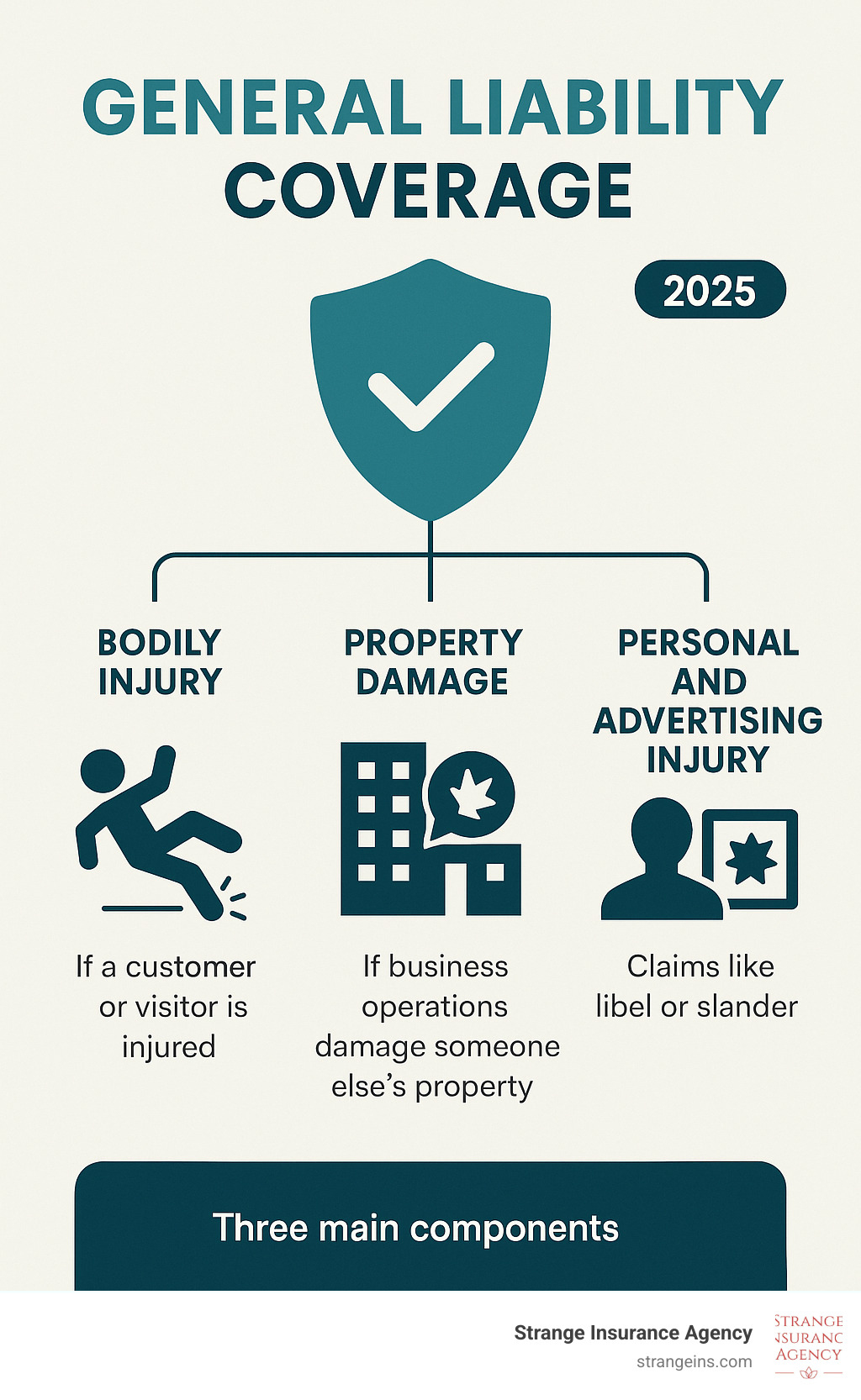
CGL helps protect your assets if your business is held responsible for:
- Bodily Injury: A customer or visitor is injured on your property.
- Property Damage: Your business operations accidentally damage someone else’s property.
- Personal and Advertising Injury: Claims like libel, slander, or copyright infringement.
- Legal Defense Costs: The expense of defending your business in court.
Without this coverage, a single incident could lead to devastating financial losses from legal fees, medical bills, and settlements. With over 15 years of experience, Christian Strange and the Strange Insurance Agency specialize in helping businesses manage risks addressed by comprehensive general liability insurance, providing custom solutions and peace of mind.
Quick comprehensive general liability insurance definitions:
What is Comprehensive General Liability Insurance (and What’s it Called Now)?
Insurance terminology can be confusing. You may hear terms like “general liability,” “commercial general liability,” and comprehensive general liability insurance used interchangeably. The term “comprehensive” is a throwback; today, the policy is most often called Commercial General Liability (CGL) or simply General Liability (GL) insurance.
At its heart, CGL insurance is your business’s shield against third-party claims. It provides protection when someone outside your business (like a customer or client) claims they were hurt, their property was damaged, or they suffered a personal injury due to your business operations. These claims often arise from lawsuits, accidents, or negligence. It’s a critical type of Business Liability Insurance that nearly every business needs. For more details, the Insurance Information Institute (III) offers a helpful resource on Commercial general liability insurance.
Understanding the “Comprehensive” Misconception
The term “comprehensive” was phased out because it implies that the policy covers everything, which is rarely true in insurance. Every policy has specific coverages and exclusions. The name change to CGL was made to set more realistic expectations.
While a CGL policy is robust, it’s not a magic shield against every risk. For example, if a customer slips in your Norfolk, VA storefront, CGL provides coverage. However, it won’t cover an employee injury (that’s Workers’ Comp) or a mistake in professional advice (that’s Professional Liability). By ditching “comprehensive,” insurers clarified that CGL is broad but has defined boundaries, leaving other risks to be covered by complementary policies.
The Core Purpose of General Liability
Despite the name change, the goal of General Liability insurance remains the same: to protect your business assets from expensive lawsuits. A minor incident can lead to significant legal fees, medical bills, and settlements. This coverage acts as your first line of defense, offering a financial cushion and peace of mind.
Furthermore, having CGL insurance builds client trust. Many clients and partners require proof of insurance before working with you. For businesses in Virginia, North Carolina, West Virginia, or Florida, meeting these contractual requirements is key to landing projects and staying competitive.
What Does General Liability Insurance Actually Cover?
General Liability insurance provides protection against common and potentially expensive third-party risks. It’s a financial shield that activates when your business is accused of causing harm to people outside your company (customers, vendors, visitors, etc.).

If a customer slips and falls in your store, or an employee damages a client’s property, your CGL policy typically responds. It covers legal defense, medical payments, and settlements or judgments up to your policy limits. For a detailed look, see our guide on What Does Business Liability Insurance Cover.
Bodily Injury and Property Damage
These are the core components of CGL coverage.
- Bodily Injury: This covers physical harm to a third party resulting from your business operations or on your premises. If a customer in your Norfolk, VA, office breaks an arm, this coverage helps pay for their medical expenses and legal fees if they sue.
- Property Damage: This covers damage to a third party’s tangible property. If your employee working in Raleigh, NC, accidentally breaks a client’s expensive vase, your CGL policy helps cover the repair or replacement cost.
Personal and Advertising Injury
This crucial coverage protects your business against claims of non-physical harm, such as:
- Libel and Slander: Making false statements that harm someone’s reputation.
- Copyright Infringement: Accidentally using copyrighted material (images, music, text) in your advertising without permission.
- Misappropriation of Advertising Ideas: Using another company’s advertising concept or slogan.
- Wrongful Eviction or Invasion of Privacy: For landlords or property managers, this covers claims related to wrongful actions against tenants.
These claims can be as financially damaging as physical injuries, and comprehensive general liability insurance is your first line of defense.
Legal Defense Costs and Medical Payments
Defending a lawsuit is expensive, even if the claim is baseless. A CGL policy is designed to cover lawyer fees, court costs, and settlements or judgments up to your policy limits.
Additionally, CGL policies include Medical Payments coverage. This provides limited, no-fault coverage for medical expenses for injuries to a non-employee on your premises. This “goodwill coverage” can pay for immediate medical care without establishing legal liability, often preventing minor incidents from escalating into major lawsuits.
Key Risks NOT Covered by a Standard Policy
While comprehensive general liability insurance is a powerful shield, understand its limitations. CGL policies are not all-encompassing and contain specific exclusions. This means you’ll need additional, specialized insurance to create layered protection for your business.

Understanding these gaps is crucial for any business owner, whether in Charleston, WV, or Jacksonville, FL. We can help you steer these complexities and find the right mix of Commercial Lines Insurance to ensure you’re fully protected.
Here are common risks not covered by a standard CGL policy:
- Professional Errors: Mistakes or negligence in your professional services require Professional Liability (E&O) Insurance.
- Employee Injuries: On-the-job injuries or illnesses are covered by Workers’ Compensation Insurance.
- Business Auto Accidents: Accidents involving vehicles used for work require a Commercial Auto Insurance policy.
- Damage to Your Property: Damage to your own building, equipment, or inventory is covered by Commercial Property Insurance.
- Cyber Attacks: Data breaches and other cyber incidents require Cyber Liability Insurance.
- Intentional Acts: CGL policies cover accidents, not intentional harm or criminal behavior.
- Product Recalls: The costs of recalling a defective product are typically excluded.
- Pollution: Environmental contamination incidents require specialized Pollution Liability insurance.
While CGL is fundamental, it’s just one piece of a complete protection strategy.
General Liability vs. Professional Liability: A Critical Distinction
Two terms that often cause confusion are General Liability (GL) and Professional Liability (PL). They protect against very different risks, and understanding the difference is key to ensuring your business is properly covered.
Simply put: General Liability covers physical risks like bodily injury and property damage. Professional Liability covers financial loss to a client resulting from your professional errors or bad advice.
This table breaks down the key differences:
| Feature | General Liability Insurance | Professional Liability Insurance (Errors & Omissions – E&O) |
|---|---|---|
| What it covers | Bodily injury, property damage, personal injury (libel, slander) to third parties. | Financial losses incurred by clients due to errors, omissions, or negligence in the professional services you provide. |
| Type of harm | Tangible harm: physical injury, physical damage to property, reputational damage. | Intangible harm: financial loss, economic damage, breach of contract, failure to perform. |
| Examples of claims | Customer slips and falls, employee damages client’s property, false advertising claim. | Accountant makes a tax error, consultant gives bad advice, web developer makes a coding mistake causing downtime, lawyer misses a deadline. |
| Who needs it | Most small businesses, especially those with physical locations, customer interaction, or advertising. | Businesses that provide professional advice, services, or expertise, such as lawyers, consultants, accountants, architects, IT professionals, marketing agencies, home inspectors, and healthcare providers. Often required by state law or clients. |
| Focus | Accidents and injuries arising from business operations or premises. | Mistakes and failures in the delivery of professional services. |
| Also known as | Commercial General Liability (CGL), Business Liability. | Errors and Omissions (E&O) insurance, Medical Malpractice insurance (for healthcare). |
The distinction boils down to tangible vs. intangible harm. General Liability handles physical incidents, while Professional Liability addresses financial losses caused by your professional work.
For example, if a client visits your office and slips on a rug, it’s a General Liability claim (bodily injury). If you give that same client bad advice that costs them thousands, it’s a Professional Liability claim (financial injury).
Nearly every business needs comprehensive general liability insurance. However, if you provide expert advice or services, Professional Liability (E&O) is also essential. We help professionals across Virginia, North Carolina, West Virginia, and Florida find the right Liability Insurance For Professionals.
How Much Does Comprehensive General Liability Insurance Cost?
The cost of comprehensive general liability insurance varies significantly based on factors unique to your business. There is no one-size-fits-all price.

However, we can provide some benchmarks. In 2024, the median monthly cost for a new policy was around $60, with an average of $85 per month. Other data suggests an average of $42 per month, or about $500 annually for small businesses. Many businesses (29%) pay less than $30 per month, while 41% pay between $30 and $60. This shows that coverage is generally affordable, especially considering the high cost of a potential lawsuit. We can provide precise Liability Insurance Quotes for your business.
Key Factors That Influence Your Premium
Several factors determine your CGL policy cost:
- Industry Risk: Higher-risk industries like construction or restaurants typically pay more than lower-risk office-based businesses.
- Business Location: Rates vary by state and city. Denser urban areas like Norfolk, VA, may have higher rates.
- Number of Employees: More employees can mean more potential for incidents, leading to higher rates.
- Claims History: A clean claims history helps keep premiums low.
- Coverage Limits: Higher limits (e.g., $2M/$4M vs. the common $1M/$2M) provide more protection but cost more.
- Deductible Amount: A higher deductible (the amount you pay out-of-pocket) can lower your premium. The average is around $500.
- Time in Business: Newer businesses may sometimes pay slightly more.
How to Save Money on Your Comprehensive General liability Insurance Policy
There are several ways to lower your premiums:
- Bundling Policies (BOP): A Business Owner’s Policy (BOP) bundles general liability with commercial property insurance, often at a lower cost.
- Risk Management: Implement strong safety protocols and training to maintain a clean claims history and reduce hazards.
- Paying Annually: Paying your premium upfront for the year often comes with a discount.
- Reviewing Coverage: Ensure your limits and deductibles align with your risk tolerance and financial situation.
- Shopping for Quotes: As an independent agency, we compare quotes from over 30 companies to find you the best rate and coverage.
Frequently Asked Questions about General Liability Insurance
Business insurance can be complex. Here are straightforward answers to common questions about comprehensive general liability insurance.
Is general liability insurance legally required?
Generally, no state or federal law mandates general liability insurance for most businesses (unlike Workers’ Compensation). However, it is often a practical necessity due to contractual obligations.
- Commercial Leases: Landlords almost always require it.
- Client Contracts: Many clients, especially larger ones, demand proof of insurance before they will work with you.
- Professional Licensing: Some licensing boards require it for you to maintain your professional license.
- Business Loans: Lenders may require it to protect their investment.
Without it, you risk being unable to sign leases, win projects, or secure financing. More importantly, you’d be personally responsible for claims.
Who needs general liability insurance?
Nearly every business can benefit from comprehensive general liability insurance. It is especially critical if your business:
- Interacts with the public: This includes retail stores, restaurants, and salons.
- Has a physical location: If clients or visitors come to your office, you have premises liability risk.
- Works at client locations: Contractors, cleaners, and repair services face a high risk of damaging client property.
- Sells products: You face product liability risks if a product you sell causes injury or damage.
- Advertises its services: This protects against claims of libel, slander, or copyright infringement.
Professions like contractors, caterers, landscapers, painters, and consultants all need this foundational coverage. Learn more in our guide on General Liability Insurance For Independent Contractors.
What is the difference between an “occurrence” and a “claims-made” policy?
This distinction determines when a claim is covered.
An Occurrence Policy covers incidents that happen during the policy period, regardless of when the claim is filed. If an incident occurs while your policy is active, it’s covered even if the claim is reported years later. This offers broader, long-term protection and is preferred by most small businesses.
A Claims-Made Policy covers claims that are reported during the policy period, as long as the incident occurred after a specific “retroactive date.” If a claim is reported after the policy expires, it won’t be covered unless you purchase an extension called “tail coverage.” These can be less expensive upfront but require more careful management to avoid coverage gaps.
We help our clients understand which policy type is the best choice for their specific needs.
Conclusion: Secure Your Business’s Future
Running a business involves inherent risks, from a customer slip-and-fall to an advertising error. Comprehensive general liability insurance, now known as Commercial General Liability (CGL), is the foundational shield that protects you from these potentially devastating third-party claims.
This policy is your first line of defense, covering legal costs, settlements, and medical payments that could otherwise threaten your financial stability. Understanding what CGL covers—and what it doesn’t—allows you to build a complete suit of armor for your business by adding other necessary policies like Professional Liability or Workers’ Compensation.
At Strange Insurance Agency, we are your trusted guide. We simplify the process by providing quotes from over 30 top-rated companies, ensuring you get the right protection at a competitive price. Whether you’re in Norfolk, VA, or anywhere across the U.S., our goal is to provide you with complete protection and invaluable peace of mind.
Don’t leave your business’s future to chance. Let us help you get a personalized quote for your Business Insurance today.