
Understanding the Need for Excess Flood Insurance
Are you looking for an excess flood insurance quote? Understanding your options and getting a quote is a more straightforward process than many homeowners realize. Here’s a more detailed look at how to get started and protect your property effectively:
- Connect with an independent agent: This is the most critical first step. An independent agent, like our team at Strange Insurance, doesn’t work for a single company. Instead, we partner with over 30 top-rated carriers. This allows us to shop the market on your behalf, comparing different policy features and prices to find the one that offers the best value and the most comprehensive protection for your unique situation. We do the heavy lifting, so you don’t have to.
- Gather your property details: To provide an accurate quote, we need specific information about your property. This includes the full address, the year it was built, its total square footage, and the type of foundation (e.g., slab, crawlspace, or basement). We’ll also need the details of your existing primary flood policy, including the carrier’s name and your current coverage limits. This information is vital to ensure the excess policy layers seamlessly on top of your primary coverage without any gaps.
- Specify your desired coverage: Don’t just settle for the default limits. Take a moment to calculate the true cost to rebuild your home and replace your belongings. This is often much higher than the market value or tax assessment. Consider creating a home inventory and getting a recent appraisal. The goal is to insure your property for its full replacement value, ensuring you can fully recover after a devastating loss.
- Expect a quick turnaround: Thanks to modern technology and our streamlined process, getting an excess flood insurance quote is fast. Many quotes can be generated within minutes, while more complex properties might take an agent 1-3 business days to thoroughly research and present the best options.
Now, let’s dig deeper into why this coverage is so essential.
Flooding is an ever-present and growing threat. It is the single most common and costly natural disaster in the United States, causing billions of dollars in damage annually. A sobering fact from federal agencies states that just one inch of floodwater can cause up to $25,000 in damage to a home. And here’s the critical piece of information every homeowner must know: your standard homeowners insurance policy explicitly excludes damage from flooding. This creates a massive, and for many, a financially ruinous, gap in protection.
The federal government’s flood insurance program was created to help fill this gap, and it provides a vital layer of foundational coverage. However, the government-backed program has strict coverage limits that have not kept pace with modern property values. For most residential properties, building coverage is capped at $250,000, and personal contents are capped at $100,000. With the median home price in the U.S. now exceeding $400,000, and much higher in coastal areas of Virginia, North Carolina, and Florida, it’s clear that a standard federal policy is often not enough. A home in Norfolk valued at $700,000 would have a $450,000 coverage shortfall on the structure alone.
This is precisely where excess flood insurance becomes a financial lifesaver. It is specifically designed to sit on top of your primary policy and cover the value of your property above the federal program’s or private primary policy limits.
With over 15 years of experience in treasury management, business consulting, and the insurance industry, my focus has always been on comprehensive risk mitigation and robust financial protection. My background allows me to analyze your risk profile from multiple angles, ensuring we identify potential gaps and secure the optimal excess flood insurance quote to safeguard your most valuable assets and grant you true peace of mind.
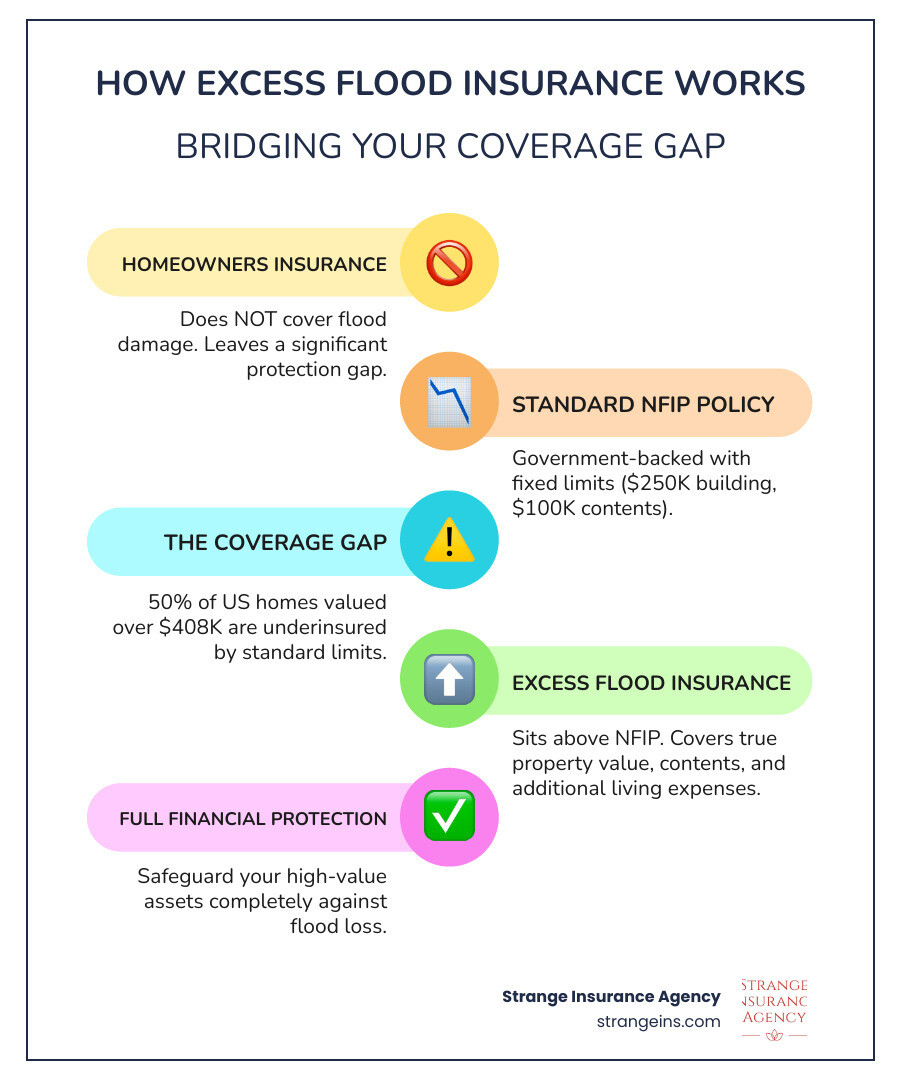
As the infographic above clearly illustrates, your primary flood policy provides a solid foundation. However, for many properties, this foundation leaves a significant portion of the home’s value exposed to risk. Excess flood insurance is the essential next layer, bridging that financial gap to cover the full replacement cost of your home, your valuable belongings, and even the critical expenses you’d face if forced to relocate during repairs.
Excess flood insurance quote terminology:
- Private flood insurance companies
- Commercial flood insurance quotes
- How to get a flood insurance quote
What is Excess Flood Insurance and How Does It Differ from a Standard Policy?
When exploring flood insurance, it’s easy to feel overwhelmed by the terminology. Let’s simplify it. Excess flood insurance is a supplementary policy that provides coverage above the maximum limits of a primary flood insurance policy. Imagine your primary policy is a bucket that can hold a certain amount of water (your coverage limit). When a flood is so large that it overflows the bucket, your excess policy is a much larger basin ready to catch the rest, preventing a financial disaster.

Most homeowners are familiar with the federal government’s flood insurance program. This government-backed program has been the bedrock of flood protection for decades, offering essential, standardized coverage across the country. You can find summaries of its residential coverage from federal sources to understand its baseline protections.
However, the federal program’s fixed limits—$250,000 for residential buildings and $100,000 for contents—are a major constraint in today’s real estate market. For commercial properties, the limits are $500,000 for the building and $500,000 for its contents. These figures, once considered adequate, now fall dangerously short for countless properties, especially in high-value coastal and riverfront communities in Virginia and North Carolina.
This is where the private insurance market provides a solution with excess flood insurance. This coverage is typically designed to “follow form,” a term meaning it adopts the same terms, conditions, and exclusions of your underlying primary policy. This alignment simplifies the claims process and ensures consistent protection. The excess policy simply extends your coverage limits to much higher, more realistic levels.
The differences between a standard government-backed policy and what’s available with an excess policy from the private market are stark. Let’s break down the key distinctions:
| Feature | Standard Federal Flood Insurance | Excess Flood Insurance (Private Market) |
|---|---|---|
| Building Limits | $250,000 residential / $500,000 commercial | Up to $15M residential / $20M commercial |
| Contents Limits | $100,000 residential / $500,000 commercial | Up to $2M |
| Additional Living Expenses | Not covered | Often included |
| Basement Coverage | Very limited | Broader coverage options |
| Coverage Type | Actual Cash Value (for contents) | Replacement Cost available |
| Waiting Period | Typically 30 days | Often matches primary policy’s effective date |
Deeper Dive into Key Benefits
Higher Limits for Building and Contents: The most obvious benefit is the ability to insure your property to its full value. A standard federal policy would leave the owner of a $1 million home on the Outer Banks with a $750,000 coverage gap on the structure alone. Excess flood insurance closes this gap, providing millions in additional coverage.
Additional Living Expenses (ALE): This is a game-changer. A standard federal policy does not cover the cost of temporary housing if a flood makes your home uninhabitable. ALE, a common feature in excess policies, reimburses you for hotel bills, rent for a temporary apartment, and other essential living costs. A major flood repair can take months; ALE can save you tens of thousands of dollars in out-of-pocket expenses.
Broader Basement Coverage: The federal program has notoriously strict limitations on basements. It covers things essential to the structure (foundation, furnaces, water heaters) but excludes finished elements like walls, flooring, and any furniture or electronics in the space. An excess policy can add back coverage for your finished basement, protecting your investment in that extra living area.
Replacement Cost Value (RCV): Standard federal policies often cover contents on an Actual Cash Value (ACV) basis, which is the replacement cost minus depreciation. This means you get less than what you need to buy new items. For example, a 5-year-old sofa that costs $3,000 to replace might only have an ACV of $1,200. An excess policy with RCV coverage would give you the full $3,000, allowing you to truly replace what you lost.
Coverage for Other Structures and Amenities: Excess policies often extend coverage to other structures on your property not covered by the standard federal policy, such as detached garages, sheds, or pool houses. They can also include coverage for pool clean-up and repair, a significant expense after a flood.
When you’re ready to get an excess flood insurance quote, you’ll find a world of flexible, customizable options that the private market offers. These policies are designed for the realities of modern property values and the comprehensive needs of today’s homeowners. Learn more about our comprehensive flood insurance solutions and how we can layer the right protection for your specific situation.