
Why Business Flood Insurance is Critical for Your Survival
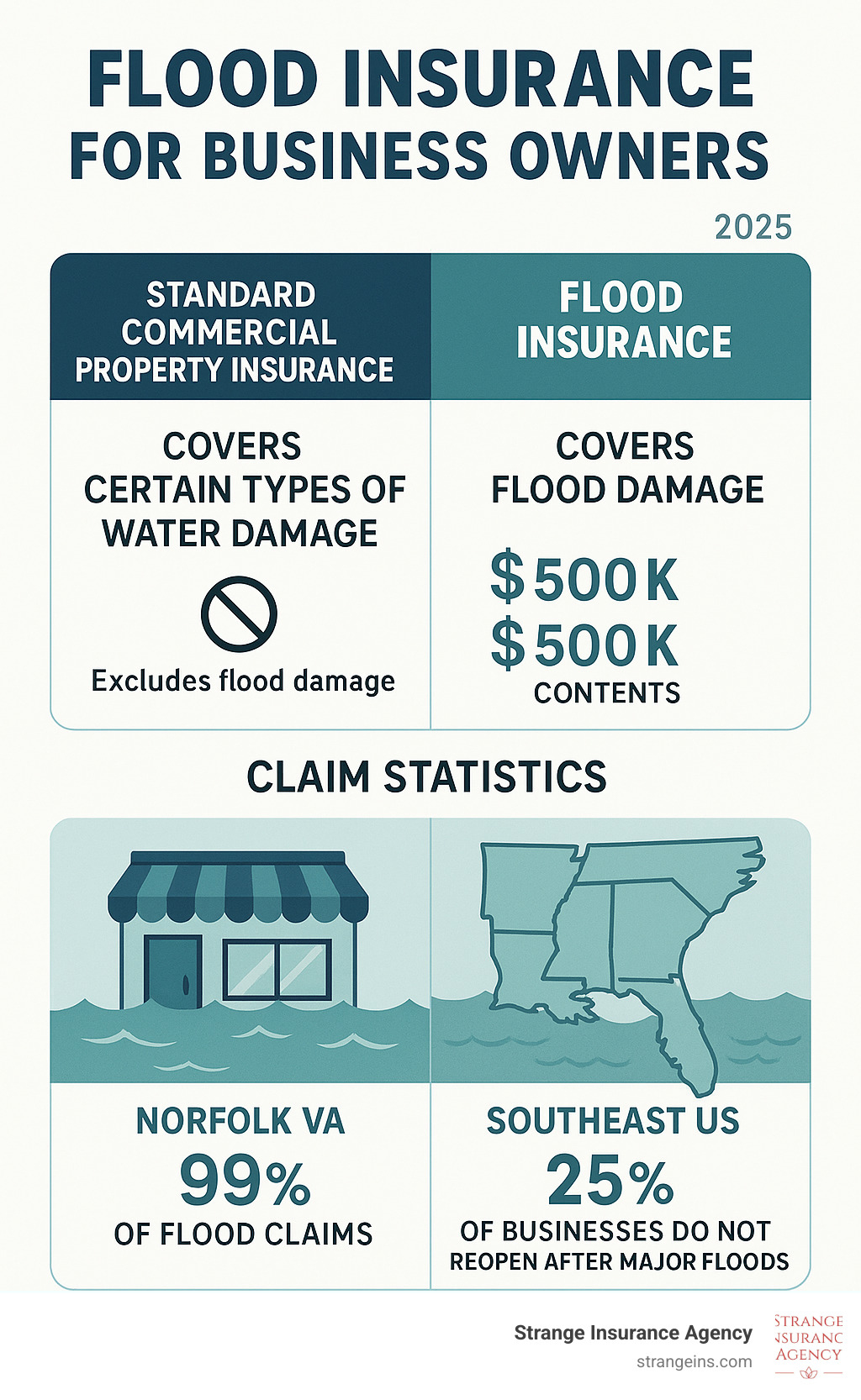
Flood insurance for business owners protects your company’s building, equipment, and inventory from water damage that standard commercial policies don’t cover. Here’s what you need to know:
Key Facts:
– Standard business insurance excludes flood damage
– NFIP provides up to $500,000 building + $500,000 contents coverage
– 30-day waiting period before coverage begins
– Required if you have a federally-backed mortgage in high-risk zones
– 25% of businesses never reopen after major floods
Flooding caused retail, office, and multi-unit residential properties to lose more than $13.5 billion in 2022 alone. About 25% of businesses never reopen after disasters like flooding, and 99% of U.S. counties have experienced floods since 1998.
According to FEMA research, even a few inches of water can lead to thousands in repair costs for building and equipment. Over 20% of flood claims come from properties outside high-risk flood zones. That downtown office or suburban warehouse you thought was safe? It might be more vulnerable than you think.
The average commercial flood claim runs close to $90,000 – enough to sink many small businesses permanently. Yet most business owners assume their standard commercial property policy covers flood damage. It doesn’t.
I’m Christian Strange, and with over 15 years of experience in insurance and risk management, I’ve helped countless businesses steer the complexities of flood insurance for business owners. Through Strange Insurance Agency, I’ve seen how proper flood coverage can mean the difference between a temporary setback and permanent closure.
Flood insurance for business owners basics:
– compare flood insurance quotes
– Private flood insurance companies
– flood insurance for new construction
Why Every Business Needs Flood Protection
Picture this: you arrive at your office Monday morning to find three inches of murky water covering your floors. Your computers are ruined, inventory is soaked, and customers can’t reach you. That nightmare scenario plays out more often than you’d think—and it’s exactly why flood insurance for business owners isn’t just smart, it’s essential.
From 2011-2015, the average commercial flood claim hit close to $90,000. When floods strike your business, you’re facing a perfect storm of expenses: building repairs, destroyed equipment, worthless inventory, lost income while closed, and ongoing expenses with no revenue.

Here’s what catches most business owners off guard: more than 40% of flood claims come from properties outside high-risk flood zones. That means your “safe” location might not be as protected as you think.
If you have a federally-backed mortgage in a high-risk flood area, flood insurance is mandatory. But even when it’s not required, the protection becomes invaluable when disaster strikes.
The government offers help through FEMA and SBA disaster loans, but there’s a catch. FEMA mainly helps individuals, not businesses. SBA loans require presidential disaster declarations, come with interest rates, and must be paid back. Compare that to flood insurance, which simply cuts you a check when you need it most.
Latest research on flood losses reveals that businesses were forced to close for a total of 3.1 million days due to flooding in 2022 alone.
Hidden Risks Beyond High-Risk Zones
Flood risk isn’t just about living near the ocean or a river. Urban flash floods happen when heavy rain overwhelms storm drains in developed areas with lots of concrete and asphalt. Storm surge pushes miles inland during hurricanes. Snow melt events during rapid spring warming can overwhelm drainage systems. Even dam or levee failures can flood areas miles from the original water source.
Floods vs. Other Perils—Coverage Gaps Explained
Your standard commercial property policy covers water damage from burst pipes, roof leaks from wind-driven rain, sprinkler system malfunctions, and HVAC condensation issues. But flood damage is different—it’s water that comes from outside and affects at least two acres of normally dry land or two or more properties.
If water comes from outside and moves across the ground before entering your building, that’s flood damage. And your regular business policy won’t cover it. That’s exactly why flood insurance for business owners exists as separate coverage.
Flood Insurance for Business Owners: Coverage Essentials
When you’re shopping for flood insurance for business owners, you’ll encounter two main types: building coverage and contents coverage. The National Flood Insurance Program (NFIP) offers commercial coverage with these limits:
– Building coverage: Up to $500,000 for your structure
– Contents coverage: Up to $500,000 for business personal property
– Increased Cost of Compliance (ICC): Up to $30,000 to help meet current building codes after major damage
The NFIP defines floods as “a general and temporary condition of partial or complete inundation of two or more acres of normally dry land or two or more properties from overflow of inland or tidal waters, unusual and rapid accumulation of runoff of surface waters, or mudflow.”
Mudflow gets special mention because it’s specifically covered—defined as “a river of liquid and flowing mud on normally dry land areas, as when earth is carried by a current of water and deposited along the path of the current.”
For businesses needing more than the NFIP limits, excess flood insurance through private carriers can provide higher coverage amounts. Many private policies also include business interruption coverage, which NFIP policies don’t offer.
| Coverage Type | NFIP Limit | Private Market | Key Benefits |
|---|---|---|---|
| Building Coverage | $500,000 | Up to $50M+ | Higher limits, replacement cost |
| Contents Coverage | $500,000 | Up to $50M+ | Business interruption available |
| Waiting Period | 30 days | Varies | Some immediate coverage options |
NFIP coverage details provide the complete picture of what’s included in your policy.
Building & Foundation Protection
Your building coverage protects the physical structure including foundation walls, anchorage systems, staircases, permanently installed flooring (carpeting doesn’t count), permanently installed paneling, wallboard, bookcases, and cabinets, plus windows and doors.
Essential systems are covered too: electrical and plumbing systems, central air conditioning equipment, furnaces, and water heaters, permanently installed fire sprinkler systems, and permanently installed machinery and equipment.
Business Personal Property Safeguards
Contents coverage protects your inventory and stock, portable business equipment, furniture, fixtures, and machinery that isn’t permanently attached, and non-licensed vehicles stored inside the building.
Tenant improvements and betterments get covered up to 10% of your contents coverage limit. Valuable items like original artwork and furs have a combined limit of $2,500.
What’s NOT Covered & Common Misconceptions
Business interruption tops the exclusion list—NFIP policies won’t cover lost income or extra expenses. Property outside your building gets no protection: landscaping, trees, plants, lawns, septic systems, wells, swimming pools, fences.
Licensed vehicles aren’t covered, even if parked inside during the flood. Sewer backup is excluded UNLESS flooding directly causes it. Pre-existing conditions, moisture, mildew, or mold that could have been prevented, and damage from earth movement won’t be covered.
Assessing Your Risk & Buying the Right Policy
Understanding your flood risk starts with FEMA’s flood maps. High-risk zones like AE and VE areas have at least a 1% annual chance of flooding. Over a 30-year mortgage, properties in these zones have a 26% chance of experiencing a flood.
VE zones face both flooding and wave action. Moderate to low-risk zones include X, B, and C designations with 0.2% to 1% annual flood chance. Over 20% of flood claims come from these “safer” areas.

Check your property’s flood zone using FEMA’s online flood map tool. FEMA’s Risk Rating 2.0 considers your distance to water sources, property elevation, cost to rebuild, and local flood frequency.
Determining Flood Zones & Hazard Levels
Special Flood Hazard Areas (SFHA) include high-risk zones—AE, VE, and A zones. If your business has a federally-backed mortgage in these zones, flood insurance is mandatory.
Moderate-risk areas often qualify for Preferred Risk Policies with excellent coverage at lower rates. An elevation certificate can significantly impact premiums by showing exactly how your property sits relative to the Base Flood Elevation.
Purchasing Process for Flood Insurance for Business Owners
The National Flood Insurance Program (NFIP) is sold through private insurance agents. Coverage terms and rates are standardized nationwide, providing up to $500,000 in building coverage and $500,000 in contents coverage.
Private flood insurance offers more flexibility with replacement cost coverage, business interruption coverage, and higher limits. At Strange Insurance Agency, we work with 30+ insurance companies through our partnership with Goosehead Insurance to compare NFIP options with private flood insurance.
Crucial timing issue: most flood insurance policies have a 30-day waiting period before coverage takes effect. Exceptions include when a lender requires coverage for a new mortgage or when your property is newly mapped into a high-risk flood zone.
Compare Flood Insurance Quotes to explore your options, and check out our Commercial Flood Insurance Quotes page for business-specific coverage information.
Premiums, Limits, and Money-Saving Strategies
Your flood insurance for business owners premium depends on your flood zone designation and building characteristics. Properties in high-risk zones pay more, but even within the same zone, premiums vary based on building elevation, age, and construction type.
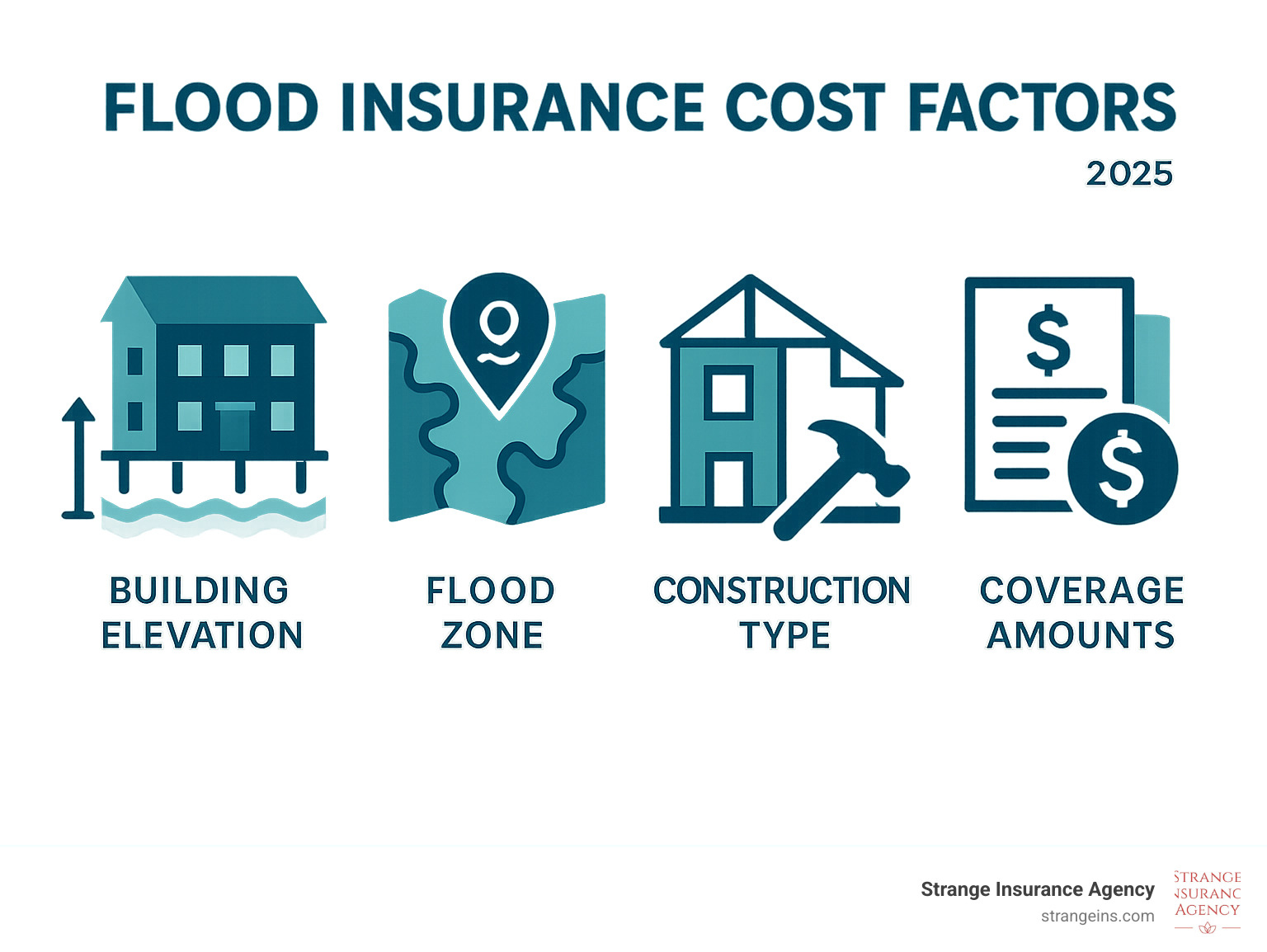
Building elevation relative to Base Flood Elevation significantly impacts rates. Your coverage amounts and deductible choices directly affect costs—higher deductibles mean lower premiums. Occupancy type and construction type also factor in.
For businesses in moderate-to-low risk areas, the Preferred Risk Policy covers both building and contents with a single, lower premium—often under $500 annually.
Reducing Premiums Through Mitigation
Lifting equipment above potential flood levels prevents costly damage and reduces premiums. Dry floodproofing techniques like sealing basement walls, installing flood vents, and adding sump pumps show insurers you’re serious about protection.

If your community participates in FEMA’s Community Rating System, you might get premium discounts of 5% to 45%. The Increased Cost of Compliance coverage provides up to $30,000 for improvements that often result in lower future premiums.
Options Above NFIP Limits
Many businesses need more than NFIP’s $500,000 limits. Excess flood insurance provides additional protection—often 10 times higher than NFIP limits. Private policies often include business interruption coverage and replacement cost valuation instead of actual cash value.
At Strange Insurance Agency, we work with over 30 carriers through Goosehead Insurance to find the right combination of NFIP and private coverage for your needs.
Filing a Claim & Recovering Quickly
When flood waters hit your business, safety comes first. Don’t enter flooded areas until power is shut off. Once safe, document everything with photos and videos before moving items.
Report your loss immediately to your insurance company. The claims process moves quickly, with an adjuster visiting within days. You’ll need to submit a Proof of Loss within 60 days.

Building and contents coverage have separate deductibles. Your insurance company may offer advance payments while the full claim is processed. Flood insurance for business owners settles claims based on Actual Cash Value—replacement cost minus depreciation.
Flood Insurance for Commercial Buildings provides additional guidance on protecting your property during recovery.
Step-by-Step Claim Guide for Flood Insurance for Business Owners
Before the adjuster arrives: Contact your agent immediately, take extensive photos of all damage, make temporary repairs to prevent further damage (save receipts), and create a detailed inventory of damaged items.
During the adjuster’s visit: Be present, walk through the property together, point out all damage including hidden areas, provide documentation for high-value items, and keep detailed notes.
After initial settlement: Review everything with your agent, submit supplemental claims for additional damage finded during repairs, and track all repair expenses.
Post-Flood Safety & Mold Prevention
Cut power to affected areas before entry. Have professionals check for structural damage and test air quality in enclosed areas. Mold prevention starts immediately—you have 24-48 hours to remove standing water and begin drying.
Use fans, dehumidifiers, and professional equipment. Remove porous materials like drywall and carpeting. Monitor humidity levels below 60%. If mold results from flood and you’ve taken reasonable prevention steps, your flood insurance covers mold damage.
Frequently Asked Questions about Flood Insurance for Business Owners
Does standard commercial property insurance cover floods?
This is probably the most common question we get, and unfortunately, the answer surprises many business owners. No, standard commercial property insurance and Business Owners Policies (BOPs) specifically exclude flood damage. This exclusion applies to all flood-related causes including storm surge, river overflow, surface water accumulation, and mudflow.
Here’s where it gets confusing: your commercial policy does cover certain types of water damage. If a pipe bursts in your office or your roof leaks during a windstorm, you’re covered. But the moment water comes from outside your building and meets the definition of flooding—affecting two or more acres or two or more properties—your standard policy won’t help.
That’s exactly why flood insurance for business owners exists as a separate coverage. You’ll need to purchase it either through the National Flood Insurance Program or from private insurers. Think of it this way: your regular business insurance protects you from water coming from inside problems, while flood insurance protects you from water coming from outside problems.
How much coverage can I obtain through the NFIP?
The National Flood Insurance Program provides up to $500,000 in building coverage and up to $500,000 in contents coverage for commercial properties. These are separate policies, which means you could potentially have up to $1 million in total coverage if you purchase both building and contents protection.
Each coverage type comes with its own separate deductibles and premiums, so you’ll want to consider your needs carefully. If you own your building, you’ll likely want both coverages. If you’re a tenant, contents coverage might be all you need.
There’s also a bonus coverage that many business owners don’t know about: up to $30,000 in Increased Cost of Compliance (ICC) coverage. This helps pay for upgrades needed to meet current building codes after substantial damage. It’s included automatically with your policy at no extra cost.
But what if your business is worth more than these limits? That’s where excess flood insurance comes in. Private carriers offer coverage that can be 10 times higher than NFIP limits or more. These policies often include valuable extras like business interruption coverage and replacement cost valuation instead of actual cash value.
When does my policy become effective after purchase?
Here’s something that catches many business owners off guard: most flood insurance policies have a 30-day waiting period before coverage kicks in. You can’t wait until you see a hurricane forming in the Atlantic and then rush to buy coverage—it simply won’t work that way.
This waiting period exists to prevent what insurance folks call “adverse selection”—basically, people only buying coverage when they know a claim is likely. It keeps the system fair for everyone who maintains year-round protection.
However, there are a few important exceptions to the waiting period:
Coverage required by a lender for a new mortgage takes effect immediately. If you’re buying a property in a high-risk flood zone and your bank requires flood insurance, you won’t have to wait 30 days.
Properties newly mapped into high-risk flood areas can get immediate coverage. If FEMA updates flood maps and suddenly your “safe” property is in a flood zone, you can purchase coverage right away.
Certain policy changes or renewals also avoid the waiting period, especially if you’re increasing coverage amounts or switching from one policy to another without a gap.
The key takeaway? Plan ahead and purchase coverage well before you need it. This is especially important here in Virginia and North Carolina, where we need to think about hurricane season preparations long before the first storm appears on the radar. Don’t let a 30-day waiting period be the reason your business doesn’t have protection when you need it most.
Conclusion
When I think about all the businesses I’ve helped over the years, flood insurance for business owners isn’t just another policy—it’s often the difference between bouncing back and closing forever.
Just one inch of floodwater can cause $25,000 in damage. 25% of businesses never reopen after major floods. 99% of U.S. counties have experienced flooding since 1998. Over 20% of flood claims come from businesses outside high-risk zones. In 2022, businesses were forced to close for 3.1 million days due to flooding.
Flood risk isn’t getting better—it’s getting worse. Climate change means more intense storms. Aging infrastructure means more failures. Your business needs to be ready.
The 30-day waiting period means if you’re reading this during hurricane season, you might already be too late for this year’s storms. Don’t let another season pass without protection.
The average commercial flood claim runs close to $90,000—enough to devastate most small businesses. But you don’t have to be a victim. You can be the business owner who planned ahead and kept their doors open when others couldn’t.
At Strange Insurance Agency, powered by Goosehead Insurance, we compare options from 30+ carriers to find coverage that fits your business and budget. Whether you’re in Norfolk, Charlotte, or anywhere we serve, we understand your unique challenges.
Ready to take the next step? Get flood insurance quotes today. Don’t wait for the weather forecast to make this decision for you.
Your business is more than just a building—it’s your future. Make sure that future is protected, no matter what storms come your way.