
Why Investment Property Owners Need Flood Insurance Protection
Floods are the most common and expensive natural disaster in the U.S., yet they are excluded from almost every standard landlord or dwelling-fire policy. This is because floods are considered a systemic risk, capable of causing widespread damage that could bankrupt a private insurer. Flood insurance for investment properties is a specialized product designed to fill this critical gap, covering damage from rising water, overflowing rivers, storm surge, or heavy rainfall that overwhelms drainage systems.
Key facts investors should know:
- Standard landlord policies exclude flood damage: This is a non-negotiable exclusion. Without a separate flood policy, you have zero coverage for flood-related losses.
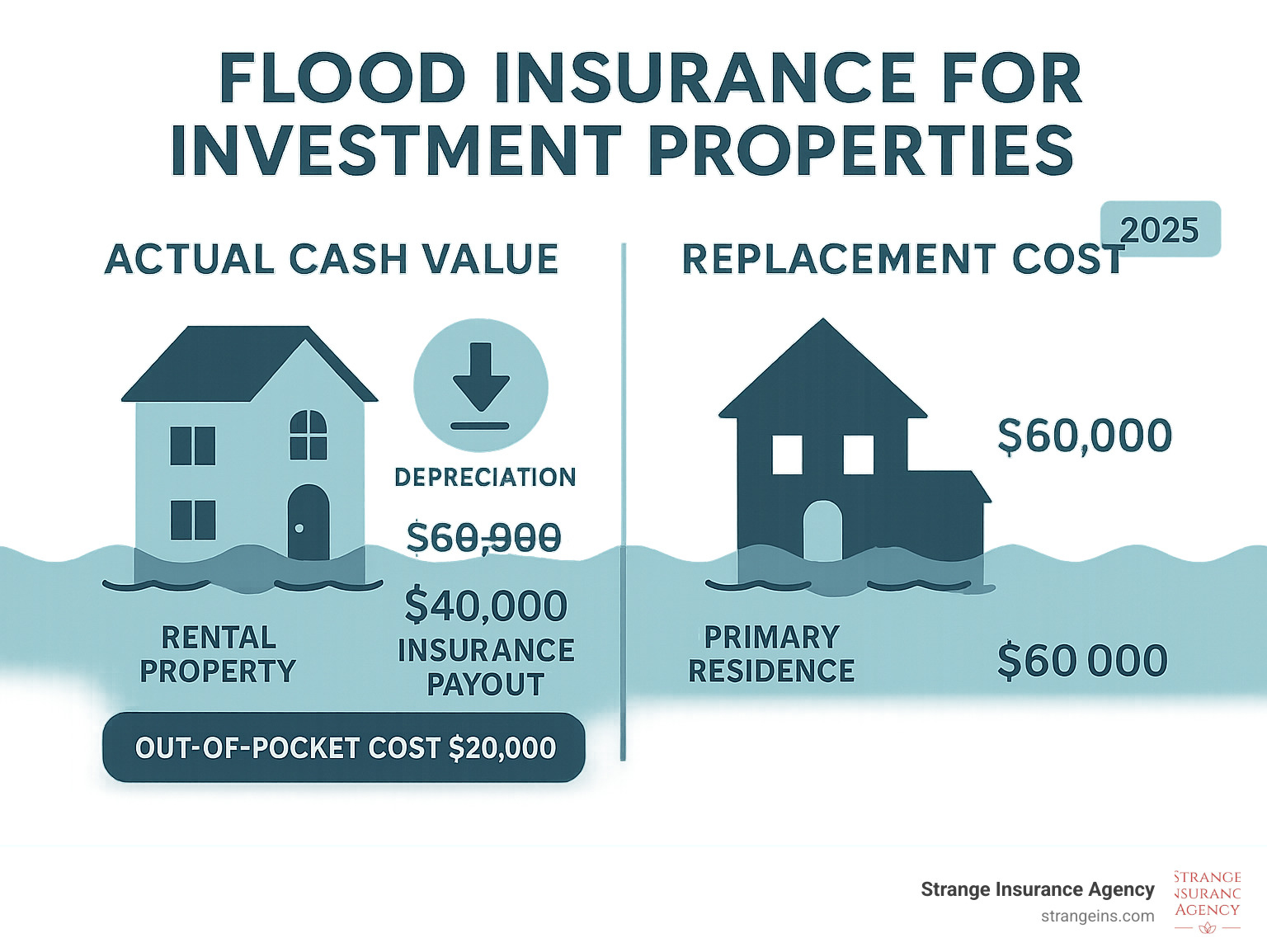
- Coverage is paid on Actual Cash Value (ACV) for rentals: Unlike a primary residence, which may qualify for Replacement Cost, rental properties are typically covered for the depreciated value of damaged items. This means you’ll likely have out-of-pocket costs to replace old systems with new ones.
- Lenders require it in Special Flood Hazard Areas (SFHA): If your property is in a high-risk flood zone and you have a mortgage from a federally regulated lender, you will be mandated to carry flood insurance.
- Most policies have a 30-day waiting period: You cannot wait until a storm is approaching to buy coverage. This waiting period is strictly enforced to prevent last-minute purchases when a flood is imminent.
- Available through NFIP or private insurers: You have options between the government-backed National Flood Insurance Program (NFIP) and a growing private market, each with different limits, costs, and coverage features.
- Protects building and systems—not tenant belongings: Your policy covers the structure and its essential systems. Your tenants are responsible for insuring their own personal property.
Floods generate more than $155 billion in property losses each year, and over 40 percent of claims come from “low-to-moderate” risk zones. Just one inch of water can cause over $25,000 in damage, requiring extensive repairs and leading to months of lost rental income. With climate change causing heavier downpours and much of the nation’s infrastructure aging, this financial risk is only increasing for property owners.
As an agency that places coverage in Virginia, North Carolina, and nationwide, Strange Insurance specializes in spotting coverage gaps and arranging affordable, comprehensive flood protection for rental portfolios.
Flood insurance terms you may see:
- Flood insurance for business owners
- Flood insurance for commercial buildings
- home flood insurance quote
Why Standard Landlord Policies Don’t Cover Flooding and What It Means for You
Your Landlord Insurance policy is a cornerstone of your risk management strategy, designed to protect you from fires, wind, theft, and liability claims. However, it contains a specific and critical exclusion: damage from flooding. FEMA defines a flood as \u201ca general and temporary condition of partial or complete inundation of two or more acres of normally dry land area or two or more properties.\u201d This broad definition includes not just coastal storm surge but also inland events like heavy rain overwhelming storm drains, river overflow, rapid snowmelt, or even a broken levee.
Because a single flood event can damage thousands of buildings simultaneously, creating catastrophic losses, private carriers universally exclude this peril from standard policies. To address this, the federal government created the National Flood Insurance Program (NFIP) in 1968. Some investors mistakenly believe they can rely on federal disaster aid after a storm, but this is a flawed strategy. Disaster assistance, if available at all, is typically a low-interest loan that must be repaid, adding debt to your balance sheet at the worst possible time. It is not a grant, and it will not make you whole.
The Critical Need for Flood Insurance for Investment Properties
The financial stakes are incredibly high. Just one inch of water can easily lead to $25,000 or more in repairs, encompassing new flooring, drywall, electrical systems, HVAC components, and extensive mold remediation. Without a dedicated flood policy, these costs come straight out of your pocket. Worse, your rental income ceases while the property is uninhabitable, compounding the financial damage. Flood insurance for investment properties is the only tool that transforms a potentially portfolio-ending catastrophe into a manageable claim with a predictable deductible.
Common Misconceptions Investors Have About Flood Risk
What Flood Insurance for Investment Properties Actually Covers

A key distinction for investment properties is that they are insured on an Actual Cash Value (ACV) basis. ACV is calculated as the replacement cost of an item minus its depreciation. For example, if a 15-year-old HVAC system with a 20-year lifespan is destroyed, the policy will pay for its depreciated value, not the cost of a brand-new unit. This “depreciation gap” is an out-of-pocket expense for the investor. Detached garages are typically covered up to 10% of the building coverage limit, provided they are used for parking or storage.
For larger multi-unit or commercial buildings that fall under a Commercial Property Insurance structure, higher flood limits are available through commercial flood policies, though deductibles and waiting periods may differ from residential policies.
Covered Building and System Components
A flood policy is designed to restore the physical structure of your property. Coverage typically includes:
- Building Structure: Foundation walls, anchorage systems, and stairs that are essential to the building’s integrity.
- Essential Systems: Electrical and plumbing systems, furnaces, water heaters, HVAC equipment, and ductwork.
- Interior Finishes: Permanently installed carpeting, cabinets, and paneling. Wallboard, drywall, and insulation are also covered.
- Appliances: Built-in appliances that you own as the landlord, such as refrigerators, stoves, and dishwashers.
- Detached Garages: Limited coverage is provided, as noted above.
Excluded Items and Damages
It’s equally important to understand what is not covered to manage your total risk:
- Tenant Belongings: The policy only protects your property. Tenants are responsible for their own contents and need a separate renters flood policy.
- Loss of Rental Income: Standard NFIP policies do not cover lost income while the property is being repaired. Some private policies may offer this as an add-on.
- Exterior Features: Items outside the building, such as landscaping, decks, patios, fences, septic systems, and trees, are not covered.
- Valuables and Vehicles: Currency, precious metals, valuable papers, and vehicles are excluded. Vehicles should be covered by the comprehensive portion of an auto policy.
- Preventable Mold: Mold or mildew damage that could have been avoided by the property owner is not covered. Only mold directly caused by the flood is included.
Understanding these coverage limits and exclusions is vital. It allows you to accurately budget for potential out-of-pocket costs, such as the depreciation gap and the income lost during repairs.
How Flood Risk Is Determined and What It Costs

Historically, flood insurance premiums were based almost entirely on a property’s location on a Flood Insurance Rate Map (FIRM). However, FEMA’s new methodology, Risk Rating 2.0, now rates each property individually based on a wider range of factors, including:
- Distance to a water source (ocean, river, lake)
- The property’s specific elevation
- Foundation type (e.g., slab, basement, crawlspace)
- Construction materials and building age
- The cost to rebuild the property
This modern approach provides a more precise and equitable assessment of risk. As a result, premiums in low-risk zones might be $500–$1,000 per year, while high-risk coastal or riverfront properties can run several thousand dollars annually. You can manage this cost by choosing a higher deductible (up to $10,000 for NFIP policies), which lowers the premium but increases your out-of-pocket expense in a claim.
NFIP coverage is capped at $250,000 for the building for 1–4-unit residential structures. For properties valued higher than this, private market flood insurance is often necessary to secure adequate protection.
Understanding Lender Requirements
If your investment property is located in a Special Flood Hazard Area (SFHA)—an area with a 1% or greater chance of flooding in any given year—and you have a mortgage from a federally regulated or insured lender, you are required by law to maintain flood insurance. The lender will mandate coverage for the lesser of:
- 100% of the property’s replacement cost
- The outstanding principal balance of the loan
- The maximum coverage available from the NFIP ($250,000)
For condominium investments, the rules extend to the entire building. Lenders require the condo association (HOA) to maintain a Residential Condominium Building Association Policy (RCBAP) that covers at least 80% of the building’s replacement cost.
How to Purchase a Policy and Typical Waiting Periods
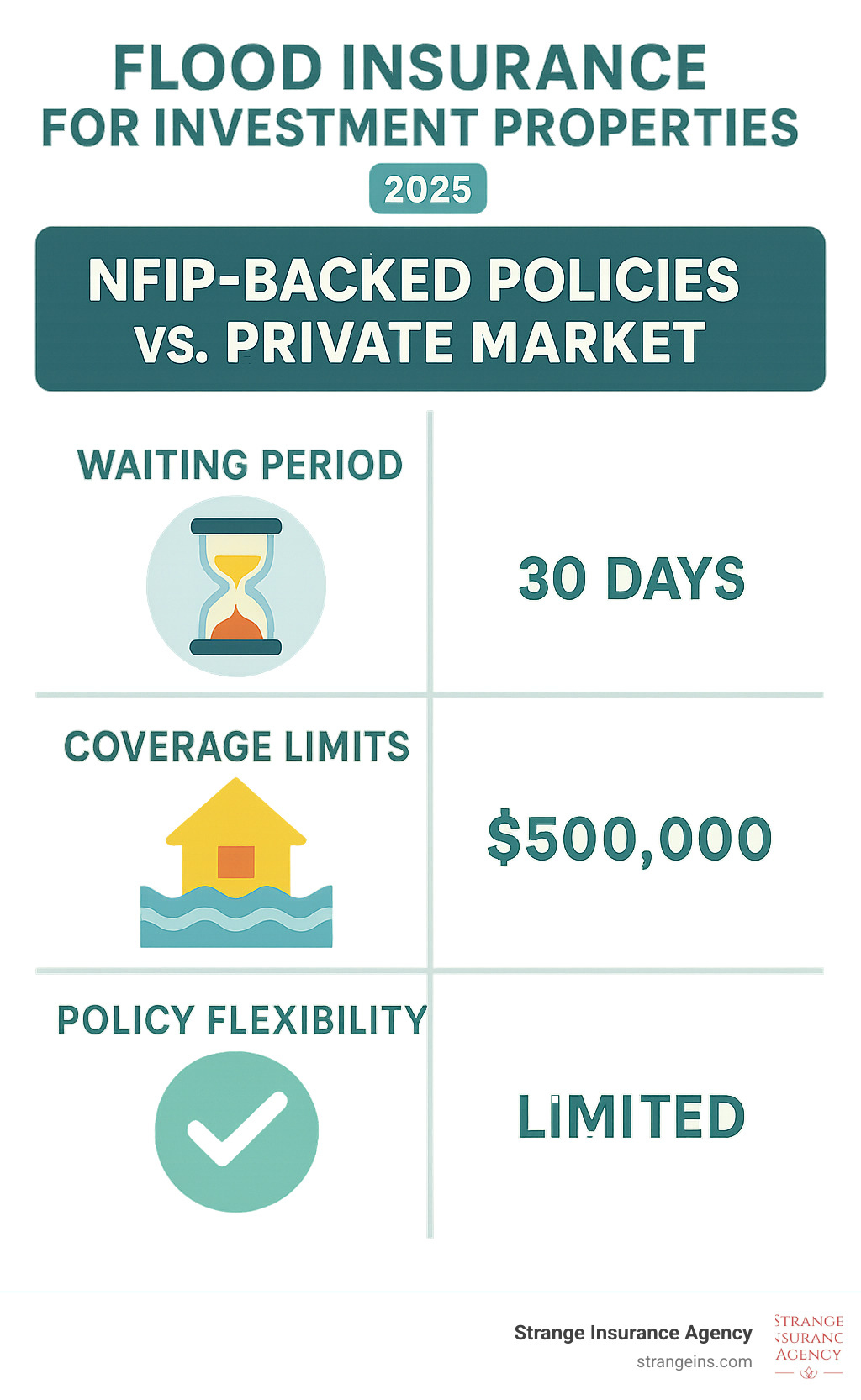
You can purchase flood insurance through two main channels: the NFIP (sold by authorized insurance companies via the Write-Your-Own Program) or directly from private insurance carriers. Both typically impose a 30-day waiting period before the policy becomes effective. This wait is usually waived only when the insurance is purchased as part of a new loan closing.
Private policies are becoming an increasingly popular alternative, often offering:
- Higher building coverage limits (exceeding the NFIP’s $250,000 cap)
- Shorter waiting periods (sometimes as little as 10-14 days)
- Additional coverages like loss of rental income or replacement cost on contents
Our Insuring Investment Property guide explains how we shop multiple markets to compare NFIP and private options, securing the right fit for your specific property and risk tolerance.
Frequently Asked Questions about Flood Insurance for Rental Properties
Does flood insurance for a rental property pay full replacement cost?
No, under the NFIP, rental properties (as non-primary residences) are covered on an Actual Cash Value (ACV) basis. This means the payout is for the replacement cost of damaged items minus depreciation. You should budget for this “depreciation gap,” especially for older components like roofs, flooring, and HVAC systems. Some private market policies may offer a replacement cost option for an additional premium.
Do my tenants need their own flood insurance?
Absolutely. Your landlord flood policy protects the building structure and any appliances you own. It does not cover your tenants’ personal belongings. You should strongly encourage, or even require in your lease agreement, that tenants purchase their own renters flood insurance policy to protect their furniture, electronics, and other possessions.
Is flood insurance required if my property isn’t in a high-risk zone?
While not legally required by lenders outside of an SFHA, it is highly recommended. Over 40% of all NFIP flood claims occur in low-to-moderate risk zones. Flash floods, drainage failures, and unusual weather can happen anywhere. Policies in these zones, often called Preferred Risk Policies, are typically very affordable and provide crucial protection against unexpected disasters.
How much does it cost?
The cost varies significantly based on your property’s specific risk profile. Under Risk Rating 2.0, factors include elevation, foundation type, distance to water, and the building’s replacement cost. Low-risk properties may cost $500-$1,000 annually, while high-risk properties can be several thousand. Choosing a higher deductible can lower your premium. Additionally, mitigation measures like installing flood vents can sometimes reduce costs.
Can I buy it through my regular insurance company?
Many standard insurance companies are authorized to sell NFIP policies through the “Write Your Own” program. A growing number also offer their own private flood insurance products. As an independent agency, we can access and compare quotes from both the NFIP and multiple private carriers to find the best combination of coverage and price for you.
What happens if I let my policy lapse?
Letting your policy lapse is risky. You will be subject to a new 30-day waiting period to get coverage again, leaving you unprotected. If flood insurance is required by your lender, they will be notified of the lapse and can purchase “force-placed” insurance on your behalf. This lender-placed coverage is significantly more expensive and provides much narrower protection than a standard policy. It’s best to maintain continuous coverage.
Protect Your Portfolio with the Right Coverage
Floods cause billions in damage across the country every year, and a single inch of water in your rental property can wipe out years of hard-earned income and equity. Because standard landlord policies explicitly exclude this pervasive peril, a dedicated flood insurance for investment properties policy is an essential component of any serious investor’s risk management plan. The financial exposure is simply too great to ignore.
Strange Insurance works with more than 30 top-rated carriers, giving investors in Virginia, North Carolina, and nationwide access to side-by-side quotes from both the NFIP and the competitive private market. Our role is to explain the process. We explain the nuances of ACV coverage, lender requirements, and waiting periods so you can make an informed decision with confidence.
Don’t wait for a storm to appear on the forecast. The time to secure protection is now. Visit our Flood insurance for investment properties page to learn more and request a comprehensive quote to protect your portfolio today.