
Why Understanding Food Liability Insurance Cost Is Critical for Your Food Business
Food liability insurance cost is one of the most important budget considerations for any food business owner. Whether you run a restaurant, food truck, catering company, or bakery, understanding these costs upfront can save you thousands in unexpected expenses down the road.
Quick Answer: Food Liability Insurance Cost Breakdown
- Basic Coverage: $25.92-$44 per month ($299-$525 annually)
- Business Owner’s Policy (BOP): $61-$251 per month ($737-$3,010 annually)
- Typical Limits: $1 million per occurrence, $2 million aggregate
- Cost Factors: Business type, revenue, location, claims history, coverage limits
Food businesses face unique risks that can result in expensive lawsuits. A single slip-and-fall incident or foodborne illness claim can cost tens of thousands in legal fees and settlements. Product recalls, contamination issues, and third-party injuries at events are just some of the scenarios that make proper insurance coverage essential.
The food industry spans everything from small bakeries to large manufacturing facilities. Each type of business has different risk exposures that directly impact insurance premiums. Understanding these cost factors helps you budget appropriately and choose the right coverage limits for your specific operation.
As Christian Strange, I’ve spent over 15 years helping business owners steer complex insurance decisions, including determining the right food liability insurance cost structure for their unique needs.
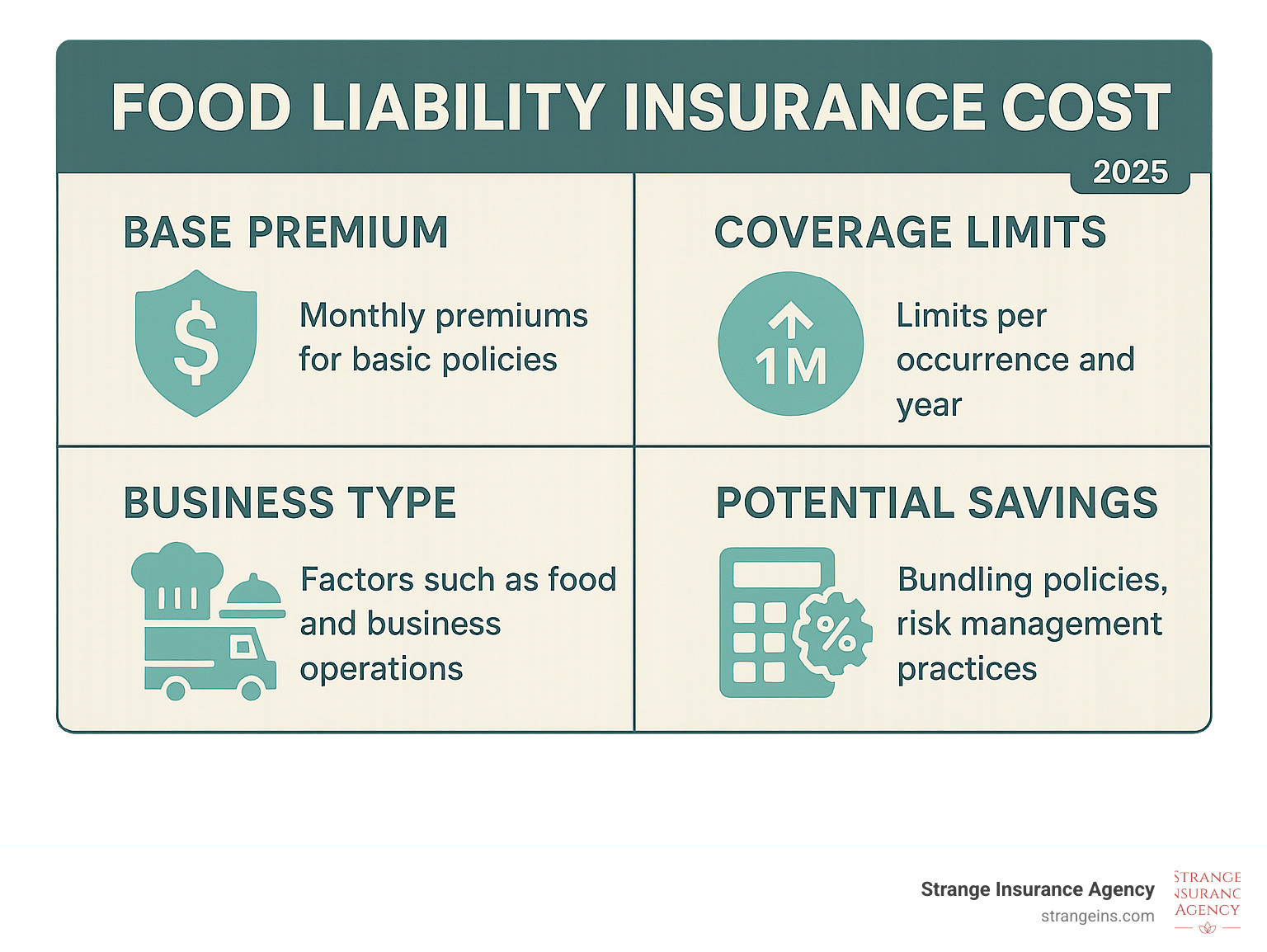
Simple guide to food liability insurance cost:
- restaurant liability insurance
- event vendor insurance
- general liability insurance for independent contractors
What Is Food Liability Insurance and What Does It Cover?
Food liability insurance is your safety net against the unique risks that come with feeding people. Think of it as specialized protection designed specifically for businesses that manufacture, process, or sell food products – from your neighborhood bakery to large catering operations.
This coverage steps in when things go wrong in ways that regular business insurance might not handle. The food liability insurance cost reflects the comprehensive protection you get against scenarios that could otherwise devastate your business financially.
Third-party injury claims are one of the most common coverage areas. Picture a customer slipping on a wet floor in your restaurant or getting burned by hot equipment during a catering event. These accidents happen, and the medical bills and legal costs can add up quickly.
Product liability coverage becomes crucial when your food products cause harm. Whether it’s a customer getting food poisoning from your signature dish or someone having an allergic reaction to an undisclosed ingredient, this protection handles the legal defense and potential settlements.
Property damage coverage protects you when your business operations cause damage to someone else’s property. Maybe your catering equipment causes a fire at an event venue, or a delivery mishap damages a client’s facility.
Foodborne illness protection is perhaps the most critical coverage for food businesses. Even with the best safety protocols, contamination can occur. When customers get sick and file lawsuits, this coverage handles everything from legal fees to settlement costs.
Product recall expenses can be financially devastating without proper coverage. If your products need to be pulled from shelves due to contamination or safety concerns, the costs of notification, retrieval, and disposal add up fast.
Food liability insurance differs from standard business coverage because it understands the unique challenges of working with perishable goods and serving the public. More info about Business Insurance
General vs. Product Liability for Food Businesses
Understanding the coverage split between general and product liability helps you make informed decisions about your protection needs. These two types of coverage work together but handle different types of risks.
General liability insurance focuses on bodily injury and property damage that happens on your premises or during your business operations. This includes customers who slip and fall in your restaurant, burns from hot equipment, or damage to a client’s property during catering setup.
Product liability insurance specifically addresses problems with contaminated products or food-related injuries. When a customer gets sick from your food, finds a foreign object in their meal, or has an allergic reaction, product liability coverage handles the claim.
Most food businesses need both types of protection. A restaurant faces slip-and-fall risks (general liability) and food poisoning claims (product liability). The good news is that these coverages typically bundle together in comprehensive policies, making them more affordable than separate purchases.
Legal defense costs are included in both coverage types, which is incredibly valuable. Even when claims are frivolous or you’re not at fault, legal fees can quickly exceed settlement amounts. More info about Business Insurance: General Liability Insurance
What’s Not Covered Under Standard Policies
Even comprehensive food liability policies have important excluded risks that could catch you off guard. Understanding these gaps helps you identify additional coverage needs before problems arise.
Equipment breakdown coverage typically isn’t included in standard policies. If your refrigeration system fails overnight and thousands of dollars worth of food spoils, you’ll need specific spoilage coverage to protect against this loss.
Cyber liability is generally excluded, but food businesses increasingly need this protection. With payment processing, online ordering, and customer data storage, cyber attacks can be devastating.
Vehicle coverage is always excluded from liability policies. If you operate delivery vehicles or food trucks, you’ll need commercial auto insurance.
Workers’ compensation is always a separate requirement when you have employees. This covers medical expenses and lost wages if employees get injured on the job.
Average Food Liability Insurance Cost & Coverage Limits
When you’re planning your food business budget, understanding food liability insurance cost is essential. The good news is that basic coverage is more affordable than most business owners expect. You can get started with general liability insurance for as little as $25.92 per month, though most food businesses pay around $44 monthly for comprehensive coverage.
The magic numbers you’ll see everywhere are $1 million per occurrence and $2 million aggregate. These aren’t random figures – they represent the sweet spot where you get solid protection without breaking the bank. Most landlords, event organizers, and business contracts require exactly these limits, so you’ll likely need them anyway.
Here’s what’s interesting about food business insurance costs: 57% of food and beverage businesses pay less than $50 per month for general liability coverage. That’s less than most people spend on their phone bill! If you’re looking at a business owner’s policy that bundles liability with property coverage, 35% of businesses pay under $100 monthly.
The food liability insurance cost breakdown looks like this: General liability runs $33-$44 monthly with $1M/$2M limits, while a business owner’s policy costs $61-$148 monthly and includes both liability and property coverage. Product liability specifically averages $42 monthly, and workers’ compensation (if you have employees) ranges from $91-$106 per month.
| Coverage Type | Monthly Cost | Annual Cost | Typical Limits |
|---|---|---|---|
| General Liability | $33-$44 | $398-$525 | $1M/$2M |
| Business Owner’s Policy | $61-$148 | $737-$1,770 | $1M/$2M + Property |
| Product Liability | $42 | $500 | $1M/$2M |
| Workers’ Compensation | $91-$106 | $1,088-$1,272 | State Required |
Typical Premiums by Food Business Type
Not all food businesses are created equal when it comes to food liability insurance cost. Your premium depends heavily on what type of operation you run and how much risk you present to insurance companies.
Bakeries get the best deal, averaging just $37 per month for general liability. This makes sense – there’s less customer interaction, no alcohol service, and fewer slip-and-fall risks compared to busy restaurants. Food vendors and concession stands are similarly low-risk, paying around $33 monthly.
Restaurants face higher costs at $141 per month on average. Why? Think about it – you’ve got customers coming and going all day, hot surfaces, potentially alcohol service, and all the chaos that comes with food service. Catering businesses sit in the middle at $42 monthly, though this can jump significantly if you serve alcohol at events.
Food trucks need special consideration because they’re mobile operations. While their general liability might be reasonable, they absolutely need commercial auto coverage for their vehicles. Manufacturing and food processing operations face the highest product liability risks since their products reach many more consumers.
Here’s a reality check: establishments serving alcohol pay 5-10% more due to liquor liability risks. A bar might pay $218 monthly compared to that $37 bakery premium. The type of food matters too – if you’re serving high-risk items like sushi or raw oysters, expect higher premiums.
Sample Policy Limits & Deductibles Impact on Food Liability Insurance Cost
The $1 million per occurrence, $2 million aggregate limits are chosen by 94% of food businesses for good reason. They provide solid protection while keeping costs reasonable. But what if you need more coverage?
Higher limits like $2 million per occurrence will bump your premium up 20-30%. For many businesses, this extra cost is worth the peace of mind, especially if you’re doing high-volume catering or serving alcohol.
Deductibles are your friend when it comes to controlling costs. Most food liability policies offer deductibles from $500 to $2,500. Choosing a $1,000 deductible instead of $500 can reduce your premium by 10-15%. Just make sure you can comfortably afford the deductible if you need to file a claim.
Umbrella liability insurance is one of the best deals in insurance. For just $200-$400 annually, you can add $1 million in additional coverage above your primary policy. If you have $1 million in general liability and add a $5 million umbrella, you’re covered for $6 million total.
Understanding per-occurrence versus aggregate limits is crucial. Per-occurrence limits apply to each individual claim, while aggregate limits cap your total coverage for all claims during the policy year. This distinction helps you choose the right structure for your specific risks. Business Insurance: Commercial Umbrella Insurance
U.S. vs. Canada Cost Differences
If you’re considering expanding your food business to Canada, food liability insurance cost differences are significant. Canadian restaurants typically pay $120 or more monthly for general liability, compared to the $44 U.S. average. Comprehensive coverage in Canada often runs $300+ monthly.
Canadian workers’ compensation costs are notably higher, averaging $140+ monthly versus $106 in the U.S. However, liquor liability costs are similar – around $50+ monthly in Canada compared to $58 in the U.S.
There are some advantages to the Canadian system. Fire protection systems often qualify for larger premium discounts in Canada, and no-claims discounts are more common, potentially reducing your premiums by 10-15% for clean claims histories.
Both countries typically require $1 million minimum liability coverage, but Canadian businesses may need higher limits due to different legal systems and potentially larger settlements. Currency fluctuations and provincial regulations also contribute to cost variations between the two countries. Industry average costs
Factors That Influence Your Premium & How to Save
Several key factors determine your food liability insurance cost. Your business’s gross annual revenue is the primary factor – higher revenue typically means higher premiums because it indicates greater risk exposure. A restaurant with $500,000 in annual revenue will pay more than one with $100,000 in revenue.
The type of food you serve significantly impacts your premium. Businesses serving high-risk foods like raw seafood, unpasteurized products, or items prone to contamination face higher premiums. A sushi restaurant will pay more than a bakery due to the increased risk of foodborne illness.
Your location affects pricing through local claim frequencies and legal environments. Urban areas with higher foot traffic and more litigation typically have higher premiums. Businesses in Virginia and North Carolina, where we operate, generally have moderate risk profiles compared to high-cost states like California or New York.
Claims history is crucial – businesses with previous claims pay higher premiums, while those with clean records may qualify for discounts. The number of employees affects workers’ compensation costs and general liability exposure.

Proven Ways to Reduce Your Food Liability Insurance Cost
You can significantly reduce your food liability insurance cost through proactive risk management. Remove tripping, slipping, or fall hazards from customer areas by maintaining clean floors, proper lighting, and clear walkways. Regular safety inspections and prompt repairs prevent many liability claims.
Follow the first-in-first-out (FIFO) rule when rotating stock to minimize spoilage and contamination risks. Proper inventory management reduces product liability exposure and demonstrates good business practices to insurers.
Adhere to all safe food handling guidelines including proper temperature control, hand washing, and sanitation procedures. Staff training on food safety protocols is essential – certified food handlers and managers often qualify for premium discounts.
Clean and maintain equipment according to manufacturer instructions. Regular maintenance prevents equipment failures that could cause injuries or contamination. Maintain detailed maintenance logs as evidence of your proactive approach.
Bundling & Discounts for Food Businesses
Bundling multiple insurance policies can significantly reduce your total food liability insurance cost. A Business Owner’s Policy (BOP) combines general liability and commercial property insurance, typically costing less than purchasing these coverages separately. BOPs for food businesses average $61-$148 per month compared to separate policies totaling $200+ monthly.
Multi-policy discounts apply when you bundle different types of coverage like general liability, workers’ compensation, and commercial auto. Many insurers offer 5-10% discounts for bundling three or more policies.
No-claims discounts reward businesses with clean claims histories. After three to five years without claims, you may qualify for 10-15% premium reductions.
Payment discounts apply when you pay annually instead of monthly, often saving 5-8% on your total premium. More info about Restaurant Liability Insurance
How to Get Covered & Manage Claims
Getting food liability insurance doesn’t have to be complicated. The process starts with gathering your business information and understanding what coverage you need. Most food businesses can get quotes quickly and start coverage within days of applying.
The key is being prepared with the right information. You’ll need details about your business operations, revenue, employees, and the types of food you serve. Having this information ready makes the quote process much smoother and helps ensure you get accurate pricing.
At Strange Insurance Agency, we help food business owners steer this process every day. Our experience with food liability coverage means we know exactly what information insurers need and how to get you the best food liability insurance cost for your specific situation. Start your application
Step-by-Step: Requesting a Food Liability Quote
Getting your food liability insurance cost quote is easier when you know what to expect. Start by gathering your basic business information including your business name, address, and exactly what type of food operation you run. Whether you’re a restaurant, bakery, food truck, or catering company, be specific about your operations.
Your revenue numbers are crucial for accurate pricing. Insurers need your current annual sales and projections for the coming year. Don’t worry if you’re a new business – reasonable estimates based on your business plan work fine.
Employee information should cover everyone who works for you. Count full-time, part-time, and seasonal workers separately. This helps insurers calculate your workers’ compensation needs and overall risk exposure.
Describe your operations in detail. What types of food do you serve? Do you handle high-risk items like raw seafood or unpasteurized products? Do you serve alcohol? The more specific you are, the more accurate your quote will be.
Coverage selection comes next. Most food businesses start with $1 million per occurrence and $2 million aggregate limits. Your deductible choice typically ranges from $500 to $2,500. Higher deductibles reduce your premium but increase your out-of-pocket costs when filing claims.

Real-World Claim Examples Covered by Food Liability Insurance Cost
Understanding real claim scenarios shows why your food liability insurance cost is actually an investment in your business’s survival. These aren’t hypothetical situations – they’re the types of claims that happen to food businesses every day.
The slip-and-fall scenario is probably the most common claim we see. A customer walks into your restaurant on a rainy day, slips on the wet floor near the entrance, and breaks their wrist. The total claim reaches $45,000 including medical bills, lost wages, and legal fees. Your general liability coverage handles everything except your deductible.
Food poisoning claims can be devastating without proper coverage. A contaminated ingredient causes food poisoning in 15 customers at your catering event. Medical bills pile up, customers lose wages while they’re sick, and some hire lawyers. The total cost reaches $125,000 in settlements and legal defense. Your product liability coverage protects you from financial ruin.
Property damage at events can create expensive problems. During a catering job, your equipment malfunctions and causes a fire that damages the venue’s kitchen. Repair costs hit $35,000, and the venue loses $10,000 in revenue while repairs are made. Your general liability policy covers both the property damage and the venue’s lost income.
Frequently Asked Questions about Food Liability Insurance Cost
Is food liability insurance required by law or event organizers?
Here’s the straight answer: food liability insurance isn’t required by federal law, but you’ll almost certainly need it anyway. Most states and cities have their own rules, and many require insurance as part of your business license or food service permit.
Your landlord will definitely require it. Nearly every commercial lease includes a clause requiring general liability insurance, usually with $1 million per occurrence as the minimum. Try to rent space without insurance, and you’ll quickly find how “optional” it really is.
Event organizers are even stricter. Whether you’re setting up at a farmers market, food festival, or private catering event, you’ll need to show proof of insurance before you can serve your first customer. Most require certificates of insurance naming them as additional insureds.
The good news? Meeting these requirements doesn’t inflate your food liability insurance cost because the minimum coverage amounts they require align with what you should carry anyway. It’s like being required to wear a seatbelt – you should do it regardless of the law.
What types of claims are most common and how are they paid?
Slip-and-fall accidents dominate food business claims, making up about 60% of all general liability claims. Wet floors, uneven surfaces, and spilled food create constant hazards. These claims typically settle between $10,000 and $50,000, though serious injuries can push costs much higher.
Food poisoning claims are scarier but less frequent. When they happen, they’re expensive – often reaching six figures when multiple people get sick. A single contaminated batch can affect dozens of customers, and each person becomes a separate claim. These cases take months or even years to resolve completely.
Allergic reactions create another category of claims. Despite clear menu labeling, cross-contamination or ingredient mistakes can trigger severe reactions. Legal costs pile up quickly even when you’ve followed all safety protocols.
Your insurance company handles everything once you report a claim. They investigate, hire lawyers, negotiate settlements, and pay judgments. You’re only responsible for your deductible – typically $500 to $2,500 per incident. The insurer covers legal defense costs separately, which often exceed the actual settlement amount.
The claims process usually takes three to twelve months. Simple cases resolve faster, while complex food poisoning cases involving multiple victims can drag on for years. Your insurer keeps you updated throughout the process and handles all communication with claimants and their attorneys.
Can I adjust policy limits later to control food liability insurance cost?
Yes, you can usually adjust your policy limits, but timing matters. Increasing limits typically takes effect immediately once you pay the additional premium. Most insurers allow mid-term increases when your business grows or contracts require higher coverage.
Decreasing limits is trickier. Many insurers only allow reductions at renewal time, and you need to consider the long-term implications. Claims are covered at the limits in effect when your policy was issued, not when the claim happens. Cutting limits to save money could leave you exposed if something goes wrong.
The cost difference between limit options is often surprisingly small. Bumping from $1 million to $2 million per occurrence might only add $200 to $400 annually to your food liability insurance cost. That’s less than a dollar per day for double the protection.
Regular reviews with your agent help ensure your coverage keeps pace with your business growth. As your revenue increases, your insurance needs may change. What worked for a small bakery might not be adequate for a growing catering operation.
Many contracts lock in minimum coverage requirements. Your lease might require $1 million, but your biggest catering client might demand $2 million. Adjusting limits downward could jeopardize important business relationships, making any premium savings counterproductive.
Conclusion
Protecting your food business doesn’t have to break the bank. With food liability insurance cost starting at just $25.92 per month for basic coverage, you’re looking at less than a dollar a day to shield your business from potentially devastating lawsuits. When you consider that a single slip-and-fall claim can cost $50,000 or more, that monthly premium suddenly looks like the bargain it truly is.
The beauty of understanding these costs upfront is that you can budget smartly and choose coverage that fits your specific situation. Whether you’re running a cozy bakery or a busy restaurant, your food liability insurance cost will reflect your unique risk profile.
Smart business owners know that the best insurance strategy goes beyond just buying a policy. By keeping your kitchen spotless, training your staff properly, and maintaining your equipment, you’re not just reducing your premium costs – you’re building a stronger, safer business.
Bundling your coverage through a Business Owner’s Policy often gives you the biggest bang for your buck. Instead of juggling multiple policies and payments, you get comprehensive protection that covers both liability and property risks. Add in multi-policy discounts and professional group savings, and you might be surprised how affordable complete coverage can be.
Here’s the reality: accidents happen in the food industry, but they don’t have to sink your business. That customer who slips on your freshly mopped floor, the unfortunate food poisoning incident, or the equipment malfunction at a catering event – these scenarios happen to good businesses run by careful people. The difference is whether you’re prepared.
At Strange Insurance Agency, we’ve seen how the right coverage protects Virginia and North Carolina food businesses. Our partnership with Goosehead Insurance gives us access to over 30 insurance companies, which means we can shop around to find you the best food liability insurance cost for your specific needs. We’re not just selling you a policy – we’re helping you build a financial safety net that lets you focus on what you do best: serving great food.
Don’t wait for that phone call from an angry customer or their attorney. The peace of mind that comes from proper coverage is worth far more than the modest monthly investment. Let’s get you protected today, so you can sleep better tonight knowing your business is secure. More info about Business Insurance