
Understanding Home Insurance and Why It’s Your Most Important Financial Safeguard
The term money market house insurance is a common misconception, not a real insurance product. It mistakenly combines two separate financial concepts. Here’s what you need to know:
Quick Answer for “Money Market House Insurance”:
- Not a real product: No insurance company offers “money market house insurance.”
- Common confusion: People mix up money market accounts with home insurance policies.
- What you actually need: Standard homeowners insurance combined with smart financial strategies.
- Better approach: Use high-yield savings for premiums and emergency funds.
- Focus instead on: Comparing actual home insurance quotes and coverage options.
Protecting your home, your biggest investment, is crucial. With average home insurance costs ranging from $1,487 per year in Ontario to $2,339 in Alberta, understanding your policy is key to getting the right coverage at the best price. Comparing quotes can save you an average of $417 annually, and bundling home and auto insurance can cut costs by 10-17%. Given that severe weather damage reached $3.4 billion in Canada in 2022, proper coverage is essential financial protection.
I’m Christian Strange, and for over 15 years, I’ve helped families steer insurance decisions. At Strange Insurance Agency, I’ve seen how the right coverage and smart financial strategies provide peace of mind.
Basic money market house insurance terms:
- investment property insurance
- best home insurance for rental properties
- homeowners insurance policy for rental property
Home insurance is your most important financial safeguard. It’s the safety net that protects your biggest asset and shields your finances from ruinous costs, whether from a fire, storm, or accident. It’s not just a policy; it’s peace of mind.
What Does a Standard Home Insurance Policy Cover?
A standard homeowners policy is designed to cover a multitude of scenarios that could impact your home and financial well-being.
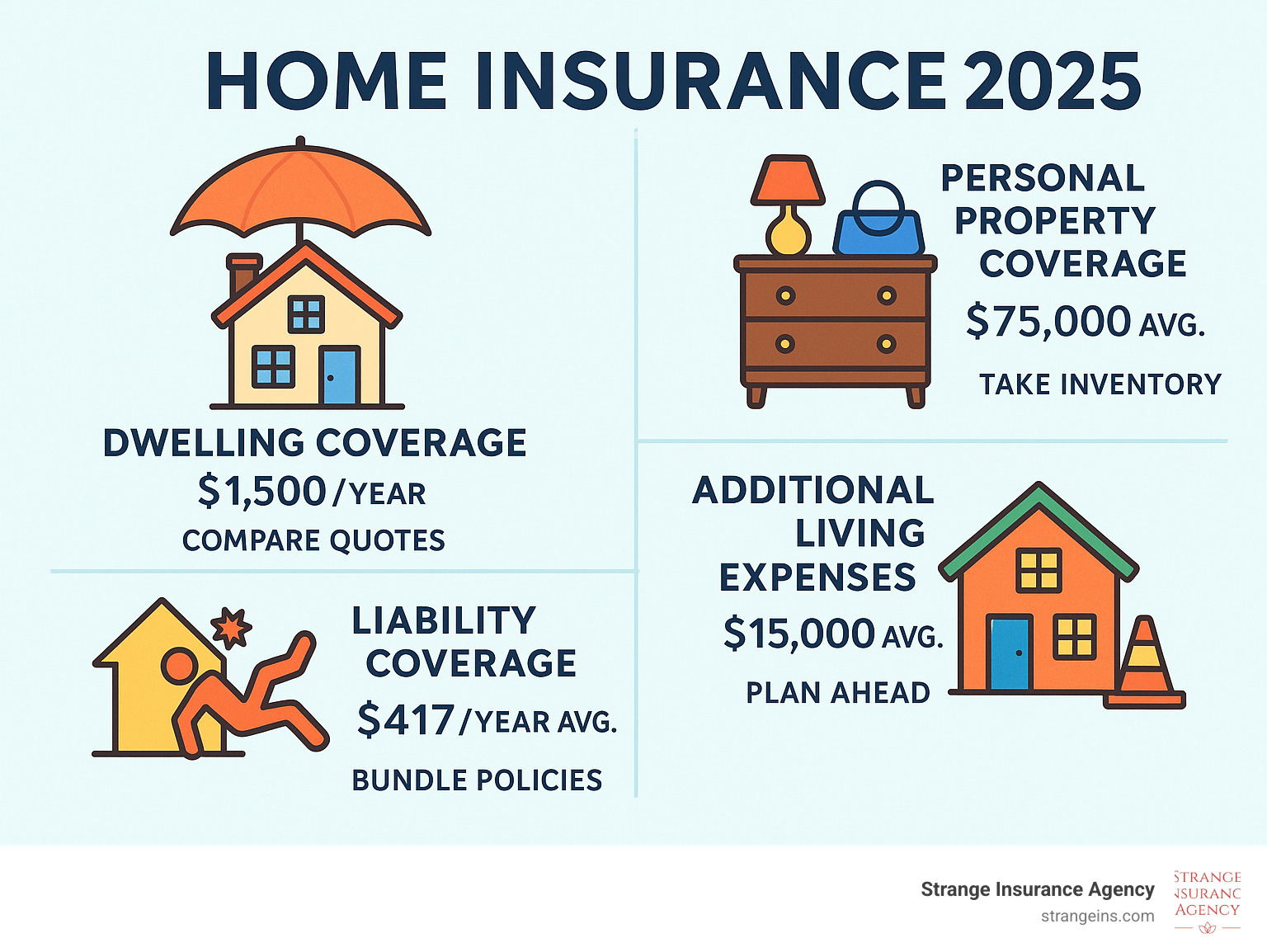
- Dwelling coverage: Protects the physical structure of your home (walls, roof, foundation) and attached structures like a garage. It covers repair or rebuilding costs from events like fire or windstorms.
- Personal property: Covers your belongings—furniture, electronics, clothing—if stolen or damaged by a covered event. High-value items like fine art may need a separate “rider” for full coverage. Contents coverage is often up to 70% of your dwelling coverage.
- Additional living expenses (ALE): Also called “loss of use,” this pays for temporary housing, food, and other living costs if your home is uninhabitable during repairs.
- Personal liability: Protects you financially if a guest is injured on your property or if you accidentally damage someone else’s property. It covers medical bills, legal fees, and court-ordered damages.
- Detached structures: Covers structures not attached to your home, like sheds or detached garages, typically as a percentage of your dwelling coverage.
Learn more about insurance coverage for unexpected events.
Common Perils Covered vs. Typical Exclusions
It’s vital to know what your policy covers and what it excludes.
Common Perils Typically Covered:
- Fire and lightning
- Theft
- Windstorms and hail
- Vandalism
- Falling objects
- Weight of ice, snow, or sleet
- Burst pipes or sudden water discharge
- Explosions
Typical Exclusions (What’s Usually Not Covered):
- Flooding: Requires a separate flood insurance policy.
- Earthquakes: Requires a separate endorsement or policy.
- Sewer backup: Often requires a specific endorsement.
- Wear and tear: Policies do not cover damage from lack of maintenance or aging.
- Acts of war or nuclear hazard: Universal exclusions.
- Pest infestations: Damage from termites or rodents is generally not covered.
- Neglect: Failure to protect your property from further damage after a loss may not be covered.
Review your policy documents to understand your specific coverage and exclusions. We can help you steer these details to ensure you have the right endorsements for your risks.
What is Money Market House Insurance? Debunking the Myth

If you’ve searched for “money market house insurance,” you’ve likely come up empty. That’s because it’s not a real insurance product. It’s a term people created by mixing two separate financial concepts: “money market” accounts (for saving and investing) and “house insurance” (for protecting your home). While both are vital to your financial plan, they are distinct tools that serve different purposes.
The Real Connection: Using Smart Money Habits for Your House Insurance
Even though “money market house insurance” isn’t a product you can buy, the idea of using smart money habits for your insurance is very real and highly recommended. A high-yield savings or money market account is the perfect tool to manage insurance costs effectively. You can use it to:
- Pay Annually: Save money by paying your premium in one lump sum, which helps you avoid monthly administrative fees.
- Fund a High Deductible: Choose a higher deductible to lower your yearly premium, and keep the deductible amount saved and ready in your account.
- Build an Emergency Fund: Cover small repairs that fall below your deductible or bridge financial gaps while you’re waiting for an insurance claim payout.
It all comes down to budgeting for insurance. Setting aside funds ensures your coverage remains active, protecting your home without any hiccups. Using a money market account is a brilliant way to manage your insurance costs.
Why You Won’t Find “Money Market House Insurance” Quotes
The reason you won’t get a quote for “money market house insurance” is that it doesn’t fit how insurance companies categorize and price their products. Insurance is about managing risk.
Insurers use specific terminology like “homeowners insurance” or “condo insurance” that clearly define the type of property and protection. “Money market” is a financial term for saving, not a type of risk.
Insurance policies fall into standard types based on what they cover (fire, theft) and the home they protect. There isn’t a category that mixes insurance with an investment account. An insurance policy is a contract to pay for a covered loss, not to grow your money like an investment. A money market account is designed to provide a return on your savings. They are different tools with different jobs.
When insurers price policies, they look at your home’s location, age, construction, and your claims history. They don’t factor in where you keep your savings. While being smart with your money helps you afford the best insurance, the two concepts remain separate.
Key Factors That Determine Your Home Insurance Premium

Your home insurance premium is calculated based on several risk factors. Understanding them can help you see why your rate is what it is and identify ways to lower it. Key factors include:
- Location: Considers local crime rates, proximity to a fire station or hydrant, and risk of natural disasters like hurricanes or severe storms.
- Replacement Cost: The cost to rebuild your home from the ground up, not its market value. The land itself is not insurable.
- Home Characteristics: The age and construction materials of your home. Newer homes and more resilient materials (like brick) often get better rates.
- Your History: Your personal claims history is a significant factor. In many places, your credit score can also influence your premium.
- Home Systems: The condition and type of your heating, electrical, and plumbing systems can affect risk. Outdated systems can increase the chance of fires or water damage.
How Your Home’s Features Impact Your Rate
Specific features of your house also play a huge role in shaping your insurance rate.
- Roof: The age and material are critical. An older roof (over 15-20 years) may mean higher premiums, while a new, impact-resistant roof could earn you a discount.
- Safety & Security: Monitored burglar alarms, fire alarms, and even smart smoke detectors can lower your premium by reducing risk.
- Swimming Pools: A pool adds to your liability risk and will likely increase your premium, though safety features like a fence can help.
- Pets: Certain dog breeds, due to perceived bite risks, might lead to higher liability costs.
- Renovations & Upgrades: Updating major systems like electrical or plumbing can lower rates. However, additions that increase your home’s size will also increase its replacement cost and premium.
The “80% Rule” and Ensuring Adequate Coverage
The “80% rule” is a key insurance principle: you should insure your home for at least 80% of its estimated replacement cost. If you insure for less, your provider might only pay a fraction of a repair claim, leaving you with an underinsurance penalty.
It’s crucial to insure for replacement cost (to rebuild) not market value (to sell). For example, if your home’s replacement cost is $400,000 and you only insure it for $280,000 (70%), the insurer might only pay 70% of a $50,000 claim, leaving you with a $15,000 bill.
To ensure adequate coverage for your belongings, create a detailed home inventory by listing your possessions and their value. For high-value items like jewelry or artwork, their value might exceed standard policy limits. In these cases, add a scheduled personal property endorsement or “rider” to insure them for their full appraised value. Regularly reviewing your policy is key to making sure you’re always protected.
Top Strategies for Lowering Your Home Insurance Costs

Home insurance is a significant expense, but there are many ways to lower your premiums without sacrificing protection. A great first step is to compare quotes every single year. Insurance rates change, so don’t just let your policy auto-renew. At Strange Insurance Agency, we simplify this by comparing options from over 30 companies for you.
Other key strategies include:
- Increase your deductible: A higher deductible lowers your premium.
- Bundle your policies: Combine home and auto insurance for significant savings.
- Install safety and security devices: Alarms and detectors can earn you discounts.
- Maintain good credit: A good score can lead to lower rates in many areas.
- Ask for discounts: Many are available but not always automatically applied.
- Review your policy annually: Ensure your coverage still fits your needs.
The Power of Bundling and Deductibles
Let’s look closer at two of the biggest money-saving strategies: bundling and deductibles.
Policy bundling is a win-win. When you buy your home and auto insurance from the same company, they often reward you with a discount on your total premium, typically between 10% to 17%. It also simplifies managing your insurance. We’ve helped many clients in Virginia and North Carolina save hundreds each year just by bundling.
Your deductible is the amount you pay before your insurance company steps in. The higher your deductible, the lower your yearly premium, because you’re taking on more of the initial financial risk. If you have an emergency fund (a perfect use for a high-yield savings account, your money market house insurance alternative!) to cover that higher amount, it’s an effective way to cut your annual costs.
Discounts You Might Be Missing
Beyond bundling and deductibles, many homeowners overlook other valuable discounts. We make it our mission to find every single one for you. Ask us about:
- Claims-free discount: For having no recent claims.
- Loyalty rewards: For staying with the same insurer over time.
- Mortgage-free discount: For owning your home outright.
- Non-smoker discount: For reduced fire risk.
- Group discounts: Through professional groups, alumni associations, or employers.
- New home credit: For newly constructed homes with modern systems.
- Senior or age-related discounts: For homeowners over a certain age.
At Strange Insurance Agency, we dig deep to find every possible discount. Our goal is to get you the best coverage at the most competitive price, thanks to our network of 30+ top companies.
Frequently Asked Questions about Home Insurance Costs
Here are answers to the most common home insurance questions we hear at Strange Insurance Agency, helping you make smarter decisions about your coverage.
How much home insurance coverage do I actually need?
This is the most important question. The key is insuring your home’s replacement cost—what it would cost to rebuild it—not its market value. You should not include the land’s value in your coverage amount.
- 80% Rule: You need to insure for at least 80% of your home’s replacement cost to avoid penalties when filing partial claims.
- Personal Property Valuation: Create a detailed home inventory of your belongings and their value. For most, contents coverage of 50-70% of your dwelling coverage is adequate.
- Liability Limits: We typically recommend starting at $300,000, but often suggest $500,000 or more for families with significant assets to protect.
- Special Endorsements: You may need additional coverage for a home business or a separate policy for flood damage. Valuable items like jewelry or art need scheduled property riders to be fully protected.
Will making a claim increase my future premiums?
The honest answer is: probably yes. Your claims history is a primary factor insurers use to predict future risk. Even a claim for something out of your control, like a hailstorm, can impact your rates.
This is where strategic thinking helps. If your repair costs are only slightly above your deductible, you might consider paying out of pocket to preserve your claims-free status. But for significant damage, that’s exactly what your insurance is for.
Some insurers offer claim forgiveness programs, which can protect your rates from increasing after your first claim. A higher deductible also naturally discourages small claims, which helps keep your premiums stable.
Is home insurance required by law?
While home insurance is generally not required by state law, it is practically mandatory for most homeowners.
- Mortgage Lender Stipulations: If you have a mortgage, your lender requires you to carry coverage to protect their investment in your property. If you let it lapse, they can force-place expensive coverage on you.
- Protecting Your Investment: Even if you own your home outright, going without insurance is a massive financial risk. Your home is likely your largest asset. Without insurance, you’d be personally responsible for rebuilding after a fire or covering legal costs from an accident.
Given the increasing severity of weather events, having solid home insurance isn’t optional for most families. The bottom line is that it’s a practical necessity that protects your financial future.
Get the Right Coverage at the Best Price
Navigating home insurance can be confusing, especially with terms like “money market house insurance.” At Strange Insurance Agency, our mission is to make it simple, helping you protect your home and family without overpaying.
Forget the myths; the right insurance is about finding the perfect fit for your life. We make comparing rates easy. We shop quotes from over 30 top-rated companies for you, presenting the best options for your needs, whether you’re in Florida, West Virginia, Norfolk, VA, or across North Carolina.
We offer personalized service, not just a quote. With over 15 years of experience, we take the time to understand your unique situation and find every available discount. We’ll walk you through the details of your policy—perils, exclusions, and deductibles—so you can make confident choices. We leverage our extensive network to uncover every possible discount, ensuring you get the best value.
Your home is more than a building; it’s where your life happens. Let us help you protect it wisely, with the care and expertise it deserves.
Get a quote for your commercial property
Ready to simplify your home insurance and find real savings? Contact us today for a free, no-obligation quote. We can’t wait to show you how we can help you insure smart and save big.