
Your Financial Safety Net in a Litigious World
Personal excess liability insurance acts as a crucial financial safety net when standard home and auto insurance limits fall short of covering major lawsuit settlements and claims.
Quick Answer for Personal Excess Liability:
- What it is: Extra liability protection beyond your home, auto, and watercraft policy limits
- Coverage amounts: Typically $1 million to $100 million in additional protection
- Cost: Around $400 annually for $1 million in coverage
- Who needs it: Homeowners, drivers, boat owners, pool owners, parents of teen drivers
- When it activates: After your underlying policy limits are exhausted
- What it covers: Bodily injury, property damage, libel, slander, and legal defense costs
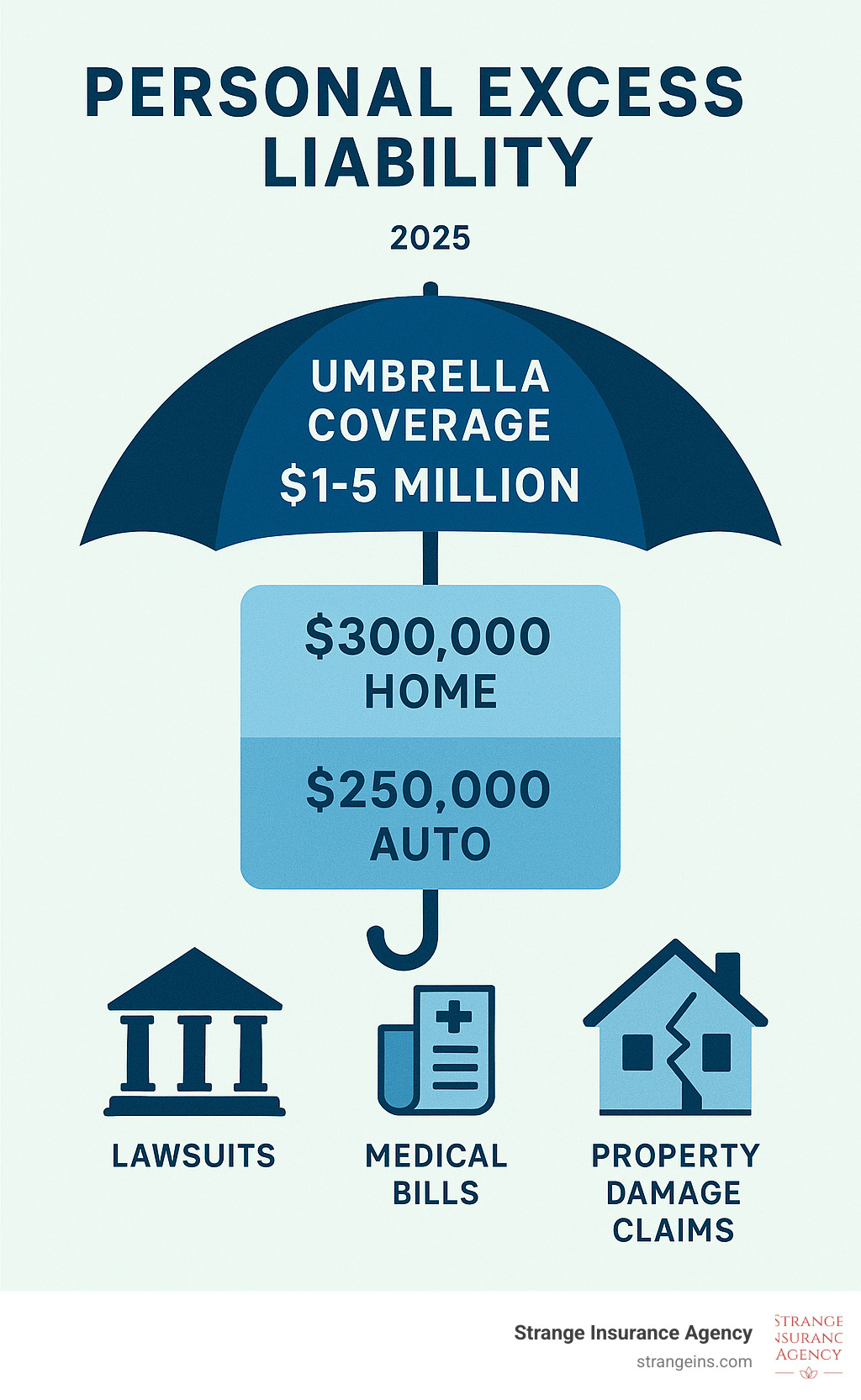
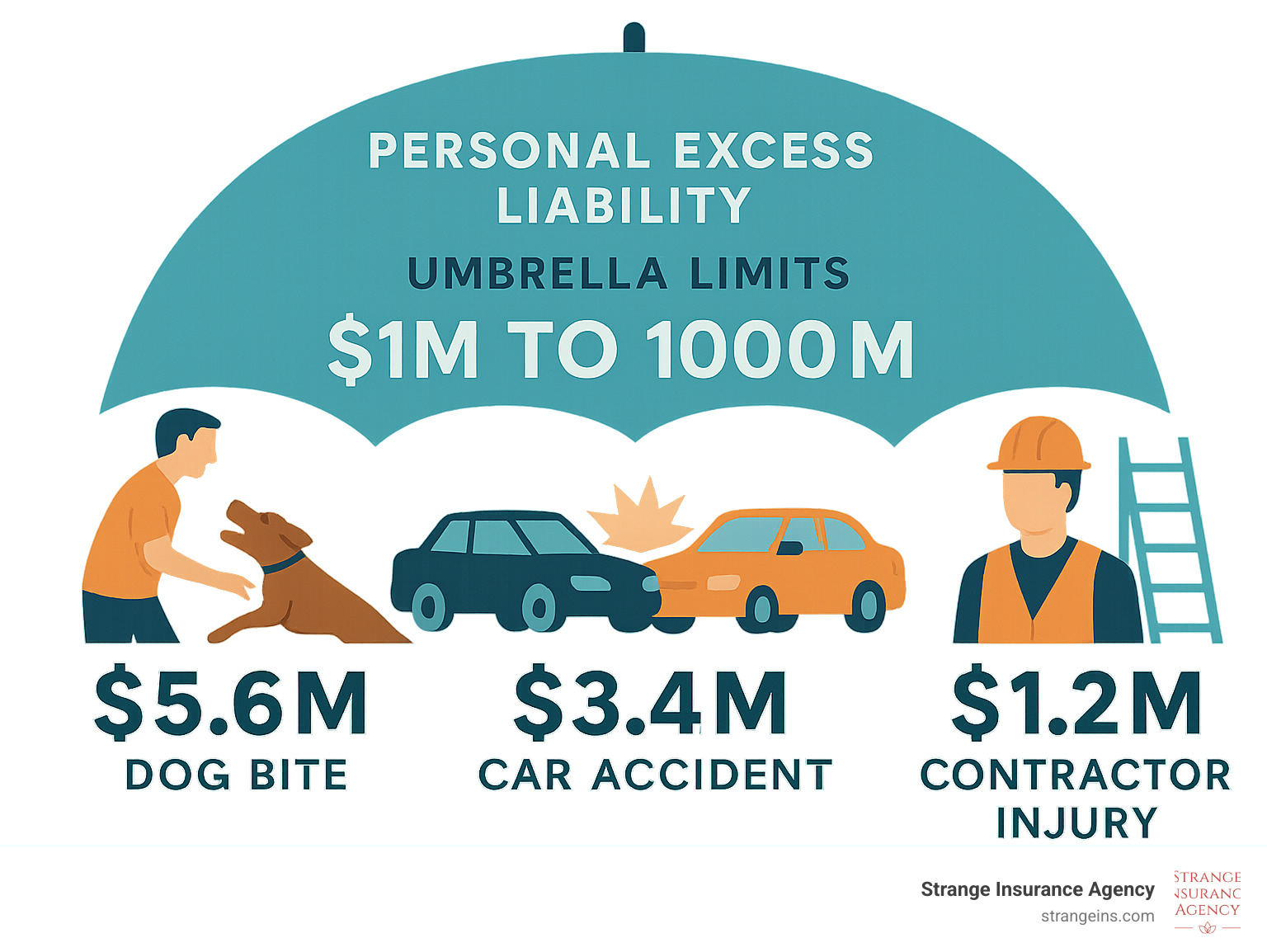
In today’s lawsuit-heavy environment, a single accident can result in judgments that far exceed typical insurance limits. Recent verdicts include a $5.6 million dog bite settlement, a $3.4 million car accident award, and a $1.2 million contractor injury claim. These real-world examples show how quickly standard homeowners liability ($300,000) or auto liability ($250,000) can be overwhelmed.
The financial reality is stark: If you’re found liable for damages exceeding your policy limits, you’re personally responsible for the difference. This could mean losing your home, savings, and future earnings to satisfy a judgment.
Personal excess liability insurance – also called umbrella insurance – provides an additional layer of protection that kicks in when your underlying policies reach their limits. It’s designed to protect the wealth you’ve worked hard to build from unexpected catastrophic claims.
I’m Christian Strange, and with over 15 years of experience in insurance and risk management, I’ve helped countless clients understand why personal excess liability coverage is essential for protecting their financial future. At Strange Insurance Agency, I’ve seen how this coverage can be the difference between a manageable claim and financial devastation.
Personal excess liability helpful reading:
What Is Personal Excess Liability (Umbrella) Insurance?
Personal excess liability insurance is your financial shield when life throws you a curveball that costs more than your regular insurance can handle. Think of it as the safety net beneath your safety net – it’s there to catch you when your homeowners, auto, and watercraft policies reach their limits.
Here’s the reality: your standard insurance policies have caps on what they’ll pay out. If someone gets seriously hurt on your property or you cause a major car accident, the bills can quickly climb beyond those limits. That’s where What Is Umbrella Liability Insurance? becomes your financial lifeline.
Let’s say you have $300,000 in homeowners liability coverage, but a guest slips on your deck and suffers injuries that result in a $1.5 million judgment. Your homeowners policy covers the first $300,000, but without umbrella coverage, you’d be on the hook for the remaining $1.2 million. With a $2 million personal excess liability policy, you’re completely protected.
But this coverage does more than just add zeros to your protection. It provides worldwide coverage, pays for legal defense costs without eating into your available limits, and often covers situations that your underlying policies might not touch.
The Key Difference: ‘Excess’ vs. ‘Umbrella’ Coverage
You’ll hear these terms used interchangeably, but there’s actually an important difference that affects both your coverage and your wallet.
Excess liability is like adding more fuel to your existing tank. It simply extends the dollar limits of your underlying policy without changing what’s covered. If your homeowners policy covers slip-and-fall accidents up to $300,000, excess coverage bumps that limit to $1.3 million (with a $1 million excess policy) – same coverage, just more money available.
Umbrella insurance is where things get interesting. It’s a form of excess liability that not only increases your limits but also broadens what’s covered. This means protection for risks like libel, slander, defamation of character, and invasion of privacy – things your standard policies might not touch.
Most umbrella policies include what’s called a self-insured retention (SIR) – essentially a deductible you pay before the umbrella coverage kicks in for claims not covered by your underlying policies.
Understanding excess and umbrella insurance differences helps you make the right choice for your situation. Most personal policies are actually umbrella policies because they provide that broader coverage beyond simple excess liability.
| Feature | Excess Liability | Umbrella Insurance |
|---|---|---|
| Coverage Scope | Follows underlying policy terms exactly | Broader coverage including additional risks |
| Cost | Generally less expensive | Slightly higher due to broader protection |
| Function | Increases limits only | Increases limits AND fills coverage gaps |
| Self-Insured Retention | Usually none | May include SIR for non-underlying claims |
How It Works with Your Existing Home and Auto Policies
Your personal excess liability policy doesn’t work alone – it’s designed to work seamlessly with your existing coverage as a coordinated layer of protection. To qualify for umbrella insurance, you’ll need to maintain minimum liability limits on your underlying policies – typically $250,000 for auto liability and $300,000 for homeowners liability.
When you have Homeowners Insurance and Auto Insurance with adequate liability limits, you’re building the foundation that makes umbrella coverage possible. The umbrella policy then sits on top of these policies, ready to spring into action when their limits are exhausted.
This layered approach ensures there are no gaps in your protection. Your primary policies handle the vast majority of everyday claims efficiently, while the umbrella policy provides peace of mind for those catastrophic events that could otherwise derail your financial future.
The underlying coverage requirements aren’t just red tape – they’re actually designed to work in your favor. They ensure that small to medium-sized claims are handled quickly by your primary insurers, while the umbrella carrier focuses on truly significant exposures that could threaten your asset protection.
Why This Coverage Is More Important Than Ever
We’re living in an increasingly litigious world where a single accident can financially devastate even the most careful person. Personal excess liability coverage has shifted from a “nice-to-have” luxury to essential protection for anyone with assets to lose or future earnings to protect.
The numbers tell a concerning story. Legal settlements and jury awards have grown far beyond normal inflation rates – what experts call “social inflation.” Juries today are more willing to award substantial damages, especially when they perceive defendants as having the financial means to pay. Meanwhile, attorney fees and court costs have skyrocketed, often consuming hundreds of thousands of dollars before any settlement is even reached.
What makes this even more challenging is that liability theories have expanded dramatically. You can now be held responsible for situations that weren’t traditionally considered your fault. This includes being liable for your teenage children’s actions, injuries to contractors working on your property, and even defamation claims related to social media posts.
The question Are Umbrella Policies Worth It? becomes easier to answer when you consider that a $1 million umbrella policy typically costs around $400 annually – less than what you’d pay for a single consultation with a defense attorney in a major lawsuit.

Real-World Scenarios and Multi-Million Dollar Verdicts
Let me share some real cases that show just how quickly standard insurance limits can be overwhelmed. These aren’t hypothetical scenarios – they’re actual verdicts that changed people’s lives forever.
A woman delivering misdirected mail was attacked by a neighbor’s dog, resulting in A $5.6 million dog bite verdict. The victim suffered permanent scarring and required multiple reconstructive surgeries. If the dog owner had typical homeowners liability limits of $300,000, they would have been personally responsible for over $5 million.
In another case, a 19-year-old driver was rear-ended in traffic, suffering back injuries that required ongoing treatment. The resulting settlement reached $3.4 million due to the young victim’s reduced earning capacity over their lifetime. Standard auto liability limits of $250,000 would have left the at-fault driver exposed to over $3 million in personal liability.
Property owners aren’t immune either. A $1.2 million contractor injury award resulted when a glass installer fell from a ladder at a private residence. The homeowner was found liable for maintaining unsafe working conditions, and typical homeowners coverage limits would have been completely inadequate.
These cases share a common thread: they involve everyday people in ordinary situations that spiraled into financial catastrophe. The scary truth is that any of us could face similar circumstances tomorrow.
Who Needs Personal Excess Liability Insurance?
The honest answer is that if you have anything to lose – whether that’s current assets or future earnings – you need personal excess liability coverage. But certain situations create higher exposure that makes this protection absolutely critical.
Homeowners face constant premises liability exposure. Every time someone steps onto your property, you could be liable for their injuries. This includes slip-and-fall accidents on icy walkways, swimming pool incidents involving guests, dog bites to delivery personnel, and injuries to contractors or service providers working on your home.
Drivers are particularly vulnerable to catastrophic liability claims. Car accidents involving multiple vehicles or serious injuries can quickly generate million-dollar settlements. The risk multiplies dramatically if you’re a parent of teen drivers – not only are inexperienced drivers more likely to cause accidents, but parents can be held liable for their children’s actions.
Boat owners face unique exposures on the water, where rescue costs and medical treatment can be extremely expensive. Water-related accidents often result in serious injuries, and emergency response in marine environments adds significant costs to any claim.
High-net-worth individuals become natural targets for lawsuits simply because they’re perceived as having deep pockets. Their visible wealth makes them attractive defendants, and juries may be more inclined to award substantial damages against someone they perceive as wealthy.
People who serve on non-profit boards can face personal liability for organizational decisions and actions, even when serving as volunteers. Pet owners, especially those with larger dogs or certain breeds, face potential liability for bite incidents that can result in substantial medical bills and pain-and-suffering awards.
Pool owners have heightened liability exposure due to the inherent risks of swimming pools. Drowning incidents and diving accidents can result in catastrophic injuries and life-changing liability claims.
The key insight here is that liability exposure isn’t just about how much money you have today – it’s about your lifestyle, activities, and the potential for accidents that could impact your financial future for decades to come.
Understanding Your Policy: What’s Covered and What’s Not
When you’re considering personal excess liability insurance, understand exactly what protection you’re getting for your investment. Think of your umbrella policy as a comprehensive safety net with some specific holes – knowing where those holes are helps you make smarter decisions about your coverage.
The good news is that umbrella policies are designed to be remarkably broad in their protection. The not-so-good news is that there are still some important exclusions you need to know about. For a deeper dive into coverage details, check out Umbrella Policy: What Does It Cover?.
Comprehensive Protection for Unexpected Events
Your personal excess liability policy acts like a financial superhero, swooping in to protect you across a wide range of scenarios that could otherwise devastate your finances.
Bodily injury coverage is probably what most people think of first – and for good reason. This protection kicks in when someone gets hurt because of your negligence, whether that’s a guest slipping on your icy driveway or a multi-car accident you caused. We’re talking about covering medical bills, lost wages, pain and suffering awards, and even long-term care costs that can stretch for years.
Property damage coverage handles the expensive stuff you might accidentally destroy. Picture this: your teenager backs into your neighbor’s brand-new Tesla, or a tree from your yard crashes through their roof during a storm. Your umbrella policy steps in when the damage exceeds your underlying policy limits.
Here’s where umbrella policies really shine compared to basic excess coverage: personal injury protection for non-physical harm. In our social media world, this coverage is more valuable than ever. It protects you against claims of libel, slander, defamation of character, invasion of privacy, wrongful eviction, and false arrest. Yes, that heated Facebook comment could potentially trigger a lawsuit – but your umbrella policy has your back.
One of the most valuable features is that legal defense costs are covered in addition to your policy limits. This means if you have a $2 million umbrella policy and face $200,000 in attorney fees, you still have the full $2 million available to pay any judgment. Since legal costs can easily hit six figures even in cases where you’re not found liable, this feature alone can justify the premium.
Your protection follows you around the globe with worldwide coverage. Whether you’re vacationing in Europe or on a business trip to Asia, your umbrella policy provides liability protection wherever life takes you.
Many policies also offer uninsured/underinsured motorist protection as an add-on, giving you extra protection when you’re injured by drivers who don’t have adequate insurance coverage.
Common Exclusions to Be Aware Of
While umbrella coverage is impressively broad, it’s not a magic wand that covers absolutely everything. Understanding these exclusions helps set realistic expectations and identifies where you might need additional protection.
Intentional acts are completely off the table. If you deliberately hurt someone or damage their property, your umbrella policy won’t help you. This includes criminal acts and any situation where you meant to cause harm. Insurance is designed to protect against accidents, not intentional wrongdoing.
Your umbrella policy won’t pay to replace damage to your own property. Liability insurance protects you from claims by other people – it’s not designed to fix your own stuff. If you want protection for your belongings, that’s what homeowners and auto insurance are for.
Business-related liabilities typically aren’t covered under personal umbrella policies. If you run a consulting business from your home office or have professional liability exposure, you’ll need separate commercial coverage. The line between personal and business activities can be blurry, so it’s worth discussing your specific situation with your agent.
Workers’ compensation claims are excluded because they’re handled by separate workers’ compensation insurance. However, there can be some gray areas with domestic employees like housekeepers or nannies, so this is another area where professional guidance is valuable.
Liability from written or oral contracts may be excluded, depending on your specific policy language and the circumstances. This is one reason why it’s important to review contracts carefully and understand what obligations you’re taking on.
The key takeaway is that while personal excess liability coverage is remarkably comprehensive, it’s not a substitute for other types of insurance or for exercising good judgment. Think of it as an essential piece of your overall financial protection strategy, not a cure-all for every possible risk.
How to Secure the Right Personal Excess Liability Coverage
Getting the right personal excess liability coverage doesn’t have to be complicated, but it does require thoughtful planning. Think of it like building a custom safety net – you need to know exactly what you’re protecting and how much coverage makes sense for your unique situation.
At Strange Insurance Agency, we’ve helped hundreds of families steer this process over the past 15 years. Working with over 30 insurance companies gives us the flexibility to find coverage that fits both your needs and budget. The best part? We handle all the comparison shopping for you. Start your protection journey with a Personal Liability Umbrella Policy Quote.
The key to getting this right is understanding three crucial elements: how much coverage you actually need, what your current policies require, and whether a group program might offer better value than individual coverage.
How Much Personal Excess Liability Coverage Do I Need?
Here’s where many people get stuck – and honestly, it’s the question I’m asked most often. The answer isn’t just about your current bank account. It’s about protecting everything you’ve worked for, plus what you’ll earn in the future.

Your net worth is the starting point. Add up your home equity, investment accounts, retirement savings, and other valuable possessions. This represents what you could lose in a lawsuit. But here’s what many people miss – your future earning potential matters just as much, especially if you’re in a high-income profession.
I once worked with a young doctor who thought $1 million in coverage was plenty because his current assets were modest. But when we calculated his lifetime earning potential, we realized he needed much more protection. A successful lawsuit could garnish future wages for decades.
Risk factors in your lifestyle also influence how much coverage makes sense. Pool owners face higher liability exposure from drowning incidents. Parents of teen drivers know the statistics aren’t in their favor. Boat owners deal with unique water-related risks where rescue costs alone can be staggering.
The good news is that personal excess liability coverage is surprisingly affordable. The Cost of Umbrella Policy shows that $1 million typically costs around $400 annually. Additional coverage often costs even less per million – sometimes just $75-100 for each additional million in protection.
Most families find $1-5 million adequate, but high-net-worth individuals may need significantly higher limits. Coverage ranges from $1 million to $100 million, so there’s flexibility to match your specific situation.
For detailed guidance on choosing the right amount, check out How Much Umbrella Insurance Do I Need? – it walks through the calculation process step by step.
Meeting the Underlying Policy Requirements
Before you can get personal excess liability coverage, your current home and auto policies need to meet certain minimum requirements. Think of these as the foundation that your umbrella policy builds upon.
Auto liability minimums typically require $250,000 per person and $500,000 per accident for bodily injury, plus $100,000 for property damage. Some insurers accept $300,000 combined single limit coverage instead. These aren’t arbitrary numbers – they ensure your primary insurance handles most claims while keeping your umbrella policy focused on truly catastrophic events.
Homeowners liability usually requires $300,000 minimum coverage, though some insurers accept $250,000. Given how affordable it is to increase homeowners liability limits, I often recommend carrying the highest available limits anyway. It typically costs less than $100 annually to jump from $300,000 to $500,000 in coverage.
Watercraft liability comes into play if you own a boat. You’ll need adequate coverage – typically $300,000 or more – depending on your vessel’s size and type. Larger boats or faster watercraft may require higher limits.
The beauty of these requirements is that they create seamless coverage coordination. Your primary policies handle everyday claims efficiently, while your umbrella policy provides peace of mind for those worst-case scenarios that keep you awake at night.
The Benefits of a Group Personal Excess Liability Program
Here’s something many people don’t know about – group personal excess liability programs can offer significant advantages over individual policies. These programs leverage collective buying power to deliver better coverage at lower costs.
Employer-sponsored plans are becoming increasingly popular as employee benefits. Many employers now offer $1 million in coverage at no cost to employees, with options to purchase additional coverage at group rates. If your employer offers this benefit, it’s usually worth investigating.
Association programs through professional organizations and membership groups can provide substantial savings. These programs often offer coverage to members who might face challenges obtaining individual policies, and the group buying power typically results in better rates.
The savings can be impressive – group pricing often delivers significant cost reductions compared to individual policies. Members purchasing higher limits can save substantial amounts annually, and the simplified underwriting process means less paperwork and faster approval.
Higher coverage limits are often available through group programs, sometimes reaching $25 million or more. The streamlined underwriting process typically doesn’t require individual risk assessment, making coverage accessible to members who might otherwise be declined.
These programs can be particularly valuable for professionals, association members, and employees whose companies offer this benefit. Even if you already have individual coverage, it’s worth comparing group options during your annual insurance review.
The key is working with an experienced agent who understands both individual and group options. We regularly help clients evaluate whether group programs make sense for their specific situation, ensuring they get the best combination of coverage and value.
Secure Your Financial Future Today
The reality is simple: personal excess liability insurance is one of the smartest investments you can make to protect everything you’ve worked for. Where lawsuits can strike anyone at any time, having this coverage isn’t just smart – it’s essential.
Think about it this way: you lock your doors at night, wear your seatbelt, and probably have smoke detectors in your home. Personal excess liability coverage is the same type of sensible protection, but for your financial well-being.
We’ve seen the numbers throughout this guide – $5.6 million dog bite verdicts, $3.4 million car accident settlements, and $1.2 million contractor injury awards. These aren’t rare, once-in-a-lifetime events anymore. They’re becoming the new normal in our legal system.
Here’s what makes this coverage so valuable: for roughly $400 a year, you can secure $1 million in additional protection. That’s about a dollar a day to protect your home, your savings, and your family’s future. When you consider that a single legal consultation for a major lawsuit can cost more than your entire annual premium, the value becomes crystal clear.
At Strange Insurance Agency, we’ve helped countless families across Virginia and North Carolina understand why this protection matters. Our access to over 30 insurance companies means we can find the right coverage at the best price for your specific situation. Whether you’re worried about premises liability from guests at your Norfolk home, concerned about auto liability while driving through Charlotte, or need watercraft coverage for your boat on the Chesapeake Bay, we’ve got you covered.
The peace of mind that comes with proper personal excess liability coverage is something you can’t put a price on. You’ll sleep better knowing that if the unexpected happens, you won’t lose your home, your retirement savings, or your children’s college fund to pay a lawsuit.
But here’s the critical point: you can’t wait until after an accident to buy this coverage. Personal excess liability insurance must be in place before you need it. Once that claim happens, it’s too late.
Contact us for a personal insurance review today. We’ll take the time to understand your unique situation, explain your options in plain English, and help you secure the protection your family deserves. There’s no pressure, no complicated jargon – just honest advice from people who genuinely care about protecting what matters most to you.

The goal isn’t to live in fear of what might happen. It’s to live with confidence, knowing you’re prepared for whatever life throws your way. With the right personal excess liability coverage in place, you can focus on enjoying your life, your family, and your success – secure in the knowledge that your financial future is protected.