
Why Personal Umbrella Policy Coverage Matters More Than Ever
In today’s increasingly litigious world, a single unexpected event can have catastrophic financial consequences. Personal umbrella policy coverage provides a critical extra layer of liability protection that activates precisely when your standard home, auto, or other insurance policies reach their limits. Think of it as a financial backstop for worst-case scenarios. This additional coverage, typically starting at $1 million and going up to $10 million or more, is designed to shield you from devastating financial losses due to major lawsuits, severe accidents, or claims that far exceed your primary insurance limits. Without it, your savings, investments, and even future income could be at risk.
Key Coverage Areas Explained:
- Bodily injury liability: This covers costs if you’re responsible for someone else’s injuries, going far beyond what your auto or home policy can handle. This is crucial in cases of severe accidents resulting in long-term medical care or disability.
- Property damage liability: If you cause significant damage to someone else’s property—for instance, a multi-car pile-up or a fire that spreads to a neighbor’s house—this coverage handles the costs that exceed your primary policy’s cap.
- Personal injury claims: This is a unique feature not always found in standard policies. It protects you against claims of libel (written defamation), slander (spoken defamation), false arrest, or invasion of privacy, which are increasingly common in the age of social media.
- Legal defense costs: An umbrella policy often covers legal fees, court costs, and settlements, even for frivolous lawsuits. Crucially, these costs are typically paid in addition to your liability limit, preserving your full coverage amount for the actual judgment.
- Worldwide coverage: Whether you’re renting a car on vacation in Europe or involved in an incident abroad, your umbrella policy often provides liability protection anywhere in the world.
- Gap coverage: It can fill in for certain claims that your primary policies might not cover at all, subject to a Self-Insured Retention (SIR), which is like a deductible.
One insurance professional puts it perfectly: “One lawsuit can change everything.” This isn’t an exaggeration. With a staggering 70% of umbrella claims being auto-related, often stemming from a moment of distracted driving, the risks are tangible and growing. A single serious accident can easily generate medical bills, rehabilitation costs, and legal judgments that soar past the typical auto insurance limits of $300,000 to $500,000, leaving you personally liable for the difference.
Your standard homeowners and auto policies provide essential, foundational liability protection, but they were never designed to handle million-dollar lawsuits. They leave significant gaps that can expose your entire financial life. An umbrella policy acts as the ultimate financial safety net, protecting not just your current assets like your home and savings, but also safeguarding your future earnings from being garnished for years to pay off a large judgment.
As Christian Strange, with over 15 years of dedicated experience in insurance and risk management, I’ve witnessed how personal umbrella policy coverage can be the deciding factor between a family recovering from a lawsuit and losing everything they’ve worked so hard to build. My expertise in financial risk mitigation allows me to help clients in Virginia, North Carolina, and beyond understand exactly what protection they need and why this affordable coverage is often the best value in the entire insurance landscape.
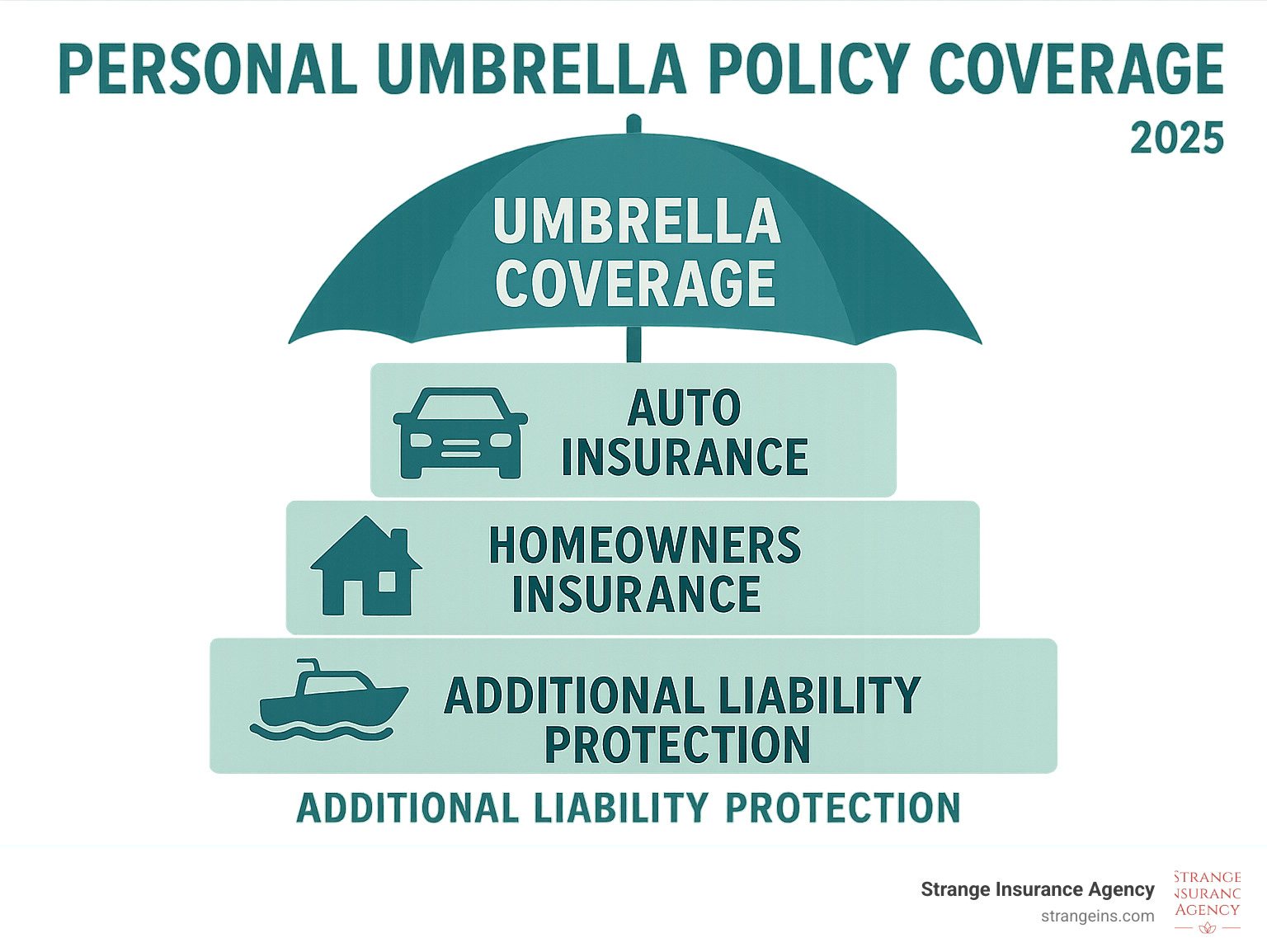
Essential Personal umbrella policy coverage terms:
What is a Personal Umbrella Policy and How Does It Work?
Think of personal umbrella policy coverage as your financial safety net – a protective shield that springs into action when life throws you an unexpected, and expensive, curveball. While your regular auto and homeowners insurance policies provide a solid baseline of protection, their liability limits can be exhausted with surprising speed in the event of a serious accident or a major lawsuit. This is where an umbrella policy steps in to protect your financial future.
An umbrella policy is fundamentally different from your standard insurance. Instead of being tied to a specific asset like your car or home, it provides a broad blanket of liability coverage that sits above all your other policies. It’s like having a dedicated financial bodyguard that intervenes when the costs become truly overwhelming. This structure allows it to cover liabilities from various sources under a single, high-limit policy.
Most insurers require you to maintain certain minimum liability limits on your underlying policies before they will issue an umbrella. For example, you might need $250,000 or $300,000 in bodily injury liability on your auto policy and at least $300,000 in personal liability coverage on your homeowners policy. These underlying limits create a solid foundation, ensuring your primary policies handle everyday risks while your personal umbrella policy coverage is reserved for catastrophic events.
A key concept to understand is the Self-Insured Retention (SIR). The SIR acts like a deductible, but it only applies to claims that are covered by your umbrella policy but not by any of your underlying policies. For example, if you are sued for slander, which your homeowners policy doesn’t cover, you would pay the SIR amount (typically $250 to $1,000), and the umbrella policy would cover the rest. However, for a covered claim that simply exceeds your primary policy’s limits, like a major car accident, there is typically no SIR; the umbrella coverage kicks in seamlessly once the primary limit is paid.
For deeper insights into how umbrella policies work, explore our specific Personal Umbrella Policy offerings.
The Concept of ‘Excess Liability’
The most straightforward way personal umbrella policy coverage protects you is through “excess liability” – it simply picks up the bill where your primary insurance leaves off. Picture this common scenario: you’re involved in a serious car accident, and the court finds you liable for $1 million in damages, which includes the other party’s medical bills, lost wages, and pain and suffering. If your auto insurance has a liability limit of $300,000, it will pay that amount, but you’re still personally on the hook for the remaining $700,000.
Without an umbrella policy, that staggering gap could force you to liquidate your retirement savings, sell your home, or face wage garnishment for years to come. With a $1 million umbrella policy, that $700,000 shortfall is covered, protecting not only your current assets but also your future earnings from being seized.
This powerful excess protection works across multiple types of primary insurance.
- Auto Coverage: It handles severe accidents where you’re at fault, especially those involving multiple vehicles, serious injuries, or fatalities.
- Homeowners Coverage: It covers major liability incidents on your property. Imagine a guest slips on an icy walkway and sustains a permanent injury, or your dog bites a neighbor, leading to extensive medical bills and a lawsuit. It can even cover damage your child accidentally causes away from home, like breaking a priceless antique at a friend’s house.
- Watercraft Coverage: If you own a boat or jet ski, your umbrella provides crucial additional liability coverage for accidents on the water, which can be just as financially devastating as those on the road.
It’s this versatile ability to step in across all these different scenarios that makes umbrella coverage such an indispensable part of a comprehensive risk management strategy. Learn more about how this works on our Excess Liability Coverage page.
How a Claim is Paid
Understanding how claims flow through your personal umbrella policy coverage is crucial, and thankfully, the process is designed to be more straightforward than you might expect, providing seamless protection when you need it most.
Here’s a step-by-step look at how it unfolds: Let’s say you are found liable for $1.5 million in damages from a multi-car accident. Your auto insurance policy, which has a $500,000 liability limit, pays out its maximum first. Once that primary coverage is officially exhausted, your umbrella policy automatically activates to cover the remaining $1 million, up to its own policy limit. The transition is handled between the insurance carriers, minimizing the stress and administrative burden on you during an already difficult time.
Legal defense costs are where umbrella policies truly shine. Defending against a major lawsuit, even a frivolous one, can cost tens of thousands or even hundreds of thousands of dollars in legal fees. Your umbrella policy typically covers these expenses from the start. What’s even better is that these defense costs are usually paid in addition to your policy’s liability limits. This means if you have a $1 million policy and incur $150,000 in legal fees, you still have the full $1 million available to pay a settlement or judgment.

This seamless financial transition ensures your personal assets remain protected from potentially devastating judgments. The expert coordination between your insurance adjusters makes the process as smooth as possible, allowing you to focus on moving forward. This comprehensive protection is exactly why we believe Umbrella Policies are Worth It.
Comparing Standard Liability vs. Umbrella Policy Coverage
To truly grasp the value of an umbrella policy, it helps to see a direct comparison with the standard liability coverage included in your home and auto policies. The table below highlights the key differences in scope, limits, and overall protection. While your primary policies are the foundation, the umbrella policy provides the high-level security needed for significant financial risks.
| Feature | Standard Home/Auto Liability | Personal Umbrella Liability |
|---|---|---|
| Coverage Scope | Bodily injury & property damage from covered incidents. | Broader coverage, including personal injury (libel, slander) & claims not covered by primary policies. |
| Coverage Limits | Typically $100k – $500k. | Typically $1M – $10M+. |
| Legal Defense | Covered up to policy limits. | Often covers defense costs even if the primary policy limit is exhausted. |
| Worldwide Coverage | Usually limited to US & Canada. | Often provides worldwide coverage. |
As you can see, a personal umbrella policy doesn’t just offer higher limits; it provides a fundamentally broader and more robust form of protection. It covers a wider range of incidents, including personal injury claims that are a growing risk in our digital society, and ensures your legal defense doesn’t eat into the funds needed to cover a judgment.