
Understanding Your Financial Safety Net
What is umbrella coverage? It’s an extra layer of liability insurance that kicks in when your standard insurance limits (like auto or homeowners) are exhausted. It also covers certain claims those policies might not.
Here’s what it generally does:
- Provides extra liability protection beyond your car, home, or boat insurance.
- Covers significant costs like medical bills, property damage, and legal fees if you’re sued.
- Can even cover claims like libel, slander, or false arrest.
- Safeguards your savings, investments, and future earnings from large financial demands.
You’ve built your financial life carefully, but an unexpected accident or lawsuit can put it all at risk. This guide will help you understand how to protect what matters most.
With over 15 years in insurance and financial risk management, Christian Strange is an expert in helping clients find comprehensive solutions like what is umbrella coverage to protect their assets and ensure financial security.
Essential what is umbrella coverage terms:
What is Umbrella Coverage and How Does It Work?
Imagine your standard auto or homeowners insurance is a sturdy raincoat. Sometimes, you need more protection from a major storm, like a liability lawsuit. That’s where what is umbrella coverage comes in, acting as an extra-large, protective umbrella to shield your financial future.
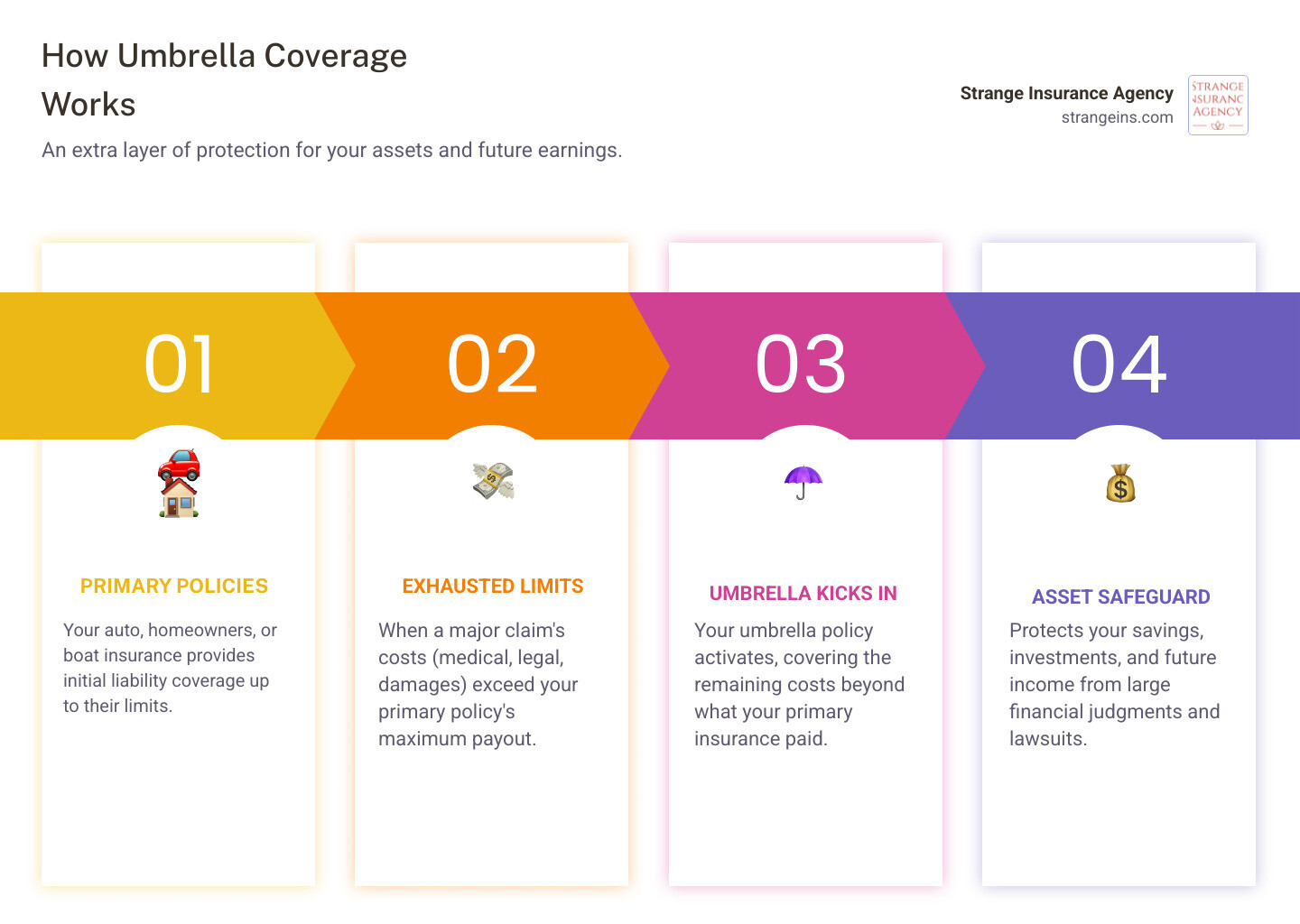
At its core, what is umbrella coverage is an additional layer of liability insurance. It’s designed to protect your assets and future earnings from devastating financial demands that arise from unforeseen accidents or lawsuits. While your basic policies provide a good foundation, they have limits. When a claim exceeds those limits, an umbrella policy steps in to cover the difference.
For instance, if your car insurance covers up to $300,000 for bodily injury, and a severe accident results in $1 million in damages, your umbrella policy would cover the remaining $700,000, preventing you from having to pay out of pocket.
An umbrella policy can also “drop down” and act as primary coverage for claims not typically included in your basic policies, such as slander, libel, or false arrest. For commercial umbrella policies, there’s often a “Self-Insured Retention” (SIR), similar to a deductible, which is an amount you pay out-of-pocket before the commercial umbrella policy covers a loss not handled by your primary policies.
Considering the value it offers, the cost of this vital protection is often surprisingly affordable, a small price to pay for significant peace of mind.
For more details on this essential protection, check out our page on What Is Umbrella Liability Insurance and learn more from A guide to Personal Umbrella and Excess Liability Insurance.
How an Umbrella Policy Responds to a Claim
Let’s walk through a real-world scenario. Imagine you’re at fault in a major car accident in North Carolina. The other driver sustains severe injuries, leading to medical bills, lost wages, and property damage totaling $1 million.
Your auto insurance has a liability limit of $300,000, leaving a $700,000 shortfall. This is where your umbrella policy leaps into action. Once your auto policy pays its maximum, your umbrella policy activates to cover the remaining $700,000. Without it, you’d be personally responsible for that huge sum, potentially wiping out your savings and future earnings.
This isn’t uncommon. A high percentage of personal umbrella claims are related to auto accidents, with many stemming from distracted driving. It’s a stark reminder that small distractions can lead to monumental financial liabilities. The peace of mind from this extra layer of protection is invaluable.
To dive deeper into how this works for your vehicle, visit our page on Umbrella Auto Policy.

Understanding the Difference: Umbrella vs. Excess Liability
While both provide additional coverage, there’s a critical distinction between umbrella and excess liability insurance.
Excess Liability Insurance simply extends the limits of one specific underlying policy. It’s a “follow-form” policy, meaning it follows the exact terms and exclusions of the underlying policy. It doesn’t broaden coverage or fill gaps.
Umbrella Insurance provides higher limits over multiple underlying policies (auto, home, etc.) and also offers broader coverage. It can “drop down” to cover claims your underlying policies might not, such as libel or slander. It can cover risks not included in primary policies, acting as primary insurance for those specific losses (subject to a self-insured retention).
Here’s a quick comparison:
| Feature | Umbrella Insurance | Excess Liability Insurance |
|---|---|---|
| Scope of Coverage | Broader; can cover claims not in underlying policies | Extends limits of one specific underlying policy |
| Follow-Form | Generally not; can have its own terms and conditions | Yes; follows the exact terms of the underlying policy |
| Coverage Gaps | Can fill gaps in underlying coverage | Does not fill gaps; only adds capacity |
| New Risks | Can cover certain new risks (e.g., libel, slander) | Does not introduce new types of coverage |
| Underlying Policies | Applies over multiple underlying policies (auto, home) | Applies over a single underlying policy |
While both provide higher limits, an umbrella policy’s ability to broaden coverage makes it a more comprehensive solution.
To explore how these higher limits can benefit you, check out our Excess Liability Coverage page.
What an Umbrella Policy Covers (and What It Doesn’t)
An umbrella policy is expansive, but it’s not a cure-all. Like any insurance, it has boundaries. It’s crucial to understand what this powerful policy protects and where its limits lie.

What is typically included in what is umbrella coverage?
An umbrella policy is your financial shield when you’re found legally liable for harming others or their property. It steps in when your primary insurance limits are reached or when a claim isn’t covered by them.
- Bodily injury liability: This covers medical bills, rehabilitation, and other costs for people injured due to your negligence, such as in a car accident, a guest injury on your property, or even a dog bite. (Note: some insurers have dog breed restrictions).
- Property damage liability: This protects you when you accidentally damage someone else’s property, like their car or home, and the costs exceed your primary policy limits.
- Guest injuries on your property: If a guest is injured by a slip and fall or an accident involving a pool or trampoline, your umbrella policy takes over after your homeowners policy limits are exhausted.
- Personal injuries: Umbrella coverage often protects against claims your standard policies might not, including slander (spoken), libel (written), defamation of character, invasion of privacy, and false arrest.
- Landlord liability: For landlords, it provides crucial protection from claims arising from tenant injuries or negligence on your part as a property owner.
- Legal defense costs: A valuable benefit is coverage for legal fees and attorney costs, often covered whether you win or lose the lawsuit.
- International coverage: Many policies offer protection even when you’re traveling abroad.
For a deeper dive, visit our Umbrella Policy What Does It Cover page, and for landlords, see Umbrella Insurance Policy For Rental Property.
What is typically excluded from an umbrella policy?
Understanding an umbrella policy’s limitations is just as important as knowing its coverages.
- Your own injuries or property damage: Umbrella policies cover liability to others, not your own losses. Your health, auto, or homeowners insurance would cover these.
- Intentional or criminal acts: Insurance is for accidents and negligence, not deliberate wrongdoing.
- Business-related liability: Personal umbrella policies exclude business activities, even for home-based businesses. You need separate commercial coverage for business protection.
- Professional services: Errors and omissions, such as medical malpractice or consulting errors, require specialized professional liability insurance.
- Punitive damages: Depending on the policy and state laws, damages meant to punish egregious behavior may be excluded.
- Liability assumed under contract: Claims arising from a responsibility you voluntarily assumed in a contract are generally not covered.
Understanding these boundaries helps you identify any additional coverage you might need. We offer comprehensive Commercial Umbrella Insurance solutions to fill those gaps.
Who Needs an Umbrella Policy and How Much?
Financial planning isn’t just about accumulating wealth; it’s about protecting what you’ve built. What is umbrella coverage is essential for safeguarding your net worth, acting as a critical defense between a lawsuit and your life’s work.

Assessing Your Risk: Who Should Consider Umbrella Coverage?
While everyone can benefit from extra protection, for some, what is umbrella coverage is absolutely essential.
- High-net-worth individuals: If your assets (home equity, savings, investments) exceed your current liability limits, you’re a prime candidate. The more you have, the bigger a target you can be in a lawsuit.
- Those with high future income potential: A large judgment can lead to wage garnishment for years, so protecting your future earnings is critical, even if your current assets are modest.
- Homeowners: Your risk increases if you have “attractive nuisances” like a swimming pool, trampoline, or playground equipment that could lead to injuries.
- Landlords: Owning rental properties significantly increases your liability exposure from tenant injuries or negligence claims.
- Parents with teen drivers: A serious accident involving an inexperienced driver can quickly exhaust standard auto policy limits.
- Pet owners: Dog bites are among the most common and costly liability claims.
- Active community members: If you’re an active social media user, volunteer, or board member, you face risks of libel, slander, or being held personally liable for your role.
- Others with increased risk: You should also consider coverage if you host gatherings frequently, have domestic staff, own recreational vehicles, or engage in high-risk hobbies.
If these situations sound familiar, explore You Need An Umbrella and see if Umbrella Policies Worth It for you.
Determining Your Coverage Needs
How much coverage do you need? The decision depends on your financial picture and risk profile.
Start by calculating your total assets: add up your home equity, savings and checking accounts, and all investments like stocks and bonds. Also, consider other valuables like jewelry or art that could be at risk.
Retirement accounts like 401(k)s are often protected from lawsuits under federal law, but IRAs may have less protection depending on state laws.
Next, consider your future earnings potential. A large judgment could impact decades of income. Many people underestimate their risk because they don’t factor in their future earning power.
The general rule is to get coverage that at least equals your total net worth. If you have $1 million in assets, a $1 million policy is a solid foundation. However, many clients choose higher limits for extra peace of mind, as jury verdicts can reach multi-million-dollar figures.
For personalized guidance, visit How Much Umbrella Insurance Do I Need. We also have info on specific amounts like our 1 Million Umbrella Policy and 5 Million Dollar Umbrella Policy options.
The Nuts and Bolts: Cost and Requirements
Now that you know what what is umbrella coverage is and why it’s a smart move, let’s cover the practical details: the cost and what you need to get a policy. We’ll review how to get quotes, the underwriting process, and the benefits of bundling.
What is the cost of what is umbrella coverage?
You might be surprised at how affordable this powerful protection can be. For the immense peace of mind it provides, the annual premiums are a small price to pay.
A $1 million personal umbrella policy typically costs between $200 and $300 per year, with some base premiums starting as low as $120. While the average may be around $380 for $1 million of coverage, it’s an undeniable bargain for the financial security it brings.
Adding more coverage is also cost-effective. An additional million in coverage might only add about $75 to your annual premium, and each million after that could be as little as $50. This tiered pricing makes it easy to boost your liability protection significantly.
Of course, the final price depends on your coverage amount, location (like Virginia or North Carolina), the number of cars and homes you own, and your claims history. Still, when compared to the potential financial disaster of a major lawsuit, the value is clear. It’s one of the most affordable ways to protect your future.
Get a precise quote on our pages for Cost Of Umbrella Policy, 1 Million Umbrella Policy Cost, or Cost Of 2 Million Umbrella Policy. See for yourself how Affordable Umbrella Insurance can be.
Prerequisites for an Umbrella Policy
An umbrella policy sits on top of your existing insurance, so you’ll need to have certain minimum liability limits on your underlying policies first. These are the building blocks for your umbrella protection.
While requirements vary by insurer, here’s a general guideline:
- Auto Insurance: Typically, you’ll need bodily injury liability coverage of $250,000 per person and $500,000 per accident, plus $100,000 for property damage. Some insurers may require up to $300,000 per person/$300,000 per accident.
- Homeowners/Renters Insurance: You’ll usually need personal liability coverage of at least $300,000.
It’s crucial to keep these underlying policies active at their required limits. Your umbrella only activates after your primary policies have paid their maximum. If your base coverage drops, you could have a serious gap in protection.
Most insurers prefer or require you to have at least one core policy (auto or home) with them to add an umbrella, though standalone policies exist. We can help you review your current coverage to ensure you meet all requirements.
Find more about how it works with your home insurance on our Umbrella Homeowners Insurance page, and learn about options for a Standalone Umbrella Policy.
Frequently Asked Questions about Umbrella Coverage
We often hear similar questions from our clients in Virginia, North Carolina, and across the U.S. when discussing what is umbrella coverage. Let’s address some of the most common ones.
Does an umbrella policy cover my business activities?
The simple answer is no. A personal umbrella policy is designed to shield you from personal liabilities, not business-related risks. If a client is injured at your home office or your business is sued for a professional error, your personal umbrella policy won’t provide coverage.
For comprehensive business protection, you’ll need a separate Commercial Umbrella Insurance policy. This specialized coverage sits on top of your commercial general liability, commercial auto, or employer’s liability policies to protect your business from large lawsuits.
Can I get umbrella insurance without owning a home?
Yes, absolutely. You can get what is umbrella coverage even if you don’t own a home. The main requirement is having an underlying liability policy.
This means a qualifying auto insurance policy is often sufficient. Alternatively, your renters insurance or condo insurance policy, with its personal liability coverage, can serve as the necessary foundation. The purpose of an umbrella policy is to provide an extra layer of protection once a primary policy’s limits are exhausted, regardless of whether that policy is for a car, a rented apartment, or a boat.
To dive deeper, explore our pages on Umbrella Insurance Without Homeowners and Umbrella Insurance Without Auto.
Does umbrella insurance cover dog bites?
Yes, in most cases, an umbrella policy will cover dog bites. If your dog bites someone and you’re found liable, your homeowners or renters insurance would respond first. Dog bite claims can be very expensive, quickly exceeding primary policy limits.
If the costs for medical bills, lost wages, and legal fees go beyond what your primary policy covers, your umbrella policy would then step in to cover the rest. This is crucial protection, but be aware that some insurers have restrictions on certain dog breeds. It’s always best to discuss your specific situation with your agent to ensure you have the right coverage.
Conclusion
Life can be unpredictable. A single unexpected lawsuit could threaten everything you’ve worked for. Understanding what is umbrella coverage is more than just insurance knowledge—it’s your financial lifeline.
An umbrella policy is your ultimate safety net, protecting your assets and future earnings from the devastating costs of large liability lawsuits. Whether it’s a serious car accident, an incident at your home, or a slander claim, this coverage steps in when your standard policies reach their limits.
This powerful protection is also surprisingly affordable. For a few hundred dollars a year, you can secure millions in liability coverage, a small price for invaluable peace of mind. Knowing you’re properly protected allows you to live your life without constantly worrying about the “what-ifs.”
At Strange Insurance Agency, serving clients in Virginia, North Carolina, and across the U.S., our goal is to ensure you have the right protection to safeguard the life you’ve built. We’re here to help you find the perfect umbrella policy that fits your unique needs and budget.
Don’t wait for a crisis to strike. The best time to get an umbrella policy is before you need it.
Ready to take the next step? Get a Personal Liability Umbrella Policy Quote today, and Learn more about our personal insurance solutions. Let us help you build a comprehensive protection plan that keeps you and your family secure.