
Why Finding the Best Flood Insurance Rates Is Critical for Your Financial Security
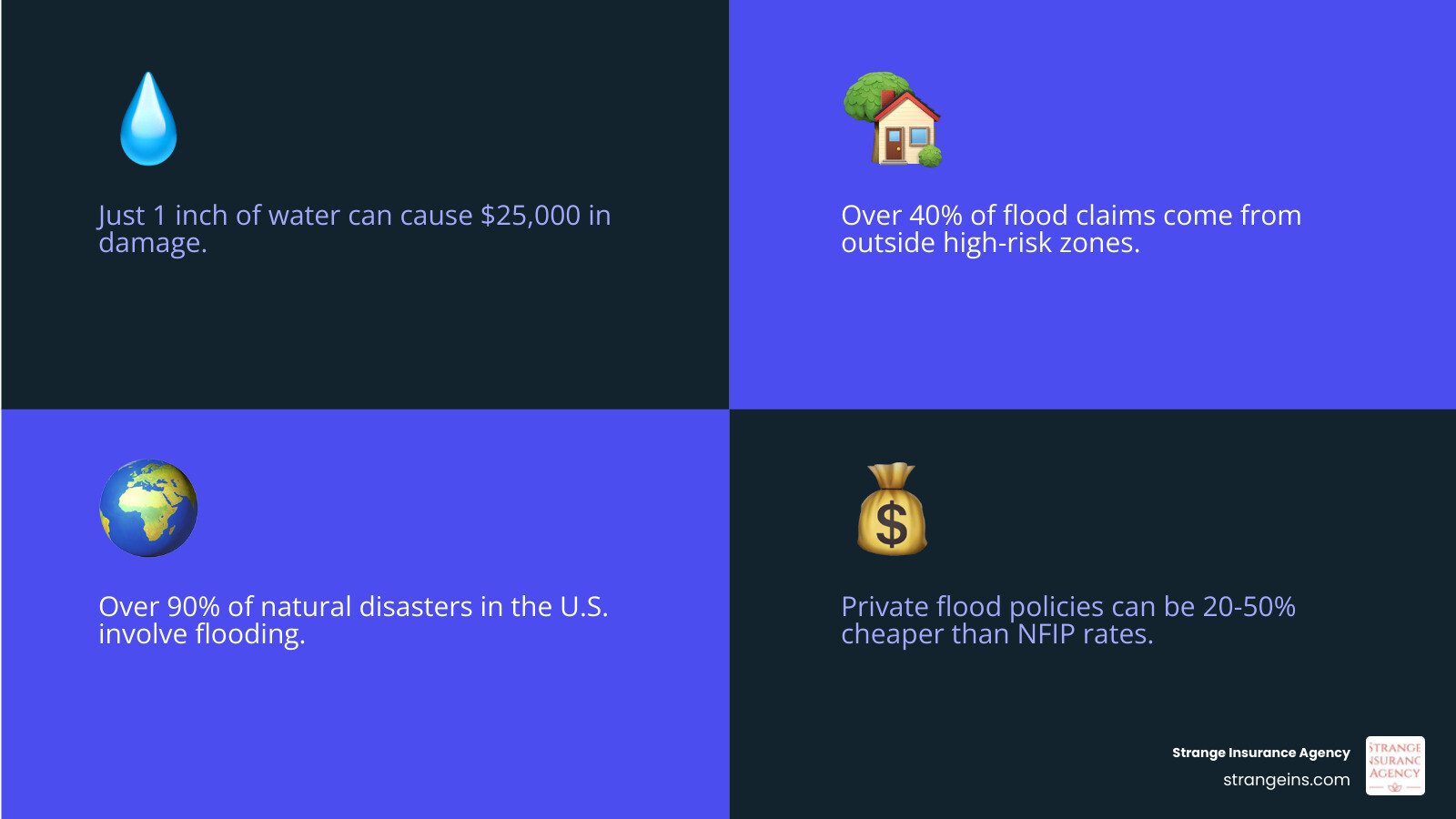
Best flood insurance rates can mean the difference between financial recovery and devastating loss. According to FEMA, just one inch of flood water can cause up to $25,000 in damage, yet standard homeowners insurance doesn’t cover flooding.
Quick Answer: Best Flood Insurance Rates Overview
- Average Cost: National average is $899 per year for NFIP policies
- Rate Range: Can vary from $100-$300 annually in low-risk areas to $500-$1,000+ in high-risk zones
- Private vs. NFIP: Private policies can be 20-50% cheaper than government rates
- Key Factors: Location, elevation, construction type, and coverage limits determine your premium
- Waiting Period: 30 days for NFIP, 7-15 days for private policies
The flood insurance landscape has evolved. While the National Flood Insurance Program (NFIP) was once the only option, private insurers now offer competitive alternatives with better coverage at lower rates. With over 90% of U.S. natural disasters involving flooding and 40% of claims coming from outside high-risk zones, this protection is essential. The financial impact of a flood can be devastating for homeowners and small businesses alike without proper coverage.
As an insurance professional with 15 years of experience at Strange Insurance Agency, I’ve helped countless clients find the best flood insurance rates. My expertise has shown me that the right policy balances comprehensive coverage, cost, and peace of mind.
NFIP vs. Private Flood Insurance: A Head-to-Head Comparison
When searching for the best flood insurance rates, you have two main options: the National Flood Insurance Program (NFIP) and the private market. The rise of private insurers has created competition, leading to better rates and more comprehensive coverage options for homeowners.
| Feature | National Flood Insurance Program (NFIP) | Private Flood Insurance |
|---|---|---|
| Coverage Limits | Dwelling: Up to $250,000; Contents: Up to $100,000 | Dwelling: Often $500,000 to $15 million+; Contents: Higher limits |
| Basement Coverage | Limited to specific items (structural components, utility equipment) | More comprehensive, can include finished basements (depending on policy) |
| Additional Living Exp. | Generally not included | Often available as an add-on or included |
| Waiting Period | Standard 30 days (with exceptions for loan closings) | Shorter, often 7-15 days (sometimes 0 for loan closings) |
| Rate Flexibility | Standardized rates set by FEMA; subject to Risk Rating 2.0 | Market-driven rates; can be more competitive or custom |
| Lender Acceptance | Federally backed, always accepted | Widely accepted by mortgage lenders |
Understanding the National Flood Insurance Program (NFIP)
Since 1968, the NFIP, administered by FEMA, has been the backbone of flood protection. This government-backed program offers reliable, though limited, coverage.
- FEMA-backed security: Your policy is guaranteed by the federal government and universally accepted by mortgage lenders.
- Standardized rates: FEMA sets the rates, so the price is the same regardless of where you buy it. This eliminates rate shopping but also competitive pricing.
- Coverage caps: Dwelling coverage maxes out at $250,000 and contents at $100,000, which is often insufficient for homes in areas with higher property values.
- 30-day waiting period: Coverage doesn’t start immediately, making it essential to plan ahead.
- Broad eligibility: Most communities participate, making coverage available to eligible properties regardless of flood history.
Ready to explore your NFIP options? Get a National Flood Insurance Quote.
The Rise of Private Flood Insurance
The private flood insurance market has expanded dramatically, creating more competitive choices for homeowners seeking the best flood insurance rates.
- Higher coverage limits: Private insurers offer limits from $500,000 to over $15 million, allowing you to protect your home’s full value.
- Customizable policies: Policies can be custom for specific needs like finished basements, pools, or detached garages. Many also include Additional Living Expenses (ALE).
- Shorter waiting periods: Waiting periods are often just 7-15 days, a major advantage over the NFIP’s 30-day wait.
- Potentially lower premiums: By using their own risk models, private insurers can often offer rates 20% to 50% below NFIP pricing.
- Selective underwriting: This allows for better rates on lower-risk properties, but it also means insurers can decline high-risk applicants.
- Lender acceptance: Most private policies meet federal requirements and are widely accepted by mortgage companies.
At Strange Insurance Agency, we shop over 30 carriers to find the best fit for you. Want to explore your private options? Learn more about Private Flood Insurance Companies or Compare Flood Insurance Quotes.
Decoding Your Premium: What Determines Flood Insurance Costs?
Flood insurance pricing is more sophisticated than ever, thanks largely to FEMA’s Risk Rating 2.0 system. Instead of relying on broad flood zones, rates are now based on your property’s unique characteristics.

To find you the best flood insurance rates, we analyze how multiple factors affect your premium. These include your property’s elevation, construction and foundation type, proximity to water, and its replacement cost value. Your choice of deductible also gives you control over your annual costs. Even community-wide mitigation efforts can earn you discounts.
The Impact of FEMA’s Risk Rating 2.0
Risk Rating 2.0 transformed premium calculations by moving from broad flood zones to a detailed analysis of individual property risk. This creates fairer, actuarially sound rates that reflect a home’s unique flood risk, meaning neighbors can have very different premiums.
Instead of just flood zones, FEMA now considers multiple factors for each property, including local flood frequency, distance to water, and the home’s rebuild cost. To prevent sticker shock, rate increases are capped at 18% annually for most existing policies. This means rates will gradually rise over several years to reflect a property’s true risk. You can read more in FEMA’s new rate-setting methodology improves soundness but highlights need for reform.
Key Factors That Influence the Best Flood Insurance Rates
Getting the best flood insurance rates requires understanding what insurers look at:
- Your home’s location: This includes specific geographic characteristics and historical flood data for your immediate area.
- First-floor height: A higher lowest habitable floor relative to the base flood elevation can significantly lower your premium.
- Foundation type: Homes on slab foundations typically get the lowest rates, while basements face the highest premiums. Crawlspace foundations fall in between.
- Flood-proofing measures: Lifting your home, installing flood vents, or using flood-resistant materials can lead to substantial savings.
- Coverage limits and deductibles: You have direct control over your costs by choosing your coverage amounts and deductible levels.
Start by understanding your property’s specific risk profile: Check your property’s flood risk on the FEMA Flood Map Service Center.
How to Secure the Best Flood Insurance Rates for Your Property
Finding the best flood insurance rates involves more than just shopping around—it’s about being proactive. The more you do to protect your home, the less you’ll pay for that protection.

Proactive Steps to Lower Your Flood Insurance Premiums
Your flood insurance premium isn’t set in stone. Both NFIP and private insurers reward homeowners who take steps to reduce their flood risk.
- Install flood vents: This cost-effective improvement allows floodwater to flow through a crawlspace or basement, reducing pressure on foundation walls and leading to significant savings.
- Lift your utilities: Moving your furnace, water heater, and electrical panel above the base flood elevation protects expensive systems and can lower your premium.
- Use flood-resistant materials: When renovating, using materials like concrete and tile in lower areas can reduce potential damage and insurance costs.
- Improve grading and drainage: Ensuring water flows away from your foundation can make a real difference in your risk profile.
- Get an Elevation Certificate: This official document proves your home’s elevation. An accurate reading can lead to substantial savings, even under Risk Rating 2.0.
For more insights, check out More on how to get a cheap flood insurance quote.
Smart Shopping: Finding the Right Policy for Your Budget
Once you’ve reduced your risk, it’s time to shop smart. At Strange Insurance Agency, we act as your advocate to find the best flood insurance rates.
- Compare multiple quotes: We work with over 30 carriers, including NFIP and private insurers, to do the legwork for you.
- Work with an independent agent: We’re on your team, not the insurance company’s. We objectively compare options to find the policy that provides the best value.
- Review coverage annually: We proactively review your policy each year to ensure you have the right coverage and are getting any new discounts you qualify for.
- Adjust deductibles wisely: A higher deductible lowers your premium, but it means more out-of-pocket cost in a claim. We help you find the right balance.
The process should be straightforward. We handle the complexity so you can focus on protecting your home. Ready to see how simple it is? Learn how to get a flood insurance quote.
Understanding Your Flood Policy: What’s Covered and What’s Not?
Even with the best flood insurance rates, a policy is only good if it covers what you need. It’s crucial to understand what’s included and excluded before a flood occurs.

Flood insurance is a financial safety net for when water from an outside source enters your home. It covers the essentials to keep your house livable, but it doesn’t cover everything. Damage from a burst pipe is typically a homeowners insurance claim, not a flood claim.
What Flood Insurance Typically Covers
Your policy protects the core elements of your home, including:
- Building structure and foundation
- Electrical and plumbing systems
- HVAC equipment (furnace, air conditioner)
- Permanently installed carpeting and paneling
- Major appliances (refrigerator, stove)
- Debris removal costs after a flood
- Detached garages (usually up to 10% of building coverage)
Common Exclusions to Be Aware Of
Understanding the following common exclusions helps avoid surprises during a claim:
- Damage from moisture or mold that could have been prevented by the homeowner.
- Currency, precious metals, and valuable papers.
- Property outside your insured building, such as fences, pools, landscaping, and septic systems.
- Vehicles, which are covered under the comprehensive portion of an auto policy.
- Temporary living expenses are not covered by standard NFIP policies, though this coverage is often available as an add-on with private policies.
- Basement contents and finished elements like drywall and furniture are generally excluded by NFIP policies. Private policies may offer more comprehensive basement coverage.
We help clients find policies that meet their specific needs. To see how home and flood policies work together, Get a Home and Flood Insurance Quote.
Frequently Asked Questions about Flood Insurance Rates
We hear a lot of questions about flood insurance rates. Here are the most common concerns we address for families in Virginia, North Carolina, West Virginia, and Florida:
Do I need flood insurance if I don’t live in a high-risk flood zone?
Yes. This is a critical protection because floods happen everywhere, not just in high-risk zones. In fact, over 40% of NFIP flood claims occur in moderate-to-low-risk areas. Standard homeowners policies do not cover flood damage, and federal disaster aid is usually a loan that must be repaid. With just one inch of water causing up to $25,000 in damage, and affordable rates available in low-risk areas, flood insurance is essential for financial security.
How much does flood insurance cost on average?
The national average for an NFIP policy is around $899 per year, but your actual cost will vary based on your property’s specific risk, location, value, and coverage. Properties in high-risk zones average about $1,031 annually, while low and moderate-risk zones average around $691 per year. Private flood insurance can often be 20% to 50% cheaper than NFIP rates. Our ability to shop over 30 carriers allows us to find you the best flood insurance rates by comparing all your options.
Can I get a flood insurance policy immediately?
Typically, no—planning ahead is crucial. The NFIP has a standard 30-day waiting period before coverage begins. There are a few exceptions, such as for a loan closing. Private flood insurance policies often have shorter waiting periods—typically 7 to 15 days. The key is to buy coverage before a storm is on the horizon, as it’s too late to get protected once a threat is imminent.
Your Next Step to Affordable Flood Protection
Finding the best flood insurance rates can feel overwhelming. Navigating NFIP vs. private policies, understanding your risk, and identifying effective mitigation efforts is complex. That’s why we’re here to help.
At Strange Insurance Agency, we simplify this process for homeowners across Virginia, North Carolina, West Virginia, and Florida. We understand the unique flood risks in these areas and are committed to finding you the right protection.
We have access to over 30 different carriers. This means we shop the entire market to find you the best combination of coverage and price, comparing NFIP and private options side-by-side. We’ll gather quotes, explain the differences in plain English, and provide honest guidance to protect what matters most.
Time isn’t on your side when it comes to flood risk. The 30-day waiting period for NFIP policies means you must act now to be covered next month. Don’t wait for storm warnings to flash across your screen. The best flood insurance rates are available today, and we’re here to help you find them.
Ready to get started? Learn more about your Personal Flood Insurance options and let’s find the coverage that fits your home and your budget.