
Why Landlord Umbrella Insurance Is Your Financial Safety Net
What is Landlord Umbrella Insurance and How Does It Work?
Imagine your regular landlord insurance as a bucket. When a lawsuit happens, that bucket starts filling up with costs. Once it overflows, you’re on the hook for everything that spills out. Landlord umbrella insurance is like having a much bigger bucket underneath to catch all that overflow.
This type of coverage is technically called “excess liability insurance” because it provides extra protection beyond your primary policy limits. It doesn’t replace your regular landlord insurance – it works alongside it as a supplemental layer of protection. Think of it as your financial safety net that only springs into action when your underlying policy has been completely exhausted.
Here’s a real-world example: Your tenant’s guest slips on ice outside your rental property and suffers a traumatic brain injury. The medical bills, rehabilitation costs, and legal settlement total $1.8 million. Your standard landlord policy covers the first $1 million, but without umbrella coverage, you’d be personally responsible for the remaining $800,000. With umbrella liability insurance, that extra coverage kicks in to handle the excess amount.
The Core Function: Topping Up Your Liability Limits
The beauty of umbrella insurance lies in its simplicity. When your primary insurance reaches its maximum payout, the umbrella policy seamlessly takes over to cover additional costs. Most standard landlord policies provide between $500,000 and $1 million in liability coverage – amounts that once seemed generous but can disappear quickly in today’s litigation environment.
Let’s break down how this works with actual numbers. Say you’re facing a wrongful eviction lawsuit that results in a $750,000 judgment. If your primary liability coverage for rental property maxes out at $500,000, you’d personally owe $250,000. An umbrella policy would cover that difference, protecting your personal assets from being seized to satisfy the judgment.
The peace of mind this provides is incredible. You can sleep soundly knowing that even if the worst happens, your family’s financial future remains secure. Legal defense costs alone can run into the hundreds of thousands, and umbrella policies typically cover these expenses regardless of whether you’re found liable.
Key Differences from Standard Landlord Insurance
While both types of insurance protect landlords, they’re designed for completely different purposes. Your standard landlord policy is like a Swiss Army knife – it covers property damage to your rental building, loss of rental income when the property becomes uninhabitable, and basic liability protection for tenant injuries or property damage claims.
Landlord umbrella insurance is more like a specialized tool with one job: extending your liability protection far beyond what your base policy provides. It won’t fix your roof after a storm or replace your tenant’s belongings after a fire. That’s what your primary investment property insurance handles.
The umbrella policy is purely focused on liability – those situations where someone gets hurt or their property gets damaged, and they decide to sue you for everything you’re worth. It’s a standalone policy that works in partnership with your existing coverage, not as a replacement for it.
Underlying Policy Requirements
Insurance companies aren’t going to sell you umbrella coverage without making sure you have a solid foundation first. They require you to maintain minimum liability limits on your underlying policies before they’ll issue an umbrella policy. It’s like requiring you to have a driver’s license before selling you car insurance – it just makes sense.
Typical requirements include maintaining landlord insurance with at least $300,000 in liability coverage, auto insurance with minimum bodily injury limits of $250,000 per person and $500,000 per accident, and homeowners insurance with $300,000 in personal liability coverage if you own your primary residence.
These requirements ensure that minor claims get handled by your primary policies, reserving the umbrella coverage for truly catastrophic situations. It creates a more stable and cost-effective protection structure. Most insurers will require proof of these underlying coverages before issuing your umbrella policy, and they’ll typically want all policies to be renewed simultaneously to avoid any gaps in coverage.
What an Umbrella Policy Covers (and What It Doesn’t)

Knowing where your landlord umbrella insurance starts and stops keeps your protection strategy crystal-clear. Umbrella policies are broad, but they are designed only for liability—nothing more, nothing less.
Liabilities and Costs Typically Covered
- Bodily injury claims – a guest slips and suffers a serious injury.
- Third-party property damage – your tenant’s fire spreads to a neighbor’s unit.
- Legal defense costs – attorney fees are usually paid “outside” the liability limit.
- Personal injury – libel, slander, wrongful eviction, discrimination, invasion of privacy, false arrest.
- Host liquor liability – issues arising from alcohol served at events on the property.
Common Exclusions to Keep in Mind
- Damage to your own building or contents – that falls under your primary investment property insurance.
- Intentional or criminal acts.
- Punitive damages (where permitted by state law).
- Business activities that go beyond simple rental income when you hold a personal umbrella.
- Contractual liability you voluntarily assume in a lease or construction contract.
In short, umbrella insurance protects what you might owe others, not what you personally lose. Pair it with solid primary coverage and, when necessary, specialty policies so that every major risk has a home.
The Essential Role of Landlord Umbrella Insurance in Your Asset Protection Strategy
Growing a rental portfolio is exciting—but it also paints a big legal target on your back. One severe claim can wipe out years of equity and future earnings. Landlord umbrella insurance is the inexpensive back-stop that keeps an unlucky incident from becoming a financial catastrophe.
Why It’s a Must-Have for Today’s Landlords
Lawsuits are larger and more common than ever. Premises liability awards regularly exceed six figures, and defense costs alone can drain your reserves. Umbrella coverage adds an extra $1–5 million (or more) of protection for a fraction of that amount—often under $2 a day.
Modern claims go far beyond slip-and-fall injuries. Wrongful eviction, discrimination, privacy violations, and environmental hazards now headline many cases. An umbrella policy absorbs these big-ticket liabilities so you don’t have to sell properties or raid retirement accounts to pay judgments.
How Umbrella Insurance Complements an LLC
LLCs are great for separating business and personal assets, but they are not impenetrable. Courts can “pierce the veil,” and an LLC does nothing to fund your legal defense. Umbrella insurance supplies the dollars that keep both the entity and your personal wealth intact.
| Protection Method | What It Shields | Key Limitation |
|---|---|---|
| LLC | Personal assets from business liabilities | Can be pierced; must be properly maintained |
| Umbrella Policy | Adds $1 M+ in extra liability coverage | Requires underlying policies & has exclusions |
| Both Together | Legal separation and deep pockets for claims | Slightly higher cost & record-keeping |
Not a Substitute for Primary Insurance
Umbrella coverage is a second layer—never the foundation. Reduce the limits on your landlord policy and you create a dangerous gap before the umbrella activates. Keep strong primary limits, then stack the umbrella on top for seamless protection.
Combined with an LLC and proper primary coverage, an umbrella policy forms a simple, affordable, and highly effective asset-protection system. Sleep easier, keep growing, and let your insurance do the worrying.
Determining Your Coverage Needs and Costs

When it comes to landlord umbrella insurance, the big question isn’t whether you need it – it’s how much coverage makes sense for your situation. Think of it like buying a car: you wouldn’t buy a Ferrari if you only need to drive to the grocery store, but you also wouldn’t buy a bicycle if you need to haul a boat.
The math behind umbrella insurance is surprisingly simple. You’re essentially trading a small, predictable annual cost for protection against a potentially catastrophic financial loss. Let’s break down exactly how to determine what’s right for your rental property portfolio.
How Much Landlord Umbrella Insurance Coverage Do You Need?
The golden rule is straightforward: carry umbrella coverage equal to or greater than your total net worth. This ensures that even if you face the worst-case scenario, your assets remain protected from creditors.
Start by calculating your total assets. Add up your primary residence value, all your rental property values, investment accounts, retirement savings, and any business assets you own. Don’t forget to include your future earning potential – if you’re 35 years old and earn $100,000 annually, you could potentially earn $3 million over your remaining career.
Your property portfolio size matters significantly. If you own 1-4 single-family homes with moderate net worth, $1 million in coverage often provides adequate protection. However, if you’re managing larger portfolios or have higher net worth, you’ll want to consider $2-3 million in coverage. For extensive portfolios or very high net worth individuals, $5+ million coverage becomes necessary.
Pay special attention to high-risk features on your properties. Swimming pools, hot tubs, trampolines, or playground equipment significantly increase your liability exposure. Older properties with potential maintenance issues or properties in high-litigation areas also warrant higher coverage limits.
The type of rental matters too. Single-family homes typically present lower risk than multi-family properties, which increase your exposure simply because more people live there. Vacation rentals may have different risk profiles depending on the activities available and the transient nature of guests.
For detailed guidance custom to your specific situation, check out our comprehensive guide on how much umbrella insurance do I need.
What Does Landlord Umbrella Insurance Typically Cost?
Here’s where landlord umbrella insurance becomes a true no-brainer investment. The cost is remarkably affordable considering the massive protection it provides.
Most $1 million policies cost between $150-$500 annually – that’s less than $1.50 per day for substantial financial protection. $2 million coverage typically runs $250-$700 annually, while $5 million coverage usually costs $400-$1,200 per year. Many carriers offer coverage in convenient $1 million increments, making it easy to scale your protection as your portfolio grows.
Several factors influence your premium costs. Your claims history plays a major role – a clean record keeps costs low. The number and type of properties you own affects pricing, as does the geographic location of your rentals. Your underlying policy limits matter too, with higher base limits often resulting in lower umbrella premiums.
Interestingly, your credit score and driving record can also impact costs, since insurers view these as indicators of overall risk management. This might seem unrelated to your rental properties, but insurance companies have found correlations between these factors and claims frequency.
You can often reduce costs by bundling with existing policies for multi-policy discounts. Maintaining higher underlying policy limits can also lead to better umbrella rates. Some landlords find that increasing deductibles on underlying policies helps offset the umbrella premium while still maintaining comprehensive protection.
For specific pricing information and money-saving strategies, visit our cost of umbrella policy page.
Is an Umbrella Policy a Worthwhile Investment?
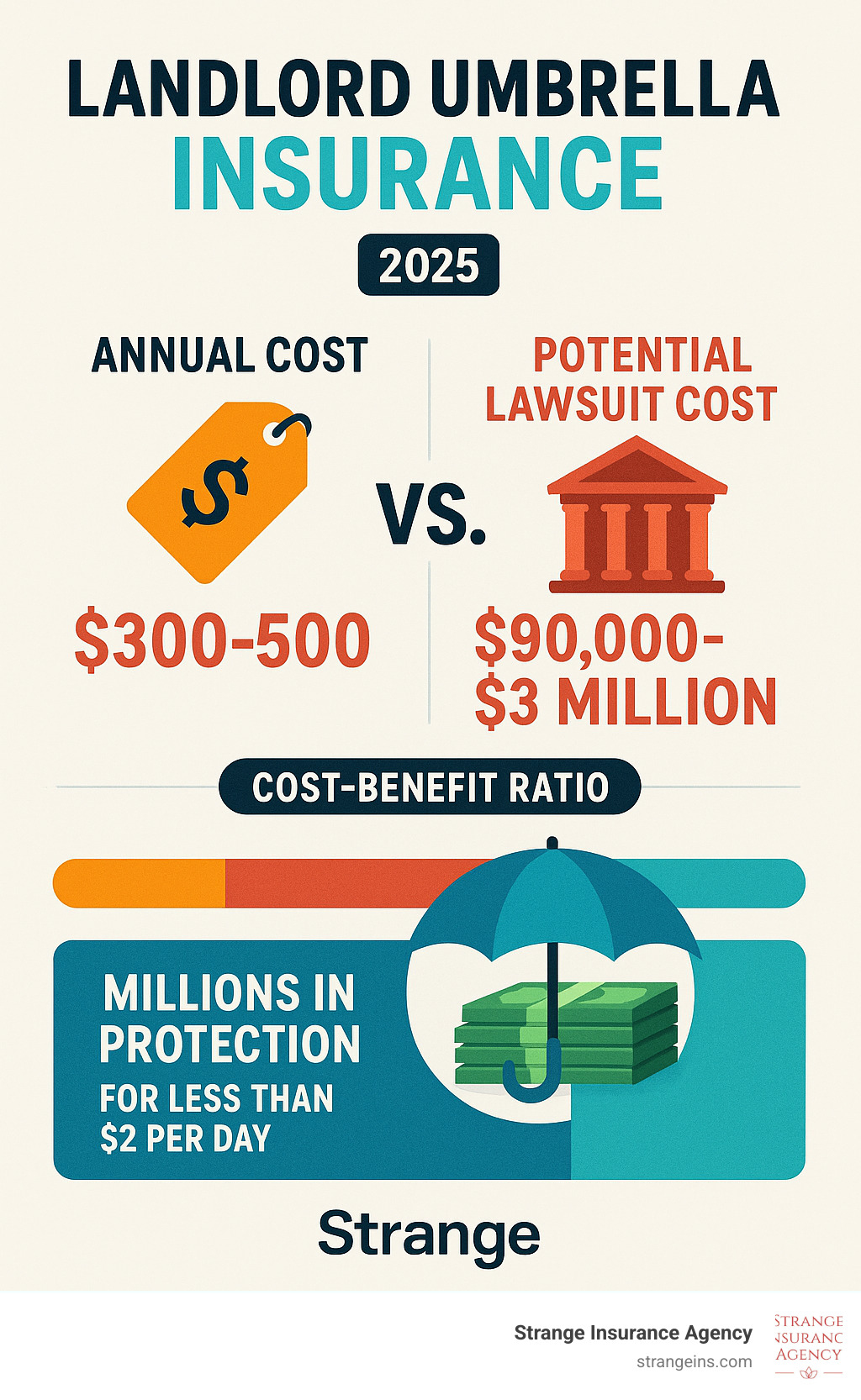
When you run the numbers, the value proposition becomes crystal clear. You’re essentially paying $300-500 annually to protect against potential losses of $90,000 to unlimited amounts (your entire net worth).
Consider this scenario: Over 20 years, you might pay $6,000-$10,000 in umbrella insurance premiums. Compare that to losing your entire rental portfolio and personal assets from a single uninsured lawsuit. One serious slip-and-fall accident or discrimination claim could wipe out decades of careful wealth building.
The peace of mind factor alone justifies the cost for most landlords. Instead of lying awake at night worrying about potential lawsuits, you can focus on growing your rental business and serving your tenants. This psychological benefit often proves as valuable as the financial protection itself.
The long-term value becomes even more apparent when you consider inflation and rising litigation costs. Legal fees continue climbing, and jury awards grow larger each year. The $300 you spend on umbrella insurance today could prevent a $3 million judgment tomorrow.
For a detailed analysis of whether umbrella coverage makes sense for your specific situation, read our article on are umbrella policies worth it.
Frequently Asked Questions about Landlord Umbrella Insurance
Based on our years of experience helping landlords protect their investments, here are the most common questions we encounter about landlord umbrella insurance.
Can one umbrella policy cover multiple properties, even in different states?
Yes, and this is honestly one of the best features of umbrella insurance! Unlike other types of coverage that tie you down to specific properties, landlord umbrella insurance gives you incredible flexibility to protect your entire rental portfolio with a single policy.
Let’s say you own a duplex in Virginia Beach and just bought a rental house in Charlotte. You don’t need separate umbrella policies for each state – one policy covers both properties seamlessly. This makes life so much easier for investors who are building portfolios across state lines.
The convenience factor is huge. Instead of juggling multiple policies with different renewal dates and terms, you have one umbrella policy that follows you wherever your investments take you. It’s like having a universal remote for your liability protection.
However, there’s a small catch to keep in mind. Some personal umbrella policies have limits on how many properties they’ll cover – typically anywhere from 3 to 6 properties. If you’re growing beyond that or operating under multiple LLCs, you might need to step up to a commercial umbrella policy instead.
Do I need a commercial or personal umbrella policy for my rentals?
This is where the ownership structure of your properties becomes really important. The way you hold title to your rental properties determines which type of umbrella policy you need.
If you own your rental properties in your personal name, a personal umbrella policy typically works perfectly. These policies recognize rental activities as part of your personal liability exposure and provide coverage accordingly. They’re usually less expensive and simpler to manage.
But here’s where it gets tricky – if you’ve formed LLCs or corporations to hold your properties, you’ll need a commercial umbrella policy. Personal umbrella policies specifically exclude coverage for business activities, and your LLC-owned properties count as business activities in the eyes of the insurance company.
Commercial umbrella policies cost more, but they’re designed to handle multiple business entities and larger portfolios. They also provide broader coverage for the various business activities that come with property management.
Most landlords start with properties in their personal name and a personal umbrella policy. As their portfolios grow and they form business entities for asset protection, they transition to commercial coverage. We help clients steer this transition all the time – it’s a natural evolution as your real estate business matures.
Can I get an umbrella policy if my primary landlord insurance is with a different company?
Technically, yes – but let me share why this usually isn’t the best approach. While some insurance companies will write umbrella policies even if your primary coverage is elsewhere, bundling everything together almost always works out better for you.
When you bundle your landlord insurance and umbrella policy with the same carrier, you typically save 5-25% on your premiums through multi-policy discounts. That’s real money back in your pocket every year. Plus, having everything with one company means you have a single point of contact when you need to file a claim or make changes to your coverage.
The claims process becomes much smoother too. Instead of dealing with two different companies trying to figure out which policy covers what, you have one carrier handling everything. This eliminates the finger-pointing and delays that can happen when multiple insurers are involved.
At Strange Insurance Agency, we work with over 30 insurance companies, which gives us the flexibility to find the perfect combination of coverage and pricing for your specific situation. We can often bundle your business liability insurance and umbrella coverage for maximum savings and protection.
The bottom line? While it’s possible to mix and match carriers, bundling usually saves you money and headaches. We’re happy to run the numbers both ways to show you exactly what makes the most sense for your situation.
Conclusion

Think of landlord umbrella insurance as the difference between sleeping peacefully at night and lying awake worrying about that next lawsuit. After walking through all the details in this guide, the choice becomes pretty clear – this coverage isn’t just smart, it’s essential.
Let’s be honest: being a landlord in today’s world means accepting that someone, somewhere, is probably going to sue you. It might be a tenant who slips on ice, a visitor who gets hurt in your stairwell, or even a discrimination claim that blindsides you. The question isn’t if you’ll face liability – it’s whether you’ll be ready when it happens.
The math is simple and compelling. For less than $500 a year, you can protect millions of dollars in assets. That’s roughly $1.37 per day for the peace of mind that comes with knowing your rental empire won’t crumble from a single lawsuit. Compare that to the potential loss of everything you’ve worked to build, and the decision becomes a no-brainer.
Umbrella insurance works beautifully with your existing protection strategies. Whether you’ve set up LLCs, formed corporations, or simply own properties in your personal name, umbrella coverage fills the gaps that other protection methods can’t address. It’s like having a safety net under your safety net.
The convenience factor is huge too. One policy can cover multiple properties across different states, making it far simpler than juggling separate policies or creating multiple business entities. If you own a duplex in Virginia and a single-family home in North Carolina, you’re covered with one straightforward policy.
Here’s what really matters: landlord umbrella insurance gives you the confidence to grow your rental business without constantly looking over your shoulder. You can focus on finding great properties, screening tenants, and building wealth instead of worrying about the next potential financial disaster.
At Strange Insurance Agency, we’ve seen too many landlords learn this lesson the hard way. We work with over 30 insurance companies to find you the best combination of coverage and pricing. Our team understands the unique challenges facing property investors in Virginia, North Carolina, West Virginia, and Florida – and we know how to protect you from them.
Don’t wait until you’re sitting in a lawyer’s office wishing you had better coverage. The best time to get umbrella insurance is right now, before you need it. Your future self will thank you for making this smart investment in your financial security.
Ready to protect your rental empire? Get a quote for your personal insurance needs and find how affordable comprehensive protection can be. Because in the rental property business, it’s not about avoiding all risks – it’s about managing them intelligently.