
Why Your Current Insurance Isn’t Enough
Personal umbrella liability insurance is extra protection that kicks in when your home, auto, or other policies reach their limits. It covers large lawsuits and legal costs that could wipe out your savings and future earnings.
Quick Answer for Personal Umbrella Liability Insurance:
- What it is: Extra liability coverage beyond your home/auto limits
- Coverage amounts: $1-10 million in protection
- Cost: $150-300 per year for $1 million coverage
- Who needs it: Anyone with assets to protect or high lawsuit risk
- What it covers: Bodily injury, property damage, legal defense, libel/slander
- What it doesn’t cover: Your own property damage, intentional acts, business activities
One lawsuit can change everything. As the research shows, 70% of umbrella claims come from auto accidents, with 25% caused by distracted driving. But umbrella insurance also protects against less obvious risks like libel, slander, and accidents on your property.
Think about it – if someone gets seriously injured at your home or you cause a major car accident, the medical bills and legal costs could easily exceed your standard policy limits. That’s where umbrella insurance steps in to protect your house, savings, retirement accounts, and even your future income from being seized to pay a judgment.
Most people think their home and auto insurance is enough. But standard policies only provide minimal liability coverage – often just $300,000 to $500,000. That’s not nearly enough protection against a serious lawsuit.
I’m Christian Strange, and with over 15 years of experience in insurance and risk management, I’ve helped countless families understand how personal umbrella liability insurance creates a critical safety net for their financial future. Let me walk you through everything you need to know to make the right decision for your family’s protection.

Must-know personal umbrella liability insurance terms:
How Personal Umbrella Liability Insurance Works
Personal umbrella liability insurance works like a giant safety net that catches you when life throws its worst surprises your way. Think of it as the backup plan for your backup plan – stepping in when your regular home and auto insurance just isn’t enough.
Here’s the reality: your standard auto policy might cover $300,000 in liability, and your homeowner’s policy another $300,000. That sounds like a lot until you’re facing a million-dollar lawsuit. That’s when your umbrella policy becomes your financial lifesaver.
The magic happens at what we call the trigger point – the moment your underlying policies max out. Let’s say you cause a serious car accident that results in $1.2 million in damages, but your auto insurance only covers $300,000. Your umbrella policy seamlessly kicks in to cover that remaining $900,000, protecting your home, savings, and future earnings from being seized.
What makes umbrella coverage truly special is its worldwide protection. Whether you’re driving a rental car in Italy or someone gets hurt at your beach house in the Outer Banks, your coverage travels with you. This global reach is something most people don’t realize they have – and it’s incredibly valuable in our connected world.
One of the most underrated benefits? Your umbrella policy will pay for legal defense costs even if the lawsuit against you is completely baseless. As the latest research on umbrella coverage shows, these defense costs alone can be worth the premium. Imagine getting sued for something you didn’t do – your umbrella policy will still hire the best lawyers to defend you.
Here’s something that keeps me up at night for my clients: courts don’t just look at what you have today. They consider your future earning potential when awarding judgments. A 35-year-old doctor could face wage garnishment for decades if they don’t have adequate umbrella protection. That’s why this coverage is so crucial for anyone with a promising career ahead of them.
For a deeper dive into the mechanics, check out our comprehensive guide on What is Umbrella Liability Insurance?.
Relationship to Home & Auto Policies
Your umbrella policy doesn’t work alone – it’s designed to work hand-in-hand with your existing coverage. Think of your home and auto policies as the foundation, and your umbrella as the extra floors you build on top.
Insurance companies require you to maintain minimum liability limits on your underlying policies before they’ll sell you umbrella coverage. This isn’t just bureaucratic red tape – it’s smart design that keeps everyone’s costs down.
The typical minimum requirements look like this: $250,000 to $500,000 in auto liability coverage, $300,000 in homeowner’s personal liability, and adequate limits on any watercraft you own. These minimums ensure there’s proper coordination between your policies.
Here’s how the coordination works in real life: when a claim happens, your underlying policy handles everything up to its limit, including the deductible. Only then does your umbrella policy step in. This creates a seamless secondary layer of protection without any gaps or overlaps.
Umbrella vs. Excess Liability Insurance
People often mix up umbrella and excess liability insurance, but there’s a crucial difference that could save you thousands.
Excess liability insurance is like adding more of the same – it just gives you higher limits on what you already have. If your auto policy covers certain things, excess coverage covers those exact same things, just with bigger numbers.
Umbrella insurance is much broader and more protective. Not only does it provide those higher limits, but it also covers situations your underlying policies might exclude entirely. We’re talking about libel and slander claims, invasion of privacy lawsuits, false imprisonment accusations, and other additional perils that could blindside you.
This broader coverage means umbrella policies often step in for claims that your home and auto policies would reject. That’s why, despite the name similarity, umbrella insurance is almost always the better choice for families who want comprehensive protection.
Does Coverage Follow You Worldwide?
Yes, and this is one of the most valuable features that people don’t fully appreciate until they need it. Your personal umbrella liability insurance provides true worldwide coverage – not just when you’re at home in Virginia or North Carolina.
This international travel protection covers you when you’re driving rented vehicles abroad, dealing with global lawsuits, or facing liability claims from incidents at overseas properties. I’ve seen families saved by this coverage when accidents happened during European vacations or while staying at vacation homes in other countries.
The worldwide aspect also protects you from the complexity of international legal systems. If someone sues you in a foreign country, your umbrella policy will help coordinate your defense and cover the costs, even if the legal system works completely differently than ours.
For frequent travelers or anyone who owns property outside the U.S., this global protection alone can justify the cost of umbrella coverage.

What a Personal Umbrella Policy Covers—and What It Doesn’t
When you’re considering personal umbrella liability insurance, understanding exactly what’s covered—and what isn’t—helps you make the right choice for your family’s protection. Think of it as knowing what tools are in your financial safety toolkit.
The good news is that umbrella policies are surprisingly comprehensive. They’re designed to catch the big, unexpected liability claims that could otherwise devastate your financial future. But like any insurance policy, they have their limits.
Covered by Personal Umbrella Liability Insurance
Bodily injury claims are the bread and butter of umbrella coverage. When someone gets hurt because of your actions—whether it’s a serious car accident, a slip and fall at your home, or your dog biting a neighbor—your umbrella policy steps in once your underlying coverage is exhausted. This includes medical bills, rehabilitation costs, lost wages, and those hefty pain and suffering awards that can quickly reach into the millions.
Property damage coverage protects you when you accidentally destroy someone else’s stuff. Maybe you back into your neighbor’s classic car, or a tree from your yard crashes through their roof during a storm. Your umbrella policy covers the repair or replacement costs that exceed your home or auto policy limits.
Here’s where umbrella insurance really earns its keep: personal injury protection. This covers the less obvious but equally devastating claims like libel and slander (when someone says you damaged their reputation), invasion of privacy, false imprisonment, and malicious prosecution. If you’re a landlord, it even covers wrongful eviction claims.
Legal defense costs might be the most valuable benefit of all. Even if you’re completely innocent, defending yourself in court can cost hundreds of thousands of dollars. Your umbrella policy covers attorney fees, court costs, and expert witness fees—regardless of whether you win or lose the case.
Many umbrella policies also include uninsured motorist coverage, protecting you when you’re hit by someone without adequate insurance. This protection follows you whether you’re driving your own car or a rental vehicle anywhere in the world.
Pet-related incidents are increasingly common umbrella claims. If your dog bites someone or causes an accident, the medical bills and potential lawsuit can be substantial. Your umbrella policy provides that extra layer of protection beyond your homeowner’s coverage.
For a comprehensive breakdown of everything your policy might cover, check out our detailed guide on Umbrella Policy: What Does It Cover?.
Not Covered by Personal Umbrella Liability Insurance
Understanding the exclusions is just as important as knowing what’s covered. Your own property damage isn’t covered—umbrella insurance only protects you from liability to others. So if you crash your own car or your house burns down, you’ll need to rely on your auto and homeowners insurance.
Intentional acts are excluded across the board. If you deliberately hurt someone or damage their property, your umbrella policy won’t help. However, acts of legitimate self-defense are typically covered.
Business activities require separate professional liability coverage. Whether you’re a doctor, lawyer, contractor, or run any kind of business, your personal umbrella liability insurance won’t cover work-related lawsuits or professional mistakes.
Workers’ compensation claims aren’t covered either. If you have employees—even domestic help like housekeepers or nannies—you’ll need separate workers’ comp insurance for any work-related injuries.
Criminal acts are automatically excluded. Any liability that stems from illegal activity won’t be covered by your umbrella policy.
Punitive damages present a gray area that varies by state. Some umbrella policies cover these court-imposed penalties designed to punish particularly bad behavior, while others don’t. It’s worth asking your agent about this specific coverage.
The key is remembering that umbrella insurance is designed for accidental liability—those “oops” moments that could happen to anyone, not intentional wrongdoing or business risks that require specialized coverage.
Who Needs Umbrella Coverage? Real-Life Scenarios
The question isn’t really “Do I need umbrella insurance?” but rather “How much do I need?” Here are the profiles of people who should seriously consider personal umbrella liability insurance:
Common High-Risk Profiles
High-Net-Worth Individuals: If your total assets (home equity, savings, investments, retirement accounts) exceed $500,000, you’re an attractive target for lawsuits. The more you have, the more you need to protect.
Homeowners with Liability Risks: Do you have a swimming pool, trampoline, or aggressive dog breed? These increase your lawsuit risk significantly. Even something as simple as a dinner party can turn into a liability nightmare if a guest is injured.
Parents of Teenage Drivers: Young drivers are statistically more likely to cause serious accidents. With 25% of auto-related umbrella claims stemming from distracted driving, having a teen with a smartphone behind the wheel multiplies your risk.
Landlords and Property Investors: Rental properties expose you to tenant injuries, wrongful eviction claims, and property damage lawsuits. Umbrella coverage is essential for anyone in the rental business.
High-Profile Professionals: Doctors, lawyers, business executives, and public figures face higher lawsuit risks due to their visibility and perceived wealth.
Volunteer Coaches and Board Members: Serving on nonprofit boards or coaching youth sports increases your exposure to liability claims.
Liability Horror Stories & How Umbrella Helped
The $500,000 Dog Bite: A family’s golden retriever bit a neighbor’s child, requiring reconstructive surgery. The medical bills and pain and suffering award totaled $500,000 – far exceeding their homeowner’s $300,000 liability limit. Their umbrella policy covered the difference, saving their home and retirement savings.
The $2 Million Defamation Suit: A business owner posted a negative review about a contractor online. The contractor sued for defamation, claiming the review destroyed his business. The case settled for $2 million – covered entirely by the defendant’s umbrella policy since defamation isn’t covered by standard homeowner’s insurance.
The $5 Million Auto Accident: A distracted driver ran a red light, causing a multi-car accident that left three people with permanent disabilities. The total judgment was $5 million. Without umbrella coverage, the driver would have faced personal bankruptcy and wage garnishment for decades.
These aren’t rare occurrences. With 70% of umbrella claims being auto-related and the average cost of a serious injury claim exceeding $1 million, adequate umbrella protection is more critical than ever.
How Much Coverage & What Does It Cost?
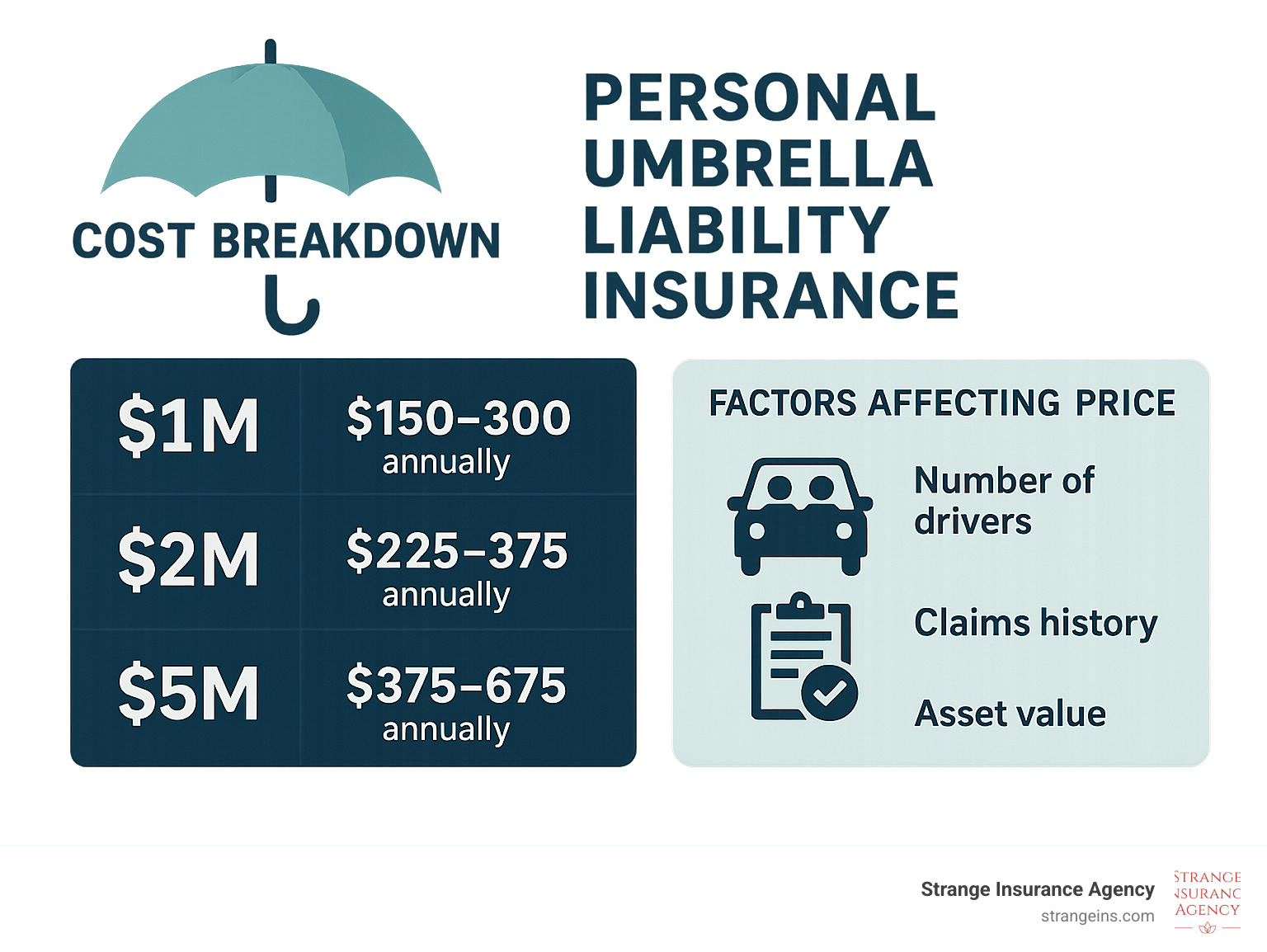
Personal umbrella liability insurance is surprisingly affordable for the protection it provides. Most policies start at $1 million in coverage and can go up to $10 million or more, sold in $1 million increments.
Typical Costs:
- $1 million coverage: $150-$300 per year
- $2 million coverage: $225-$375 per year
- $5 million coverage: $375-$675 per year
The cost increases are minimal for additional coverage because the likelihood of extremely large claims decreases significantly at higher levels. That’s why many families find it cost-effective to purchase $2-3 million in coverage rather than just $1 million.
Factors Affecting Your Premium:
- Number of drivers in your household
- Your claims history
- Types of vehicles you own
- High-risk activities or property features
- Your total asset value
- Geographic location
For detailed pricing information, check out our guides on 1 Million Umbrella Policy Cost and Cost of Umbrella Policy.
Minimum Underlying Requirements
Before you can purchase umbrella coverage, insurers typically require you to maintain minimum liability limits on your underlying policies:
Auto Insurance Requirements:
- Bodily injury: $250,000 per person / $500,000 per accident
- Property damage: $100,000 per accident
- Some insurers may require higher limits
Homeowners Insurance Requirements:
- Personal liability: $300,000 minimum
- Medical payments: $5,000 minimum
Watercraft Requirements:
- Liability limits vary by boat size and horsepower
- May require separate boat insurance policy
Choosing the Right Limit
How much umbrella coverage do you need? Start with this calculation:
- Add up your assets: Home equity, savings, investments, retirement accounts
- Consider future earnings: Multiply your annual income by years until retirement
- Factor in lifestyle risks: Pool, teenage drivers, rental properties, etc.
- Apply the risk multiplier: Choose coverage 2-3 times your total exposure
For example, if you have $800,000 in assets and expect to earn $2 million more before retirement, consider $5-10 million in umbrella coverage.
Umbrella insurance is relatively inexpensive, so it’s often better to err on the side of more coverage rather than less.
Buying Personal Umbrella Liability Insurance in Canada & the U.S.
Getting personal umbrella liability insurance is easier than most people think. The key is knowing what to look for and asking the right questions. Let me walk you through the process so you can make a confident decision.
Step-by-Step Shopping Checklist
Start by taking a hard look at what you currently have. Pull out your auto and homeowners insurance policies and check your liability limits. Most people are shocked to find they only have $300,000 in coverage – barely enough to cover a serious fender-bender these days.
Next, make an honest assessment of your risk factors. Do you have teenage drivers who think they’re invincible? A swimming pool that’s the neighborhood hangout spot? Rental properties that could expose you to tenant lawsuits? Write these down because they’ll help you determine how much coverage you need.
Now comes the fun part – shopping for quotes. Start with your current insurance company since they often offer attractive discounts for bundling your umbrella with your existing policies. But don’t stop there. Get quotes from at least two other carriers to make sure you’re getting the best deal.
Pay attention to the details when comparing quotes. Some policies have higher deductibles (called “retained limits”) that could leave you paying more out of pocket. Others might have exclusions that could catch you off guard when you need coverage most.
Confirm the underlying coverage requirements before you commit. Most insurers want you to carry at least $250,000/$500,000 in auto liability and $300,000 in homeowners liability. If your current limits are lower, you’ll need to increase them first.
For easy quote comparisons, check out our Umbrella Insurance Policy Quote page to get started.
How to File a Claim on Your Umbrella Policy
Nobody wants to think about filing a claim, but knowing the process ahead of time can save you stress and money when you need it most.
Contact your primary insurance company first – whether that’s your auto or homeowners insurer. They need to know about the claim immediately, even if you suspect it might exceed their limits. Don’t wait and don’t try to handle it yourself.
Call your umbrella insurance company right away too. You don’t need to wait until your primary coverage is exhausted. In fact, most umbrella insurers want to know about potential claims as soon as possible so they can coordinate with your primary carrier and sometimes even take over the defense.
Keep detailed records of everything – police reports, medical bills, correspondence with attorneys, court documents. Your umbrella insurer will need all of this information to properly defend and settle your claim.
Never agree to any settlement without approval from both your primary and umbrella insurers. I’ve seen people accidentally void their coverage by trying to settle claims on their own, thinking they were being helpful.
The most important thing to remember is that umbrella insurance companies have experienced legal teams who handle these situations every day. Let them do their job – that’s what you’re paying them for.

Frequently Asked Questions about Personal Umbrella Liability Insurance
Do I need umbrella insurance if I’m retired?
Yes, retirement doesn’t reduce your need for personal umbrella liability insurance – it often increases it! Here’s why: after decades of hard work, you’ve likely accumulated substantial assets. Your home is probably paid off or nearly paid off, you have retirement savings, investment accounts, and maybe even a vacation property.
All of these assets make you an attractive target for lawsuits. Unlike younger people who might have high incomes but low net worth, retirees often have significant wealth that can be seized to satisfy a judgment.
Your liability risks don’t disappear in retirement either. You’re still driving (and statistically, older drivers have higher accident rates). You might travel more, own rental properties, or volunteer for organizations – all activities that can increase your lawsuit exposure.
Plus, many retirees have more time for activities like hosting gatherings, which increases the chance of someone getting injured on your property. The bottom line? Your golden years should be worry-free, and personal umbrella liability insurance helps ensure they stay that way.
Can I buy personal umbrella liability insurance as a stand-alone policy?
While it’s possible to buy personal umbrella liability insurance as a stand-alone policy, it’s not always the easiest or most cost-effective route. Most insurance companies prefer to sell umbrella coverage to customers who already have their auto and home insurance with them.
Here’s what you need to know about stand-alone umbrella policies: You’ll still need to maintain minimum liability limits on your underlying policies, regardless of which company provides them. This typically means $250,000/$500,000 in auto liability coverage and $300,000 in homeowners liability coverage.
Stand-alone policies may cost slightly more than bundled coverage, and you might have fewer options to choose from. However, some specialty insurers do focus on stand-alone umbrella coverage and can provide competitive rates.
The coordination between your underlying policies and your umbrella policy can be more complex when they’re with different companies, but it’s certainly manageable. If you’re happy with your current auto and home insurers but want umbrella coverage, shopping for a stand-alone policy might be your best option.
Does umbrella insurance cover rental properties I own?
This is one of those “it depends” answers that makes insurance so frustrating! Some personal umbrella liability insurance policies do cover rental property liability, while others specifically exclude it.
If you own rental properties, this coverage is crucial. Think about it – you have tenants, maintenance workers, and visitors coming and going from properties you own. Someone could slip on icy steps, be injured by faulty wiring, or claim you wrongfully evicted them. These scenarios can lead to expensive lawsuits.
The key is reading your policy carefully or asking your agent directly. Some umbrella policies will cover rental properties automatically, others require you to specifically list them, and some exclude them entirely.
If your umbrella policy doesn’t cover rental properties, you’ll need separate landlord liability insurance. This isn’t necessarily a bad thing – landlord policies often provide coverage specifically designed for rental property risks that a standard umbrella policy might not include.
The important thing is making sure you have adequate liability coverage for all your properties, whether it comes from your umbrella policy or a separate landlord policy.
Conclusion
Personal umbrella liability insurance isn’t just another box to check on your insurance list—it’s the true safety net that stands between your family and devastating financial loss. With lawsuit settlements often soaring past $1 million—and a whopping 70% of umbrella claims starting with auto accidents—the real question isn’t “Should I get umbrella coverage?” It’s “Can I really afford not to?”
At Strange Insurance Agency, we’ve seen how fast life can change. Many families believe their regular home and auto insurance will shield them from the worst, only to find out—too late—that they’re exposed. That’s a tough lesson, and one we never want you to learn the hard way.
Our team is here to make sure you don’t become another cautionary tale. We partner with over 30 top-rated insurance companies to help you find the perfect fit, whether you’re right here in Virginia or calling North Carolina, West Virginia, or Florida home. You’ll get straightforward answers, clear options, and quick service, every time.
For as little as $150–$300 a year, you can add $1 million in extra liability protection. That’s real peace of mind, especially when you think about how a single accident, injury, or lawsuit could put your home, retirement, and future earnings on the line. Suddenly, umbrella insurance isn’t just “nice to have”—it’s essential.
If you’re ready to protect what you’ve worked so hard for, start by reading our Personal Umbrella Policy guide or reach out for a personalized quote. Your family’s security deserves more than hope—it deserves real protection.
Remember: It only takes one lawsuit to change everything. Let’s make sure you’re ready, no matter what comes your way.