
Why Virginia Homeowners Need Comprehensive Insurance Protection
Homeowners insurance virginia provides essential financial protection for your most valuable asset. Virginia residents face unique risks, from coastal flooding in Norfolk to winter ice storms in the Blue Ridge Mountains, making proper coverage crucial.
Quick Facts for Virginia Homeowners:
- Average Cost: $1,119-$1,445 annually (25-31% below national average)
- Required by Law: No, but required by mortgage lenders.
- Standard Coverage: Dwelling, personal property, liability, and additional living expenses.
- Key Exclusions: Flood damage (requires a separate policy), earthquakes, and normal wear and tear.
- Virginia-Specific Risks: Hurricanes, nor’easters, coastal flooding, and winter storms.
Virginia’s diverse geography creates distinct insurance challenges. Coastal areas like Virginia Beach face hurricane and flood risks with average premiums near $2,425 annually. Inland cities like Richmond have lower rates, around $1,100-$1,475, due to reduced disaster exposure. These weather patterns make understanding your coverage options essential for protecting your home and financial future.
With over 15 years in risk management, we have helped countless Virginia families steer the complexities of homeowners insurance virginia. We know that proper coverage is the key to financial security when disaster strikes.
Homeowners insurance virginia terminology:
Understanding Your Core Coverage in Virginia
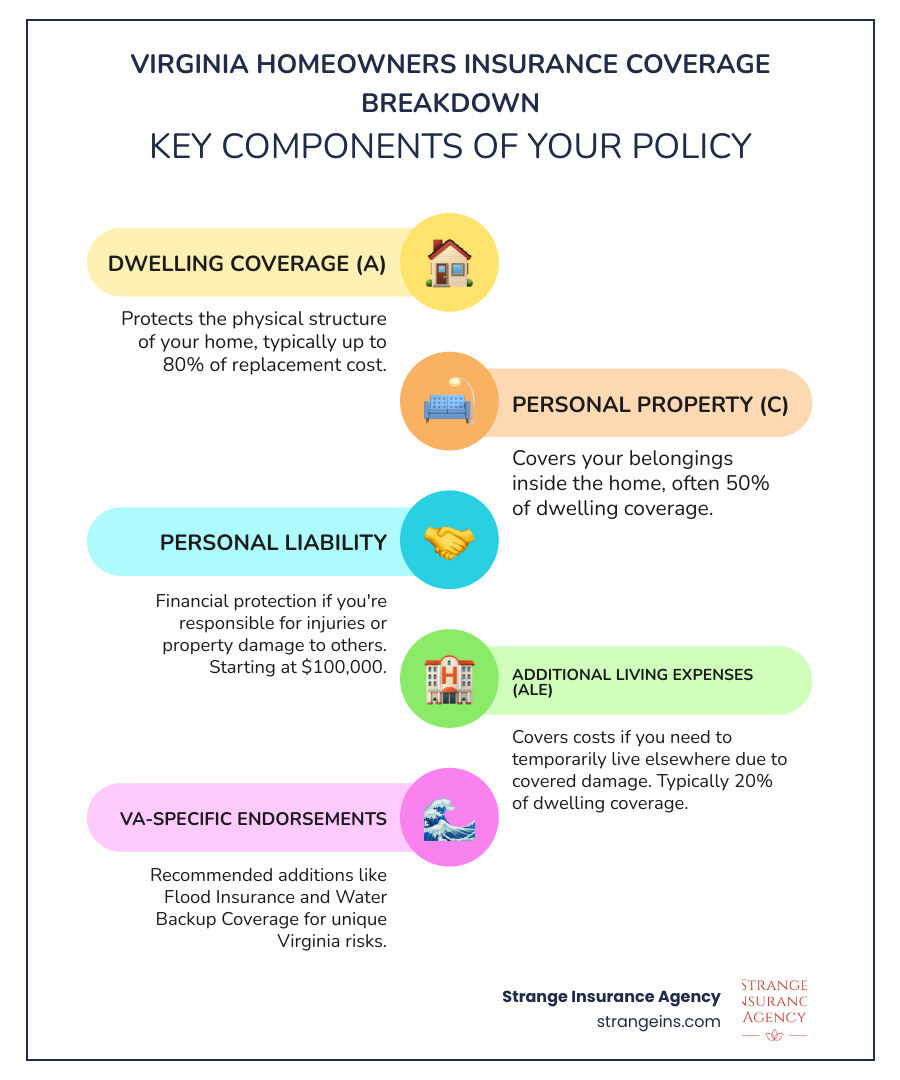
A homeowners insurance virginia policy is a package that bundles several key protections into one comprehensive plan, covering your home, belongings, and potential liability.

- Dwelling Coverage (Coverage A): Protects your home’s physical structure, from the foundation to the roof, including attached structures like a garage. Your coverage amount should reflect the cost to rebuild your home today, not its market value.
- Other Structures (Coverage B): Covers structures not attached to your house, like a detached garage, shed, or fence. This is typically set at 10% of your dwelling coverage but can be adjusted.
- Personal Property (Coverage C): Covers your belongings, such as furniture, electronics, and clothes. Standard coverage is usually 50% of your dwelling amount, but high-value items like jewelry or art may have low limits and require separate scheduling.
- Loss of Use (Coverage D): Pays for additional living expenses like hotel stays or restaurant meals if a covered event forces you from your home during repairs. It’s typically about 20% of your dwelling coverage.
- Personal Liability: Shields you financially if you’re responsible for injuring someone or damaging their property. We recommend at least $300,000 in coverage to protect your assets.
- Medical Payments to Others: Covers minor medical bills for guests injured on your property, regardless of fault, helping to prevent larger liability claims.
For more detailed insights, visit our Homeowners Insurance page.
Replacement Cost vs. Actual Cash Value
Understanding this choice is crucial for your financial recovery.
- Actual Cash Value (ACV): Pays for a damaged item’s value right before the loss, factoring in depreciation. An old appliance’s ACV payout won’t be enough to buy a new one. ACV policies have lower premiums but can lead to high out-of-pocket costs.
- Replacement Cost: Pays to replace your damaged property with new items of similar quality, without deducting for depreciation. This ensures you can rebuild your home and replace your belongings to their original state.
We strongly recommend replacement cost coverage for both your dwelling and personal property. The peace of mind knowing you can replace “new for old” is well worth the slightly higher premium.
Learn more on our Property Insurance Virginia page.
The 80% Rule and Why It Matters
Virginia homeowners must know the “80% rule,” a coinsurance clause that can reduce your claim payment if you’re underinsured. The rule requires your dwelling coverage to be at least 80% of your home’s full replacement cost.
If you fail to meet this threshold, you’ll face a penalty on all claims, even partial ones. For example, if your home’s replacement cost is $400,000, you must carry at least $320,000 (80%) in dwelling coverage. If you only have $200,000 and suffer a $40,000 loss, your insurer will only pay a portion of the claim, leaving you to cover a significant shortfall.
To avoid this, get an accurate replacement cost estimate and review it annually. An inflation guard endorsement can automatically adjust your coverage to keep pace with rising construction costs, protecting you from this penalty.
For more details on costs, check out our guide on How Much Does Virginia Home Insurance Cost?.
Tailoring Your Policy for Virginia-Specific Risks
Virginia’s diverse climate requires a homeowners insurance virginia policy custom to its unique challenges. Understanding the difference between “named peril” and “open peril” coverage is key to your financial protection.

- Named Perils (HO-2): Only covers losses from events specifically listed in your policy, such as fire, windstorm, hail, or theft. If the cause of loss isn’t on the list, it’s not covered.
- Open Perils (HO-3, HO-5): Covers everything unless it is specifically excluded. This offers broader protection against unexpected events. The HO-3 is the most common policy, while the HO-5 provides the highest level of coverage for both your home and belongings.
The price difference is often small, making open peril coverage a smart investment for most Virginians.
For detailed guidance, check out A consumer guide to Virginia Homeowners Insurance.
What Standard homeowners insurance virginia Policies Exclude
Even the best policy has exclusions. Knowing these gaps helps you prepare. Common exclusions include:
- Flood Damage: This is the most critical exclusion for Virginians. Damage from storm surge, rising rivers, or ground water requires a separate flood policy.
- Earthquakes: While rare, seismic activity does occur in Virginia and is not covered by standard policies.
- Maintenance Issues: Gradual damage from pest infestations, wear and tear, or neglect is considered a homeowner’s responsibility.
- Water Backup: Damage from sewer or sump pump overflow is typically excluded unless you add a specific endorsement.
- Nuclear Hazard & War
Visit our Home Insurance Virginia page for more details on how to fill these coverage gaps.
Flood Insurance: A Critical Add-On for Virginians
Flooding is Virginia’s most common natural disaster, yet standard homeowners insurance virginia policies exclude it. With extensive coastline and rivers prone to flooding, the risk is widespread. Critically, about 25% of all flood claims occur outside high-risk zones. You can get coverage through the National Flood Insurance Program (NFIP) or a growing number of private flood insurance carriers. There’s usually a 30-day waiting period, so don’t wait for a storm to be on its way.
Get a quote from the National Flood Insurance Program website or Compare Flood Insurance Quotes through our agency.
Recommended Endorsements for Extra Protection
Customize your policy with these key endorsements:
- Water Backup Coverage: Essential for protection against sewer backups or sump pump failures. Virginia law requires insurers to offer this coverage.
- Ordinance or Law Coverage: Covers the extra cost to rebuild your home to current, stricter building codes after a loss.
- Scheduled Personal Property: Provides full coverage for high-value items like jewelry, art, or firearms, which have limited coverage under a standard policy.
- Umbrella Liability: Adds an extra layer of liability protection (typically $1 million or more) on top of your standard limits, protecting your assets from major lawsuits.
These add-ons provide comprehensive protection custom for Virginia living. Learn more in our guide What Is Umbrella Coverage?.
The Cost of Homeowners Insurance Virginia: Rates and Discounts
Let’s talk about what you can expect to pay for homeowners insurance virginia and how to keep those costs reasonable.

Virginia homeowners enjoy affordable rates, with the average cost running between $1,119 and $1,445 annually—about 25-31% below the national average. However, your actual premium depends on several factors:
- Location: Coastal areas like Virginia Beach face higher rates ($1,947 to $2,610) due to hurricane risk, while inland cities like Roanoke see lower premiums ($1,031 to $1,180). Proximity to a fire station and neighborhood crime rates also play a role.
- Home Characteristics: The age, construction materials, and condition of your home are key. Older homes often cost more to insure, while fire-resistant materials like brick can lower rates. A new, impact-resistant roof can also earn a discount.
- Coverage Choices: Higher limits and optional endorsements will increase your premium, but they provide crucial protection for your largest asset.
- Claims History: A history of claims can increase your premiums for several years. It’s often wise to handle smaller losses out-of-pocket.
For a deeper dive, check out our Homeowners Insurance Rates Virginia page.
How Your Credit Score Impacts Your Premium
Your credit score is a major factor in your homeowners insurance virginia premium. Insurers use a credit-based insurance score to predict claim frequency. Excellent credit can lead to significant savings, while poor credit can dramatically increase your rates. Virginia law prevents insurers from canceling your policy solely based on credit and requires them to explain any adverse action, giving you a chance to correct errors.
How to find cheap homeowners insurance virginia
Saving money on your premium is possible without sacrificing protection. Here are some of the most effective ways to lower your costs:
- Bundle Policies: Combining your home and auto insurance with one company can save you 10-15% on both.
- Raise Your Deductible: Increasing your deductible from $500 to $1,000 can cut your premium significantly. Just be sure you can cover the higher out-of-pocket cost.
- Install Safety Devices: Monitored alarms, smoke detectors, and smart home leak detectors can earn you discounts of 5-15%.
- Other Discounts: Ask about discounts for being claims-free, having a new home, customer loyalty, being retired, or setting up paperless billing.
We help Virginia homeowners combine these strategies to find the right balance of protection and affordability. Learn more about finding cheap home insurance virginia.
Smart Steps for Virginia Homeowners: From Application to Claims
The Role of Your Insurance Agent
Think of your agent as your personal insurance consultant and advocate. A good agent doesn’t just sell policies; they build relationships. They help you tailor coverage to your unique Virginia property, explain complex terms in plain English, and guide you through the claims process. They ensure you understand Virginia-specific requirements and qualify for every available discount.
Creating a Home Inventory
A detailed home inventory is invaluable during a claim. The process is simple:
- Document: Go room by room, listing items with brand names, model numbers, and purchase dates.
- Photograph/Video: Take clear pictures and videos of your belongings, especially high-value items.
- Keep Receipts: Store digital copies of receipts for major purchases.
- Store Off-Site: Keep your inventory in the cloud or on an external drive stored elsewhere. This simple step can transform a stressful claims process into a straightforward one.
Vacancy vs. Unoccupancy Clauses
Understanding this distinction is critical for maintaining coverage.
- Unoccupied: Your home is temporarily empty (e.g., you’re on vacation), but your belongings are still inside. Most policies allow this for 30-60 days.
- Vacant: The home is empty of people and property with no immediate plan to return. Standard policies often suspend or reduce coverage for vacant homes after 30-60 days.
If your home will be vacant or unoccupied for an extended period, call your agent immediately. They can arrange for a vacancy permit or specialized coverage to prevent a devastating gap in protection.
An independent agent works to connect you with the best home owners insurance company in virginia for your unique situation.
What to Do If Your Application is Denied
An denial for homeowners insurance virginia isn’t the end of the road. Common reasons include property condition (e.g., old roof), claims history, location risks, or poor credit.
Here’s your action plan:
- Ask Why: Request the specific reason for denial in writing.
- Make Fixes: If the issue is correctable, like a needed repair, make the improvement and reapply.
- Shop Around: Insurers have different risk appetites. An independent agency works with multiple carriers, increasing your chances of finding coverage.
- Use the VPIA: If you’re denied by multiple companies, the Virginia Property Insurance Association (VPIA) is the state’s “Fair Plan” or insurer of last resort. It provides basic, though often more expensive, coverage.
Virginia law protects you from certain unfair denials. Getting denied is a detour, not a dead end, and an agent can help you find the right path forward.
Learn more about this safety net at the Virginia Property Insurance Association website.
Frequently Asked Questions about Homeowners Insurance in Virginia
Here are answers to some of the most common questions we hear from Virginia homeowners.
Is homeowners insurance legally required in Virginia?
No, Virginia state law does not require you to have homeowners insurance virginia. However, if you have a mortgage, your lender will almost certainly require it as a condition of the loan. They do this to protect their financial interest in your property. If your coverage lapses, your lender can purchase a more expensive “force-placed” policy and charge you for it.
What’s the difference between a ‘named peril’ and an ‘open peril’ policy?
This determines what types of damage your policy covers.
- A named peril policy (like an HO-2) only covers losses from causes specifically listed in the policy (e.g., fire, theft). The burden is on you to prove the loss was from a covered event.
- An open peril policy (like an HO-3 or HO-5) covers all losses except for those specifically excluded. This provides much broader protection.
We typically recommend open peril policies for their comprehensive coverage and fewer surprises at claim time.
Does my policy cover damage from a hurricane?
The answer is nuanced and critical for Virginians.
Wind Damage: YES. Your standard homeowners insurance virginia policy typically covers damage from hurricane winds. However, be aware of a potential hurricane deductible, which is often a percentage (e.g., 1-5%) of your home’s insured value, making it much higher than your standard deductible. This only applies to officially named hurricanes.
Flood Damage: NO. Standard homeowners policies explicitly exclude damage from flooding, including storm surge and heavy rainfall. You must purchase a separate flood insurance policy for this essential protection.
Conclusion
Navigating homeowners insurance virginia means preparing for the state’s unique risks, from coastal hurricanes to inland storms. The right policy is your best defense against financial loss.
Key takeaways include choosing replacement cost coverage over actual cash value, adhering to the 80% rule to avoid penalties, and understanding that the cheapest policy isn’t always the best. Smart strategies like bundling policies and installing safety devices can lower your rates without sacrificing protection.
Most importantly, remember the critical need for endorsements like water backup coverage and a separate flood insurance policy, which standard policies exclude. These add-ons are essential for comprehensive protection in Virginia.
An independent insurance agent can help you find the ideal balance between robust coverage and affordable premiums. With access to multiple top-rated carriers, they can tailor a policy that fits your home, budget, and peace of mind.
Virginia’s weather is unpredictable. Don’t wait for the next storm to find out you’re underinsured. Take steps to secure the right protection today.
Ready to protect what matters most? Get your personalized homeowners insurance quote today and build a policy that truly safeguards your future.